Mystery is the key to every successful story. Even if a story is not explicitly a mystery, it needs to have some element of mystery within it. If there’s no mystery, wherein the reader is wondering what will happen next, they have little reason to continue reading the story.
Continue readingFun Facts about Work for Idle Hands
The paperback version of my new novella, Work for Idle Hands, is now available on Amazon.
Some fun facts about WFIH:
1. From Short Story to Screenplay to Novella
Work for Idle Hands was originally written in 2016 as a 9,000-word short story. At that time I was still pursuing screenwriting in tandem with prose writing, so I decided to adapt the story into a screenplay. But after unsuccessfully trying to pitch the screenplay to agents and producers, I decided to re-adapt it back into prose form, but longer since I had expanded the original short story when adapting it into movie form. This final version is a sort of amalgam of the short story and screenplay, which I expanded upon further. The final word count is triple the length of the original short story, at almost 30,000 words. I think this novella version is the best of the three. The novella may be my favorite form for a story. It is the perfect length to tell a full story and develop characters without getting bogged down by side-plots.
Continue readingWork for Idle Hands: A Novella
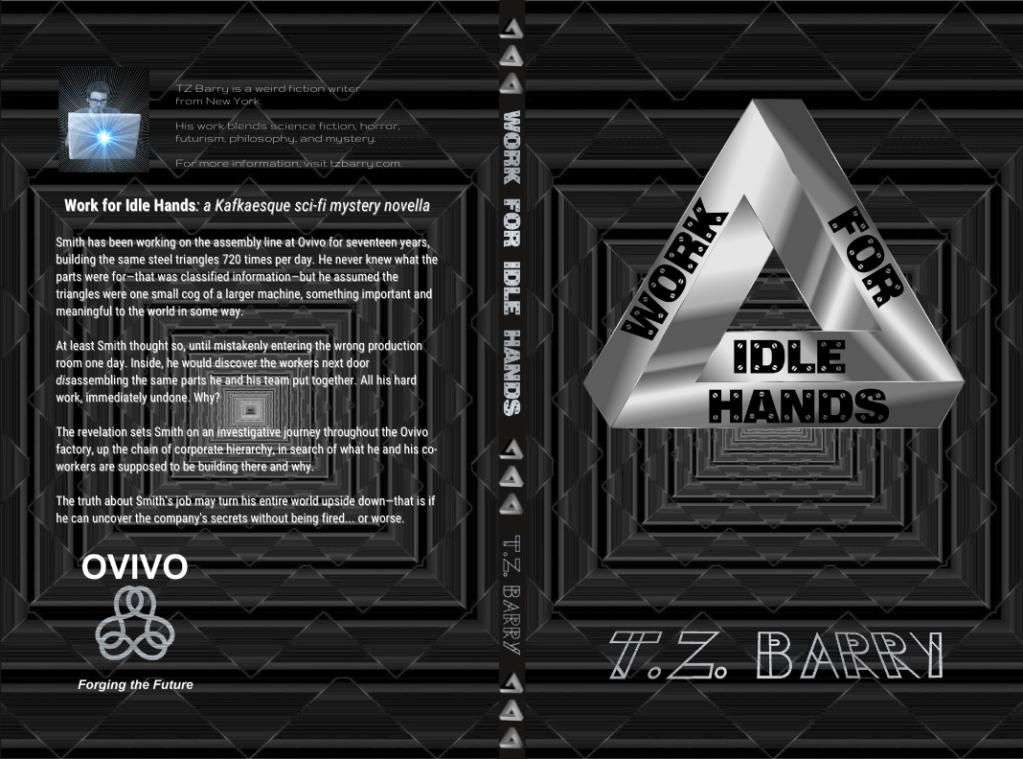
Smith has been working on the assembly line at Ovivo for seventeen years, building the same steel triangles 720 times per day. He never knew what the parts were for—that was classified information—but he assumed the triangles were one small cog of a larger machine, something important and meaningful to the world in some way.
At least Smith thought so, until mistakenly entering the wrong production room one day. Inside, he would discover the workers next door disassembling the same parts he and his team put together. All his hard work, immediately undone. Why?
The revelation sets Smith on an investigative journey throughout the Ovivo factory, up the chain of corporate hierarchy, in search of what he and his co-workers are supposed to be building there and why.
The truth about Smith’s job may turn his entire world upside down—that is if he can uncover the company’s secrets without being fired… or worse.
Work for Idle Hands — a science fiction mystery novella by T.Z. Barry
Franz Kafka meets Philip K. Dick… What happens when AI replaces all human jobs?
- Available now on Amazon (free for Kindle Unlimited)
- Or email to buy the book directly from the author via PayPal, CashApp, or cryptocurrency (pay as you wish)
- Or subscribe to my Substack, Time Zone Weird, to access a free download of the ebook
What is Science?
Do you believe in science, or do you not believe in science? Hopefully neither, because science is not a belief system. Science is not something you believe or don’t believe in. Neither is science a monolith. As Arthur C. Clarke said, “For every expert there is an equal and opposite expert.” Science is description, not prescription. Science does not tell you what to do—it gives you data.
Continue readingA Manifesto to Weird
I’ve always been weird. As a child, my earliest memories from school were how I was always so much different than everyone else—not just personality-wise, being extremely shy compared to them, but also in my interests. The other kids weren’t into the things I wanted to do and talk about which was probably why I didn’t like talking to them. But the weird thing is I didn’t like being weird as a kid. I had such severe social anxiety that I wanted to fit in and be like everybody else. I was terrified of being ostracized and rejected by my peers. I didn’t want to stand out, so I would hide my weird interests from them.
Continue readingSocial Media is the New Word of Mouth
The best form of advertising is word of mouth, and the new word of mouth is social media. The aim of social media companies is to make their users spend more time on their platforms in order to generate more ad revenue. The more time people spend online, the less time they spend with other people in person, which means less time for physical “word of mouth” interactions. Today, people have more interactions with other people on the internet than in real life, making social media the new “word of mouth”. (This was true before the Covid-19 pandemic which only compounded this effect further.)
Continue readingHow to Learn How to Write Fiction

Writing fiction is not something that can be taught with a simple “how-to” book. A creative artistic endeavor like fiction writing is something you have to learn by doing yourself. Each writer is different—at least the good ones are—therefore their method to write fiction is different. So this post is not “how to write fiction like others” but “how to teach yourself to write fiction your own way.”
Continue readingDo Artists Get Less Creative Over Time?

Have you ever noticed that most artists tend to get less creative when they get older? A band’s first album is often their best—or maybe their second or third album is better—but rarely does a band record their most creative music on their twelfth album. Sure, some artists like The Rolling Stones continue to perform well into their 70s, but they are only rehashing the creativity of their 20s and 30s. They are not recording new songs, or if they are, those new songs are nowhere near as beloved or creative as their earlier work. That is the normal life cycle of most musical artists: they release creative music when young, get popular, then “play the hits” for the rest of their career.
Continue readingTalking vs. Writing

What is a better form of communication: talking or writing? For me, talking is inferior and inefficient compared to writing. Writing gives you time to pause, reflect, consider, and then express exactly what you feel. Some may say that talking to someone face to face is the only way to really know another person fully—to get a sense of their true self. While that may be true for some people, that is not the case for me.
Continue readingMy Rabbit Holes

Throughout my life, I get super-interested in certain topics and go all-in, becoming completely absorbed in the subject for weeks, months, or sometimes years. Eventually, when I’ve learned everything worth knowing, I become bored of the subject and move on to something else, becoming super-interested in that new topic… until I’m not. Then the cycle repeats again.
Continue reading