First there was AI images, then there was AI text. It was only a matter of time until AI music came along—and with Suno, it is here. The AI music generator (and others such as Udio) has become my latest obsession. It is simple to use with surprisingly good results. Just enter a text prompt with a subject matter and/or musical genre, and it will quickly produce a 2-minute song of professional quality. Of course the results vary—some songs are better than others. But in a short amount of time I have already created a few gems, such as this 1980s-style electronic anthem for “Time Zone Weird” that I can’t get out of my head:
On April 8, 2024 in Burlington, Vermont I witnessed my first total solar eclipse. The moment of totality in which the moon covered the sun was the most awe-inspiring act of nature I have ever seen. No photograph or video can do it justice. Words fail to convey the experience. There is no comparison to seeing a total eclipse in person with your own eyes. It is an unforgettable sight every human being should see at least once in their lives.
The last total solar eclipse visible in the United States was in 2017. I was not in the path of totality, and I couldn’t get a pair of glasses, so I only saw the second-hand effects of the partial eclipse. I watched videos of totality, which looked impressive, and I heard accounts of people saying how transcendent it was, but there was a disconnect. It was like hearing somebody else talk about their dreams. The events in a dream may be astounding, but it doesn’t matter to anyone but the dreamer. Likewise, you can see videos of a total eclipse and hear people describe what they saw, but it will never matter as much to those who witnessed it firsthand. Regardless, I will attempt to describe my experience that day.
One of the great upsides of AI art is the ability for artistically unskilled people to create their own artwork. Instead of spending years learning the craft of how to paint or draw, you can instantly generate a skilled painting or drawing. The most artistic part of the process in AI art becomes choosing which image to create. For that image to be artistically meaningful, prompters must learn how to think like an artist.
One day while hiking I encountered a couple of coyotes along the trail. At first I got frightened, wondering if they were dangerous. But the coyotes just stood still, watching me from a distance and minding their own business. I walked away, continuing along the trail, while googling for information on my phone. With relief, I learned coyotes rarely ever attack adult humans—only small pets and children. (So don’t leave them out alone in coyote-populated areas.)
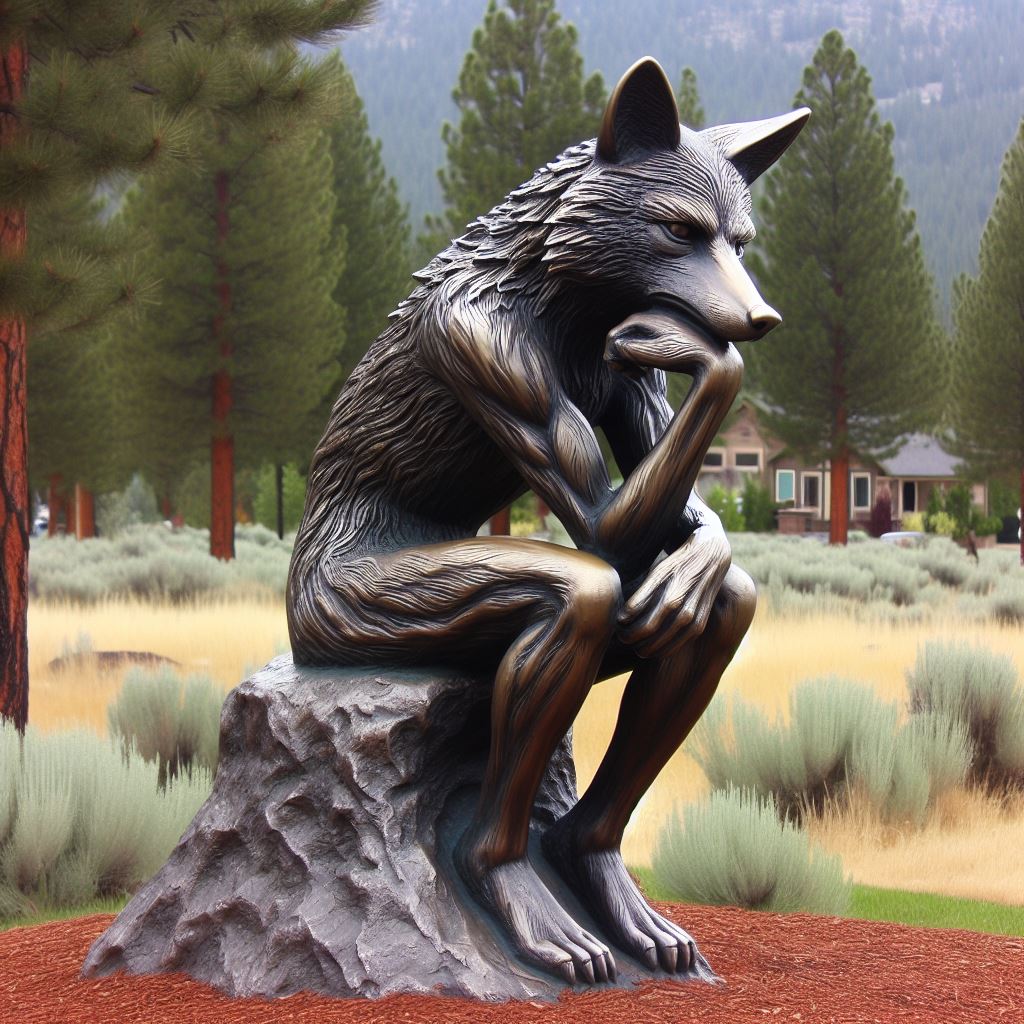
I then started wondering what it feels like to be a coyote. What was going through that creature’s mind as it watched me hiking by. Is anything going through its mind? What I mean to say is, are coyotes conscious? But not just consciousness as subjective experience, or the classic definition by Thomas Nagel—that there is something that it is like to be that thing. I mean are coyotes—or dogs, cats, and any animals other than humans—conscious in the same way humans are, with self-awareness, an inner monologue, and imagination? Does any species besides Homo Sapiens possess “sapience?”
There are essentially two types of writers: plotters and pantsers. Those who outline their plot beforehand, and those who write from the seat of their pants (AKA go in blind and make everything up as they go along). I said in the past that I was an outliner, but I now outline less than I used to.
Outlines make it easier to know where you have to go in the plot. But one benefit of writing from the seat of your pants is that you are motivated to write more often and faster because you want to know what happens next. If the full story is thoroughly outlined, writing can become more of a tedious transcription-like process with little surprise for the writer. Less planning can create more fun, though I don’t know if I would recommend that approach to someone who doesn’t have sufficient writing experience.
The great screenwriter William Goldman had a famous quote about Hollywood: “Nobody knows anything.” His full quote elaborated: “Not one person in the entire motion picture field knows for a certainty what’s going to work. Every time out it’s a guess and, if you’re lucky, an educated one.” Goldman meant that, beforehand, nobody (neither the producers, studio executives, directors, actors, or critics) could accurately predict which movies would be breakout hits or which would be box office duds. There are always surprises in both directions: movies everyone thinks will succeed end up bombing, while surefire flops become smash hits. At least that’s the way the movie industry used to work. Now Hollywood thinks they know everything.
I have yet to read Infinite Jest (it is on my bucket list), but I enjoyed this collection of DFW’s long nonfiction essays, maybe even more than his short fiction. They are absolutely genius—not just in their content but in the craftsmanship of the prose on a sentence level. I read a couple of these essays several years ago but struggled with Wallace’s complicated syntax. Between the page-long sentences, invented words and acronyms, and multi-paged footnotes, you practically need a map to read a David Foster Wallace book. With my reading comprehension having expanded since then, I can now better understand and appreciate the complexity of his prose. Few writers could string words together better than DFW (RIP). The essays in this collection include:
This continues to be one of the most uniquely brilliant shows on television. It blows my mind how John Wilson is even able to create this show, what his process must be, constantly filming his daily life and somehow editing it all into something cohesive and interesting. There is nothing else like it on TV. It’s almost like an entire show built around synchronicity. He follows serendipity wherever it takes him, around New York City and the entire country. He finds the weirdest people, and like Nathan Fielder, isn’t afraid to get super awkward. But the show is also quite heartfelt at times. Sadly, this is the final season, but I will eagerly watch whatever John Wilson does next.
2. Succession
I wrote about all four seasons of Successionhere (and a fictional fifth season here).
I had been planning to read this book for a while after repeatedly hearing it recommended as one of the greatest American novels. When Cormac McCarthy passed away this year, I thought it would be a good time to finally do so. I’d seen and loved several movies based on McCarthy’s books but had never read one.
There’s not much of a plot to Blood Meridian: it’s basically a group of men riding across the Old West, encountering gruesome scenes of violence in and between skirmishes with Apaches. What really sets the book apart—why it is hailed as one of the greatest modern novels by one of the greatest modern writers—is McCarthy’s writing style, painting portraits of the scenes with beautifully simple poetry and deep philosophical insight, mostly through the character of “the judge.” Which is the second thing that sets Blood Meridian apart. The character of judge Holden is an all-time classic antihero (or outright villain). He studies nature and catalogs specimens in his journal, yet kills men, women, and children, sometimes just for the thrill of it.
The story is told from the perspective of “the kid,” a young man riding with the judge and their leader, Glanton. But whenever the focus drifted away from the judge, I wanted to return to him. He is such a fascinating character and if/when the book is made into a movie, whoever plays the judge will likely win an Oscar. The book is full of violence but not gratuitously—it is there for a reason. The book explores the very nature of violence and war, how it is fundamental to life, inescapable. Perhaps the central question of the book is who or what is Holden the judge of?
I already did my annual list of the ten best older movies I saw in 2023, so here is a list of the newer movies I saw this past year. They are separated into five tiers based on quality and listed alphabetically within each tier. (Check JustWatch.com to see where they are currently streaming.)
I sat stunned as the credits rolled, amazed at how great this low-budget indie horror film was. It is an absolute masterpiece, maybe my favorite horror movie ever—at least of the new millennium. I was on edge throughout, legitimately frightened—all without a single jump scare. It is an occult horror movie about black magick and rituals, but they take the subject matter extremely seriously and clearly did research to make it seem realistic—which makes it all the more haunting. [Slight Spoilers Ahead] The story is about a grieving mother who hires an occultist to perform a ritual to summon her guardian angel to ask a favor so she can speak to her murdered son—and get revenge against his killers (who used him to perform an occult ritual). The ritual in the film is based on an actual ritual from The Book of Abramelin, which the famous occultist Aleister Crowley performed in real life. I find the world of occult ritual magic fascinating but also frightening. Occult horror scares me more than most other subgenres because the type of dark magic portrayed in the film might actually exist. Whether such dark forces are real or not doesn’t matter, because there certainly do exist occultists who believe them to be real and actually perform these magical rituals—but to what end?