Tag Archives: libertarianism

The Government as a Pizza

The US government is like a pizza that everyone agrees tastes terrible. The Democrats and Republicans in Congress argue over whether to add rainbow sprinkles or chocolate sprinkles to make it taste better. Libertarians1 insist neither will make it taste better—sprinkles shouldn’t even be on a pizza. Besides, you’ve got all these other toppings on it already, which don’t go together at all: marshmallows, licorice, mayonnaise, and jelly. But the real problem is the dough is stale and the cheese is rotten. Besides, there are healthier things to be eating than pizza.

Continue reading

Best Fiction Books I Read in 2024

They Had No Deepness of Earth (2021) by Zero HP Lovecraft

Zero HP Lovecraft (@0x49fa98) is an anonymous internet poster I originally discovered around 2016 when I was looking at the accounts Naval Ravikant (@naval) followed on Twitter. His name and bio (horrorist) intrigued me, so I read his short story, “The Gig Economy,” which was like a modern cyberpunk take on “The Call of Cthulhu.”

I instantly became a fan and read all of Zero’s stories as they originally came out on his WordPress site (now on Substack), and later assembled in this collection. I had been meaning to re-visit the stories because they deserve (and often require) re-reading. His fiction is like a combination of the cosmic horror of H.P. Lovecraft with the dense philosophical speculation of Jorge Luis Borges and the mind-bending science fiction of Ted Chiang.

Continue reading

Best Nonfiction Books I Read in 2022

1. Time Loops: Precognition, Retrocausation, and the Unconscious (2018) by Eric Wargo

This is a fascinating book about the type of precognition often experienced in dreams, built off the work of J.W. Dunne. Author Eric Wargo provides numerous famous examples of precognitive dreams, often about traumatic events such as plane crashes or the sinking of the Titanic. Wargo claims such cases of precognition are actually “prememory”: your unconscious mind remembering a future memory, not of the event itself, but of your emotional reaction to learning news of the event. Both the author and I are aware of how crazy and “woo” this all sounds, but Wargo’s research is scientifically rigorous, and he walks a fine line of being both skeptical about paranormal claims but also open-minded to their possibilities (something I wish more on both sides of the paranormal/skeptical debate were willing to do).

Continue reading

Best Nonfiction Books I Read in 2021

Note: The books from this list that aren’t available online for free are available for purchase through my Bookshop.org page.

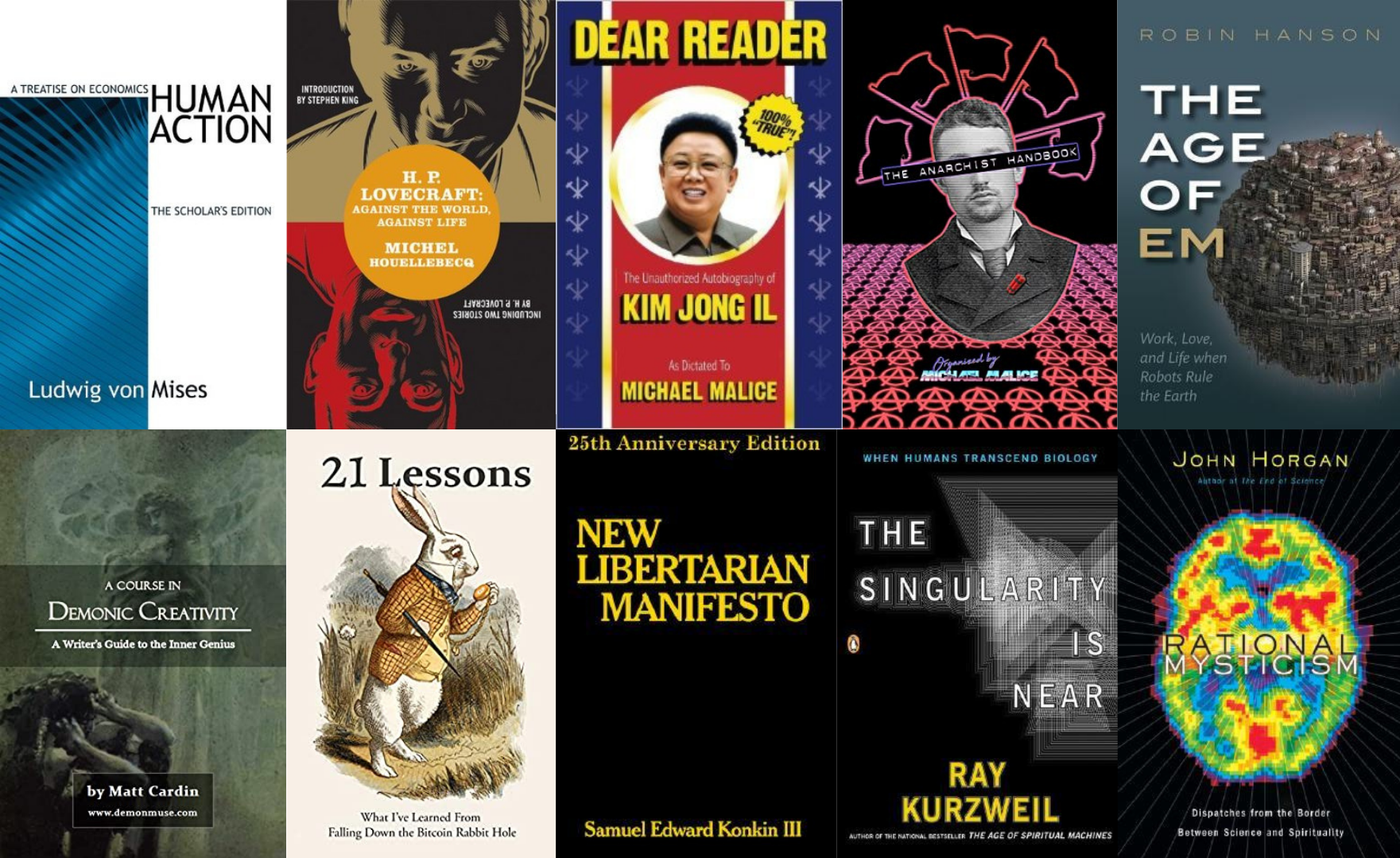
1) Human Action: A Treatise On Economics (1940) by Ludwig von Mises

This is the bible of Austrian economics by the grandfather of Austrian economics, Ludwig von Mises. Human Action is Mises’ magnum opus on economics, philosophy, and history—or more precisely, it’s about what Mises terms “praxeology”: the study of human action, which all economic activity boils down to. This is a long book (it took me half the year to get through, which is why there are fewer honorable mentions this year) but it was worth it. You will better understand the world today by reading this 82-year-old tome than by reading today’s newspapers.

Continue reading

Best Nonfiction Books I Read in 2020

According to my Goodreads stats (which I use to track every book I read), I read 95 books in 2020, which is down slightly from last year (114). Though that includes comic books, which are shorter and quicker to read, plus audiobooks, and I read less comics, so more full-books in all. My increased reading was not due to being stuck at home during quarantine as that didn’t affect my lifestyle much—it’s primarily because I severely cut down on reading Twitter and other online news. I previously wrote about the futility of following the daily news closely, but I still clung to Twitter—a little too much—sometimes a lot too much. I will expand upon how I broke my Twitter addiction in a future post, but suffice it to say, these days I check Twitter just once a day (at night after getting my work done) for only a couple minutes—if at all. This immediately reduced my stress levels and gave me much more time to read more valuable things that will stand the test of time, such as the following books.

Continue reading

Best Nonfiction Books I Read in 2019

nonfiction2019

1. The Age of Spiritual Machines: When Computers Exceed Human Intelligence (1998) by Ray Kurzweil

Kurzweil is an inventor and futurist famous for his optimistic predictions for technology in the future, particularly the idea of the singularity—when humans will be able to upload their minds to computers and potentially live forever—which he predicts will happen by the year 2045. Kurzweil has his doubters, but it’s hard to dismiss his track record of predictions when you look at how many have already come true in this book written over thirty years ago. Continue reading