Most movies are ninety minutes to two hours. Some are longer, veering toward three hours, but those tend to be more epic in scope, from established filmmakers and/or blockbuster franchises. However, for screenwriters trying to break into the industry, it is strongly recommended—if not required—to write spec screenplays between 90 and 120 pages (with one page of screenplay roughly equating to one minute of screen time).
Generation-Z is the first generation to grow up entirely online. For as long as Zoomers can remember, the internet has been ubiquitous and pervasive to daily life through smartphones. As a result, Gen-Z has no consensus culture—no TV shows, movies, or music they all consumed growing up. Everything had fractured into thousands of subcultures on the internet. Each Zoomer is an island. There may be another person who shares all your same niche cultural interests, but you are unlikely to ever randomly meet that person in person. You will only ever “meet” that person online. This fragmentation of culture is not necessarily good or bad. It just is. And it is different from every other generation that came before.
As artificial intelligence advances, many people are worrying about where it will lead. What happens if and when AI becomes more intelligent than humans? Will it grow beyond our control and have a will of its own? Will artificial general intelligence (AGI) result in the end of human civilization? To prevent such doom, AI must be aligned with humanity.
Planning your life can be difficult because there are so many possibilities. It may be best to take a lesson from nature and choose your career path like evolution. DNA evolves by reproduction with random mutations. Many variations are created, not knowing which will succeed. When one trait does succeed, it replicates and builds upon that mutation. This system of evolution clearly works—it produced us, humans, from a single cell of bacteria.
First there was AI images, then there was AI text. It was only a matter of time until AI music came along—and with Suno, it is here. The AI music generator (and others such as Udio) has become my latest obsession. It is simple to use with surprisingly good results. Just enter a text prompt with a subject matter and/or musical genre, and it will quickly produce a 2-minute song of professional quality. Of course the results vary—some songs are better than others. But in a short amount of time I have already created a few gems, such as this 1980s-style electronic anthem for “Time Zone Weird” that I can’t get out of my head:
On April 8, 2024 in Burlington, Vermont I witnessed my first total solar eclipse. The moment of totality in which the moon covered the sun was the most awe-inspiring act of nature I have ever seen. No photograph or video can do it justice. Words fail to convey the experience. There is no comparison to seeing a total eclipse in person with your own eyes. It is an unforgettable sight every human being should see at least once in their lives.
The last total solar eclipse visible in the United States was in 2017. I was not in the path of totality, and I couldn’t get a pair of glasses, so I only saw the second-hand effects of the partial eclipse. I watched videos of totality, which looked impressive, and I heard accounts of people saying how transcendent it was, but there was a disconnect. It was like hearing somebody else talk about their dreams. The events in a dream may be astounding, but it doesn’t matter to anyone but the dreamer. Likewise, you can see videos of a total eclipse and hear people describe what they saw, but it will never matter as much to those who witnessed it firsthand. Regardless, I will attempt to describe my experience that day.
One of the great upsides of AI art is the ability for artistically unskilled people to create their own artwork. Instead of spending years learning the craft of how to paint or draw, you can instantly generate a skilled painting or drawing. The most artistic part of the process in AI art becomes choosing which image to create. For that image to be artistically meaningful, prompters must learn how to think like an artist.
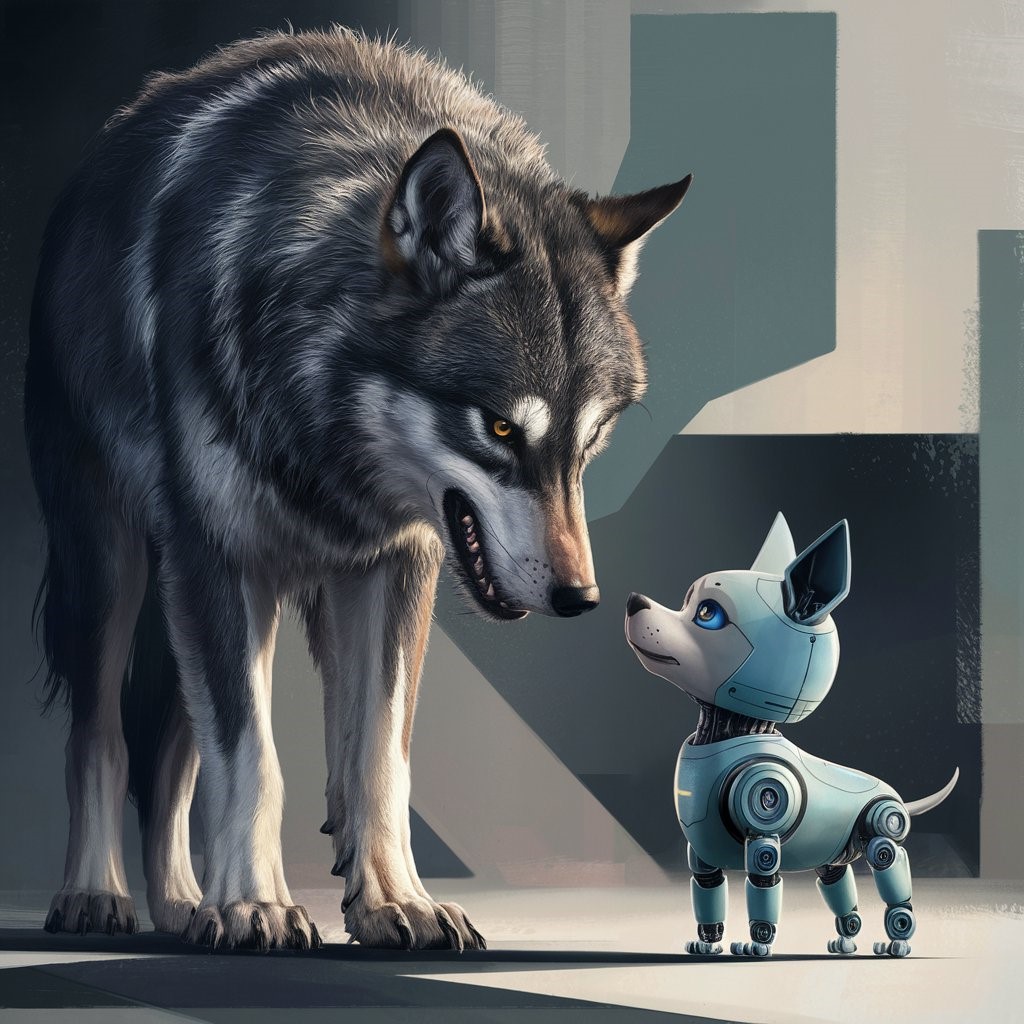
One day while hiking I encountered a couple of coyotes along the trail. At first I got frightened, wondering if they were dangerous. But the coyotes just stood still, watching me from a distance and minding their own business. I walked away, continuing along the trail, while googling for information on my phone. With relief, I learned coyotes rarely ever attack adult humans—only small pets and children. (So don’t leave them out alone in coyote-populated areas.)
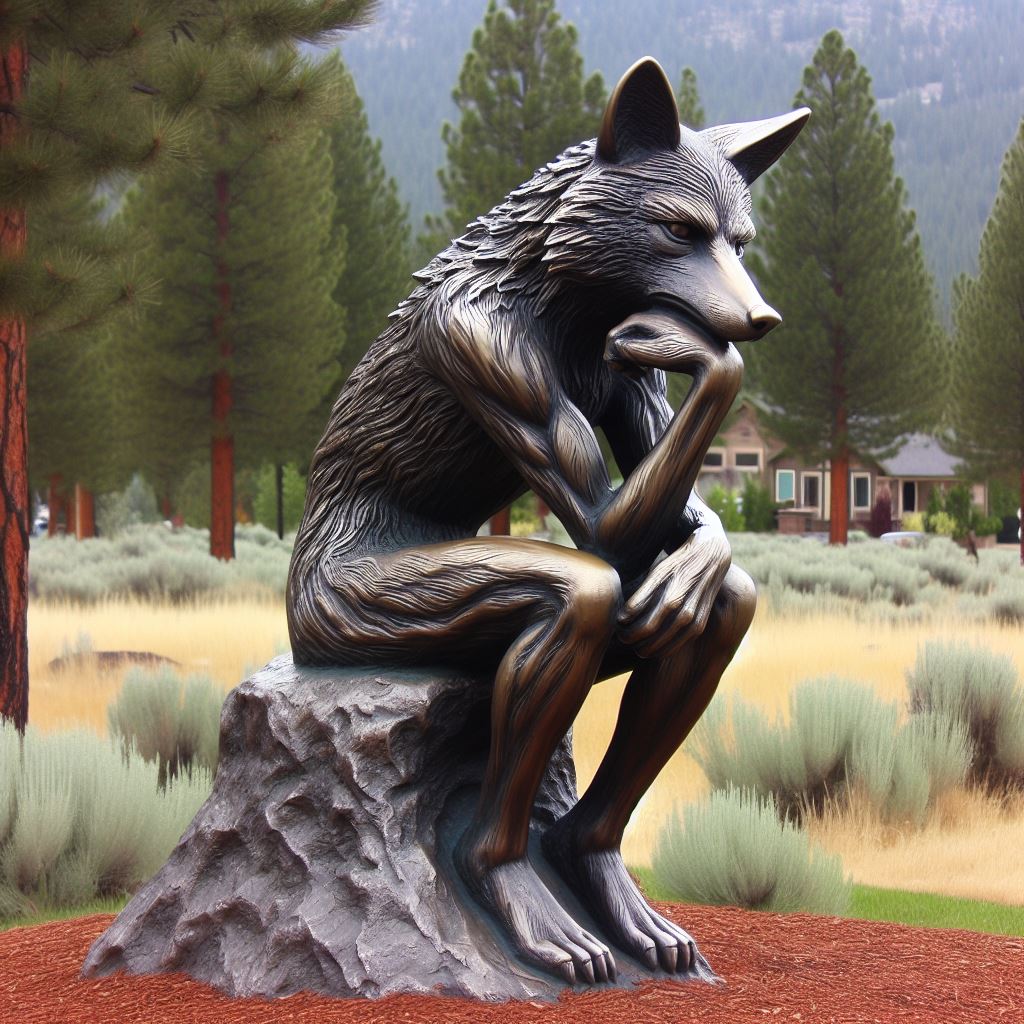
I then started wondering what it feels like to be a coyote. What was going through that creature’s mind as it watched me hiking by. Is anything going through its mind? What I mean to say is, are coyotes conscious? But not just consciousness as subjective experience, or the classic definition by Thomas Nagel—that there is something that it is like to be that thing. I mean are coyotes—or dogs, cats, and any animals other than humans—conscious in the same way humans are, with self-awareness, an inner monologue, and imagination? Does any species besides Homo Sapiens possess “sapience?”
There are essentially two types of writers: plotters and pantsers. Those who outline their plot beforehand, and those who write from the seat of their pants (AKA go in blind and make everything up as they go along). I said in the past that I was an outliner, but I now outline less than I used to.
Outlines make it easier to know where you have to go in the plot. But one benefit of writing from the seat of your pants is that you are motivated to write more often and faster because you want to know what happens next. If the full story is thoroughly outlined, writing can become more of a tedious transcription-like process with little surprise for the writer. Less planning can create more fun, though I don’t know if I would recommend that approach to someone who doesn’t have sufficient writing experience.
The great screenwriter William Goldman had a famous quote about Hollywood: “Nobody knows anything.” His full quote elaborated: “Not one person in the entire motion picture field knows for a certainty what’s going to work. Every time out it’s a guess and, if you’re lucky, an educated one.” Goldman meant that, beforehand, nobody (neither the producers, studio executives, directors, actors, or critics) could accurately predict which movies would be breakout hits or which would be box office duds. There are always surprises in both directions: movies everyone thinks will succeed end up bombing, while surefire flops become smash hits. At least that’s the way the movie industry used to work. Now Hollywood thinks they know everything.






 T.Z. Barry