Tag Archives: politics

Indie Publishing is Free Market Publishing

Professional publishing is fiat publishing, while indie publishing is free market publishing. The professional publishing industry, which consists of the “Big 5” book publishers (Penguin Random House, HarperCollins, Macmillan, Hachette Book Group, and Simon & Schuster) and literary agencies, are like central banks in the economy: they manipulate the market and create artificial scarcity by limiting which authors and books can be published. Indie publishing (self-publishing and small independent presses) is the free market for books, as it has a more natural flow of supply and demand. Everyone has the same opportunity, and success is more closely correlated with merit—or how much readers actually enjoy a book.

Continue reading

The Bright Side of Deepfakes

AI is continually getting better at creating “deepfakes” of real people. A deepfake is an AI-generated image or video that depicts real people saying and doing things they did not actually do. Such deepfakes have fooled viewers into believing the scenes depicted to be real. Many are understandably alarmed about these developments in AI and fear the implications for the future—the political chaos and societal upheaval deepfakes may cause. While such negative outcomes are a worrisome threat, there is an upside to deepfakes as well.

Continue reading

The Government as a Pizza

The US government is like a pizza that everyone agrees tastes terrible. The Democrats and Republicans in Congress argue over whether to add rainbow sprinkles or chocolate sprinkles to make it taste better. Libertarians1 insist neither will make it taste better—sprinkles shouldn’t even be on a pizza. Besides, you’ve got all these other toppings on it already, which don’t go together at all: marshmallows, licorice, mayonnaise, and jelly. But the real problem is the dough is stale and the cheese is rotten. Besides, there are healthier things to be eating than pizza.

Continue reading

Putting Messages in Fiction

People often say that if you want to include a didactic message in your fiction story, then you should just write an essay. Which is true—but not because essays are better, or because art can’t have a message. But messages should be put in essays rather than art, more due to the audience of the medium than the medium itself.

Continue reading

Best Nonfiction Books I Read in 2024

Man and His Symbols (1968) by Carl G. Jung

I have been wanting to read Jung for a while after hearing so much about his work second-hand through podcasts, blogs, and books. Jung has been highly influential on so many writers, thinkers, and artists I admire—and I can see why. His symbolic and mythological approach to psychology is sorely needed in our overly reductionist materialistic world. This book serves as a great introduction to Jung’s work. It features one chapter by Jung himself while the rest are written by his associates. The book also features lots of images to help illustrate the points about symbols because visual symbols are so powerful. Jung writes about the unconscious and the role of the artist:

Continue reading

The Success of Succession

Since Succession premiered in 2018, I repeatedly heard so many people I respect say how great the show was, but I hesitated to start watching. It wasn’t that I doubted them; I was just waiting to find the time to dive in. (Too much content.) With the final season airing this year, I thought it would be a good time to catch up before the finale. Part of the reason I hesitated to start Succession was fear of getting absorbed in yet another series that would go on indefinitely—or get canceled prematurely. Knowing there was an end in sight allowed me to begin. Long story short, it turns out all those people were right: Succession is a great show. It is highly dramatic with surprising twists and turns, but it is also extremely funny—funnier than most sitcoms, full of classic one-liners. It ranks up there with The Wire, The Sopranos, Mad Men, and Breaking Bad as one of the top television series of all time.

Continue reading

Best Nonfiction Books I Read in 2022

1. Time Loops: Precognition, Retrocausation, and the Unconscious (2018) by Eric Wargo

This is a fascinating book about the type of precognition often experienced in dreams, built off the work of J.W. Dunne. Author Eric Wargo provides numerous famous examples of precognitive dreams, often about traumatic events such as plane crashes or the sinking of the Titanic. Wargo claims such cases of precognition are actually “prememory”: your unconscious mind remembering a future memory, not of the event itself, but of your emotional reaction to learning news of the event. Both the author and I are aware of how crazy and “woo” this all sounds, but Wargo’s research is scientifically rigorous, and he walks a fine line of being both skeptical about paranormal claims but also open-minded to their possibilities (something I wish more on both sides of the paranormal/skeptical debate were willing to do).

Continue reading

Best Nonfiction Books I Read in 2021

Note: The books from this list that aren’t available online for free are available for purchase through my Bookshop.org page.

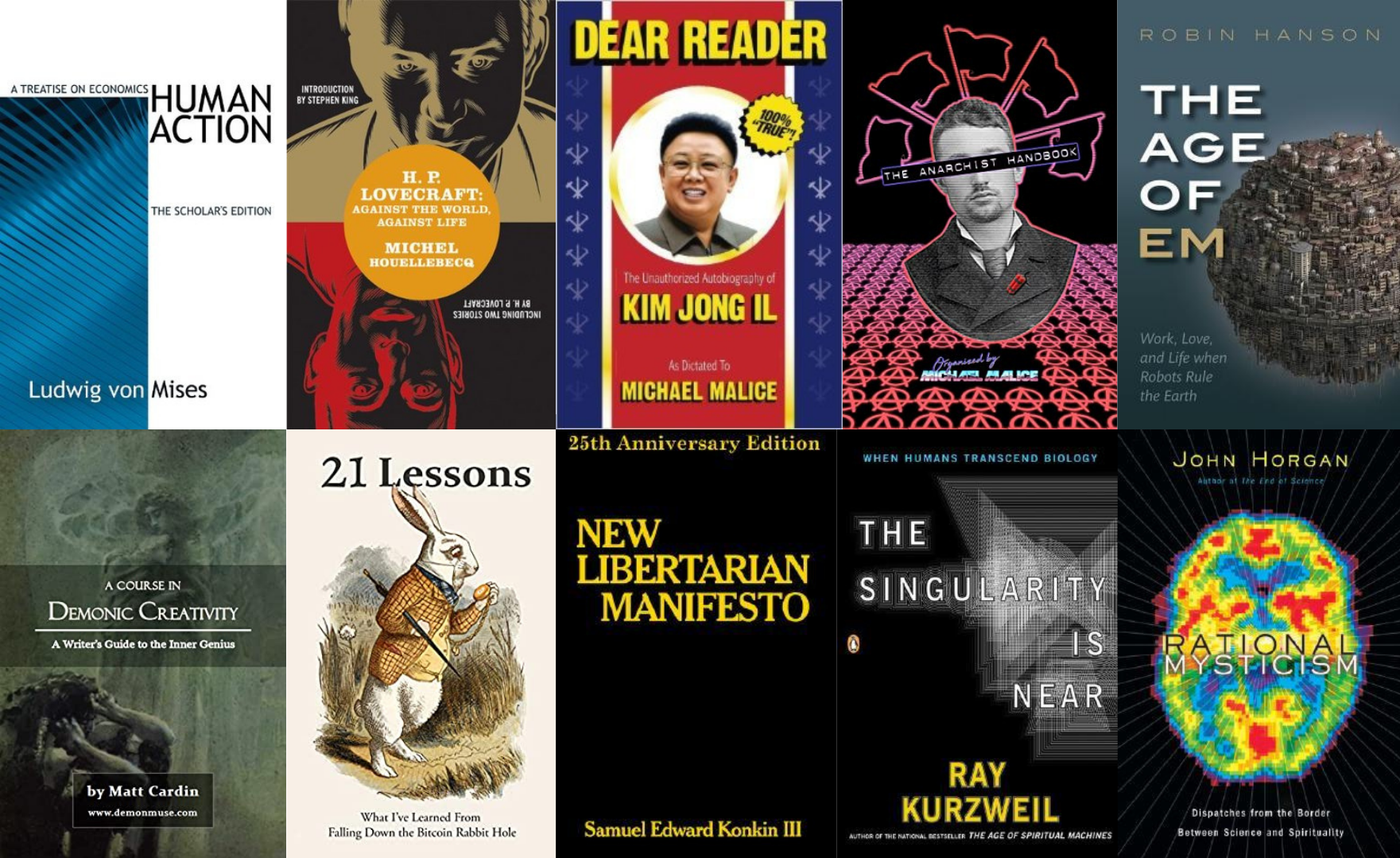
1) Human Action: A Treatise On Economics (1940) by Ludwig von Mises

This is the bible of Austrian economics by the grandfather of Austrian economics, Ludwig von Mises. Human Action is Mises’ magnum opus on economics, philosophy, and history—or more precisely, it’s about what Mises terms “praxeology”: the study of human action, which all economic activity boils down to. This is a long book (it took me half the year to get through, which is why there are fewer honorable mentions this year) but it was worth it. You will better understand the world today by reading this 82-year-old tome than by reading today’s newspapers.

Continue reading

Best Nonfiction Books I Read in 2019

nonfiction2019

1. The Age of Spiritual Machines: When Computers Exceed Human Intelligence (1998) by Ray Kurzweil

Kurzweil is an inventor and futurist famous for his optimistic predictions for technology in the future, particularly the idea of the singularity—when humans will be able to upload their minds to computers and potentially live forever—which he predicts will happen by the year 2045. Kurzweil has his doubters, but it’s hard to dismiss his track record of predictions when you look at how many have already come true in this book written over thirty years ago. Continue reading

The Misunderstanding of Elon Musk

Musk-sword

Elon Musk’s appearance on the Joe Rogan Experience podcast will go down in history and be rewatched forever by whatever form of humans/AI exist in the future. I love podcasts and have listened to thousands over the past dozen years, but this one may be my favorite yet. It’s better than the best science fiction movies because it’s not science fiction. High-speed maglev tunnels, self-driving electric cars, solar-powered roofs, AI brain interfaces, space exploration, Mars colonization, and VR simulations are the reality of our present and future. Continue reading