
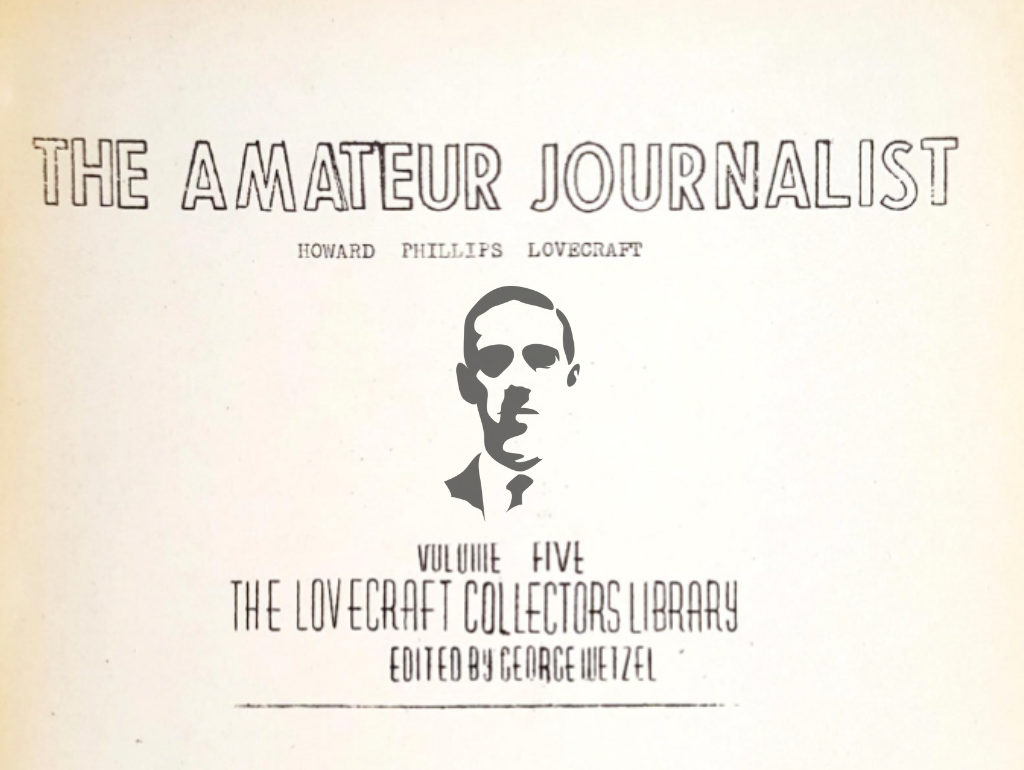
“The Professional Incubus” was an essay written by H.P. Lovecraft in 1924 in The National Amateur, a magazine he self-published. In the essay, Lovecraft wrote about “amateur literature,” or what would now be known as “indie publishing,” AKA self-publishing. Not much has changed in the century since, except that indie publishing has become much more widespread and easier to do. Using excerpted quotes from Lovecraft’s essay, I will explore how amateur literature in the past relates to indie publishing today.
It has often been remarked that fiction is the weakest point in amateur literature, and I do not think the belief is a mistaken one. None can deny that we have nothing in the field of the story which may be compared with the poetry of Samuel Loveman, the essays of Edward H. Cole, or the phantasies of Frank Belknap Long, Jr. True, Mrs. Edith Miniter produces work of the highest quality—but unfortunately only the most infinitesimal fraction of this appears in the amateur press. Our loss is the outside world’s gain.
This may be one facet of amateur literature or indie publishing that has changed. Much more high-quality fiction is being self-published today. Sure, there is also a lot of slop being self-published—the majority of it is unreadable1—but the best of indie books are indistinguishable from those released by the professional big-5 publishing houses—and often better.
The generally assigned cause for our fictional debility is lack of space, and this factor is certainly a potent one. For the adequate development of a story idea, ample room is an absolute essential; and this we are unable to provide for under present financial conditions.
There is no longer any “debility” due to “lack of space” in the world of fiction writing. With ebooks, blogs, and print-on-demand, anyone can publish any work of any length at zero cost to the writer. Not only is it cost-effective to write thousand-page door-stoppers, but also to write thin novellas. In the past, the novella was a difficult length for professional publishers to print profitably because it was too short to release on its own. Thanks to ebooks and print-on-demand, that is no longer an issue, and there has been a renaissance of novellas being published today2.
But of late I have come to believe that there is another cause; a cause extending very deeply into the composition of the American scene, and affecting us because of our slowness in making a certain distinction. This cause is the hopeless inferiority and inartistry of the entire standard of American bourgeois fiction, and the neglected distinction is that between successful professional fiction and honestly artistic attempts at self-expression in the narrative.
Established American institutions (the top publishers, agents, reviewers, awards, magazines, and periodicals) still promote “bourgeois fiction” that accords to their tastes and preferences. Just as Lovecraft was rejected by them during his time, the Lovecrafts of today will be rejected by the mainstream publishing gatekeepers as well. The tastes and preferences of the gatekeepers change over time, but the gates persist. Indie publishing provides a way to bypass all gatekeepers.
If the object of amateur journalism were to train likely young plodders in the skilled manual labour of professional fiction carpentry, no one might justly protest at the existing condition. But the idea has been held by some that amateurdom is synonymous with aesthetic sincerity, and with the loving craftsmanship for its own sake which is art. If this is so, we are on the wrong track; for there is nothing of art or true merit in the “salable short story” which too often forms the model of our efforts. I do not think any meritorious short story could be sold to an average professional magazine of the popular class except by accident. He who strives to produce salable fiction is lost as an artist, for the conditions of American life have made art impossible in the popular professional field.
The short story market has changed a lot since Lovecraft’s time. Fiction magazines were extremely popular back then—as popular as television is today (because TV did not yet exist). There are even more short story publishers today, but because so many alternative media forms exist (such as TV, movies, YouTube, TikTok, and Twitter), there are less readers of short stories and less money for writers. Lovecraft’s fiction was published by Weird Tales and Astounding Stories, magazines that paid 1-2 cents per word, which, adjusted for inflation, would be about 17-35 cents per word today. Yet today, the professional rate for short sci-fi/horror fiction is only 8-10 cents a word. The subscriber base for a top short fiction magazine then was about 100,000, but is only about 10,000 today. In short, nobody today writes short stories for the money. Lovecraft’s above quote might more aptly describe the world of Hollywood filmmaking today. The only way to make a movie of artistic worth is independently, outside of the studio system.
Editors and publishers are not to blame. They cater to their public, and would suffer shipwreck if they did not. And even when one transfers the blame to the larger unit, one cannot justly be very savage in his blaming; for analysis shows that most of the trouble is absolutely inevitable—as incapable of human remedy as the fate of any protagonist in the Greek drama. Here in America we have a very conventional and half-educated public—a public trained under one phase or another of the puritan tradition, and also dulled to aesthetic sensitiveness because of the monotonous and omnipresent overstressing of the ethical element. We have millions who lack intellectual independence, courage and flexibility to get an artistic thrill out of an original and realistic situation, or to enter sympathetically into a story unless it ignores the colour and vividness of actual human emotions and conventionally presents a simple plot based on artificial, ethically sugar-coated values and leading to a flat denoument which vindicates every current platitude and leaves no mystery unexplained by the shallow comprehension of the most mediocre reader.
This still applies to the modern world of short story and book publishing (and Hollywood), which continues to be constrained by the dominant ideology of the consensus culture—though the dominant ideology has changed since then. A story that critiques or goes against the consensus ideology of mainstream publishing will not be published by the mainstream, then or now. Independent publishing provides an alternative to ideological constraint.
That is why our professional fiction is unworthy of the emulation of any literary artist. Editors, however, cannot logically be blamed. If any magazine sought and used artistically original types of fiction, it would lose its readers almost to a man. Half the people wouldn’t understand what the tales were about, and the other half would find the characters unsympathetic—because these characters would think and act like real persons instead of like the dummies which the American middle classes have been taught and persuaded to consider and accept as human beings. Such is the inevitable condition regarding the enormous bulk of fiction which sets the national standard and determines the type of technical training given all fictional students even in our best universities.
An editor may find merit in an artful story that is heterodox or transgressive toward the dominant culture, and many readers may likewise admire such a work of art. However, if a small minority of readers are offended by the story, they will launch social media outrage campaigns against the writer, editor, and publisher. These cancel mobs are small but loud, and they pressure the publisher to remove the story and deter them from even considering to publish a similarly risqué story in the future, no matter the artistic merit of the work. Hence the most original, transgressive, and counter-cultural fiction is now being published independently, as it was during Lovecraft’s time.
But even this is not all. Added to this, as if by the perversity of a malign fate, is the demand of an overspeeding public for excessive quantity production. Simply put, the American people demand more stories per year than the really artistic author of American fiction could possibly write. A real artist never works fast except by mood, and never turns out large quantities except by rare chance. He cannot contract to deliver so many words in such and such a time, but must work naturally, gradually, sometimes very slowly, and always as his psychological state determines; utilizing favourable states of mind and refraining from putting down the stuff his brain turns out when it is tired or disciplined to such effort. Now this, of course, will not do when there are hundreds of magazines to fill at regular intervals. So many pages per month or week must be filled; and if the artistic writers lag behind, the publishers must find the next-best thing—persons of mere talent, who can learn certain mechanical rules and technical twists, and put forth stuff of external smoothness, whose solo merit is in conforming to patterns and rehashing the situations and reactions which have been found interesting to the people by previous experience.
This particular problem of quantity over quality may now apply more to the world of self-publishing than the professionals. Many indie publishers have become quite “professional” operations and are making more money than traditionally published authors. However, to be successful in self-publishing there is a formula: you must publish on-going series on a regular schedule in a popular genre that conforms to readers’ expectations. Indie writers make their money from “whale” readers who voraciously buy and read many books (hundreds per year). Some indie writers publish a new novel each month, due to the demand from their readers.3 But these whale readers are in specific genres—such as romance, urban fantasy, and cozy mystery—and the last thing they want is originality. They want to receive more of the same: a new story that follows the same formula with all the traditional story beats of that genre.
In many cases these writers achieve popularity—because the public recognizes the elements that pleased it before, and is satisfied to receive them again in dexterously transposed form. Actually, the typical reader has very little true taste, and judges by absurd freaks, sentimentalities, and analogies. So it has come to be an accepted tradition that American fiction is not an art but a trade—a thing to be learnt by rule by almost anybody, and demanding above all else a complete submergence of one’s own personality and thought in the general stream of conventional patterns which correspond to the bleakly uniform view of life forced on us by mediocre leadership. Success therefore comes not to the man of genius, but to the clever fellow who knows how to catch the public point of view and play up to it. Glittering tinsel reputations are built up, and dumb driven hundreds of otherwise honest and respectable plumbers take correspondence courses to crush their individuality and try to be like these scintillant “great ones” whose achievements are really no more than mere charlatanry.
In the world of indie publishing, writers often talk about the keys to success (genre, title, keywords, cover art, ads, and a series with the first book discounted or free). If a writer does not achieve success, they assume one element of those keys must be optimized, most often the cover art. However, they never talk about the artistic merit and quality of the story itself, as if that would have any impact on sales of the book. At most, they might say, “Maybe it needs some proofreading to fix the typos.” Never do they say, “You need a more original concept or more poetic prose.” Because the people who read those types of books do not care about that stuff. They don’t want art and originality; they want slop and familiarity.
Such formulaic fiction does not interest me, which is why my self-published books have not been as commercially successful as those indie writers who follow “the formula.” I would rather take my time to meticulously create works of individual artistic expression, even if it results in less immediate financial reward. I could follow “the formula” to write a commercial genre series of books, but doing so would leave me no time to work on my passion projects. An indie writer can still be successful publishing original genre-defying standalone books at a lower frequency—just less successful than those who follow the tried and true commercial formula.
Plus, it is exactly those kinds of formulaic commercial fiction books that can easily be replicated and replaced by AI. Many indie fiction writers are already using LLMs to aid their writing process and publish more frequently. But what cannot be easily programmed by AI is an individual’s unique perspective. So for lasting success, that is what a true artist should pursue.
Such is our fictional situation—indiscriminate hordes of writers, mostly without genius, striving by erroneous methods toward a goal which is erroneous to start with! One sees the thing at its zenith in periodicals like “The Saturday Evening Post,” where men of more or less real talent are weighted down with the freely flung gold which forms the price of their originality and artistic conscience. A fearful incubus—which only a few adroit or daring souls ever shake off. But here in amateurdom there is no gold to weigh us down or buy our conscience…. Here, if anywhere, we ought to be able to write for the love of writing and the thrill of aesthetic conquest. Shall we not at least strive to do this, in order that our institution may be a thing of real dignity and value instead of a rather ridiculous caricature of the tawdry professional sphere?
In Lovecraft’s day, there was no way for amateurdom or indie writers to achieve financial success through self-publishing, so the only reason to do it was artistic passion. I will never bemoan another writer for wanting to make a living and receive as much money as possible for their work. But I would also hope that at least some indie writers choose to put art over commerce and take their time to publish innovative fiction that, while it may not sell like hotcakes in the immediate future, could become timeless classics in the long run. Such fiction is not being published by the mainstream professional institutions—it wasn’t during Lovecraft’s day and likely never will be. Indie publishing gives writers the creative freedom to take risks and follow their individual artistic and intellectual passions. I intend to take advantage of that freedom and hope other writers do the same.
— “The Professional Incubus” — Originally published by H.P. Lovecraft in The National Amateur XLVI, 1924 (Republished in The Amateur Journalist, 1955)
- This was true before LLMs, and it is even more so now. ↩︎
- Such as Work for Idle Hands. ↩︎
- And with AI, you could publish a new novel daily. ↩︎

