Tag Archives: reading

Goosebumps Books and 90s Nostalgia

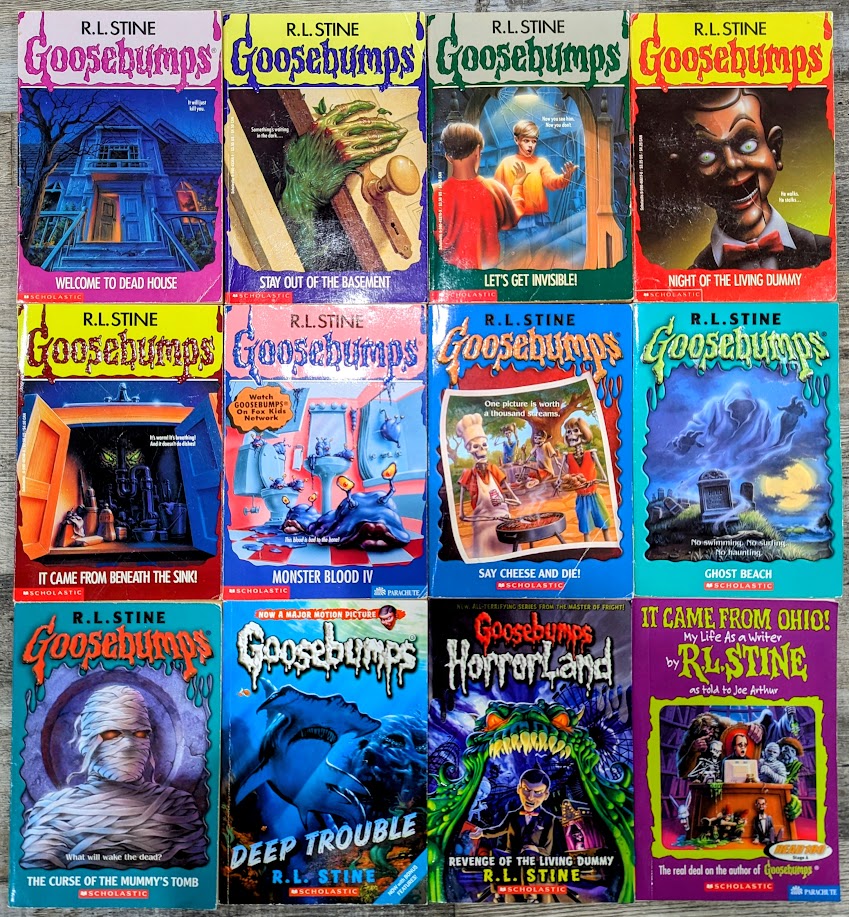
One of my favorite hobbies is going to used book sales and finding rare gems for low prices. It’s not just about paying less; it is more fun and fulfilling to find books in the wild rather than simply ordering a copy on Amazon. It’s akin to treasure-hunting—you never know what you might find. At one such sale, I acquired a collection of Goosebumps books for $0.25 each.

Written by R.L. Stine in the 1990s, Goosebumps was a series of horror books aimed at kids in the “middle grade” level. Goosebumps books were massively popular bestsellers in the 90s and were adapted into a television show, and the franchise remains popular today, with Stine still writing more books, Hollywood movie adaptations, and a rebooted TV series.

Despite being in the target age range at the time, I never read Goosebumps as a kid—though I was always curious about the books because of their evocative covers. Last year, while working on my re-write of Trick or Zombie Treat (a horror book about kids in the 1990s, very much in the vein of Goosebumps), I was feeling nostalgic for the 90s, the formative decade of my childhood, so I decided to see if the Goosebumps books were worth the hype (or at least worth a quarter).

Continue reading
Writers Must Read

I often hear published writers say they don’t have time to read anymore. It is often in interviews while promoting their own work, when they are asked what books they have read lately. Some writers say they don’t have time to read at all, others not as much as they would like to. Those who do read often only read ARCs (advanced reader copies) of new books they have been asked to write a blurb for, or nonfiction books as research for their fiction. They are too busy writing books to be reading books for leisure, or so they say. But this is not an excuse—it is cope. All writers need to always be reading. (ABR)

Continue reading

How to Expand Your Attention Span

Many people today claim they don’t have the attention span, patience, or self-discipline to read dense books and long-form content. That is because they have become too accustomed to the quick short-form hyperactive content on the internet like tweets, Instagram stories, YouTube videos, memes, and TikToks. In this post, I wrote about breaking my Twitter addiction and focusing my efforts and time on reading books. I suggested Twitter and social media are like drugs in that they change your brain chemistry. That is not hyperbole. Social media changes your brain by shortening your attention span.

Continue reading

From Hating Reading Books to Writing Them

When I was a child, I hated reading books. Yet today as an adult, I not only read a ton of books—I write them. How did this happen? Did my temperament change drastically? I don’t think so. I think I could have learned to love reading as a child if only I was exposed to the right books.

Continue reading

Should Writers Read Classic or Modern Books?

I often feel anxiety about the overwhelming amount of books I want to read, knowing I won’t live long enough to read them all. This has been a problem for all humans throughout history—the race against time—but the problem grows exponentially over time as the amount of content continually increases. 

Continue reading

Audiobooks vs. Reading

audiobooks-reading

I love listening to podcasts, but for some reason I never got into audiobooks. I couldn’t quite connect with a novel by listening to it in the same way I did by reading it. Which I found odd. Oral storytelling is evolutionarily ingrained in humans, dating back to when our prehistoric ancestors told stories around the campfire. Therefore, audiobooks should be more natural than reading. Which explains why I prefer listening to podcasts over reading transcripts or articles. However, I still prefer reading books over audiobooks. Why the apparent discrepancy? Continue reading