
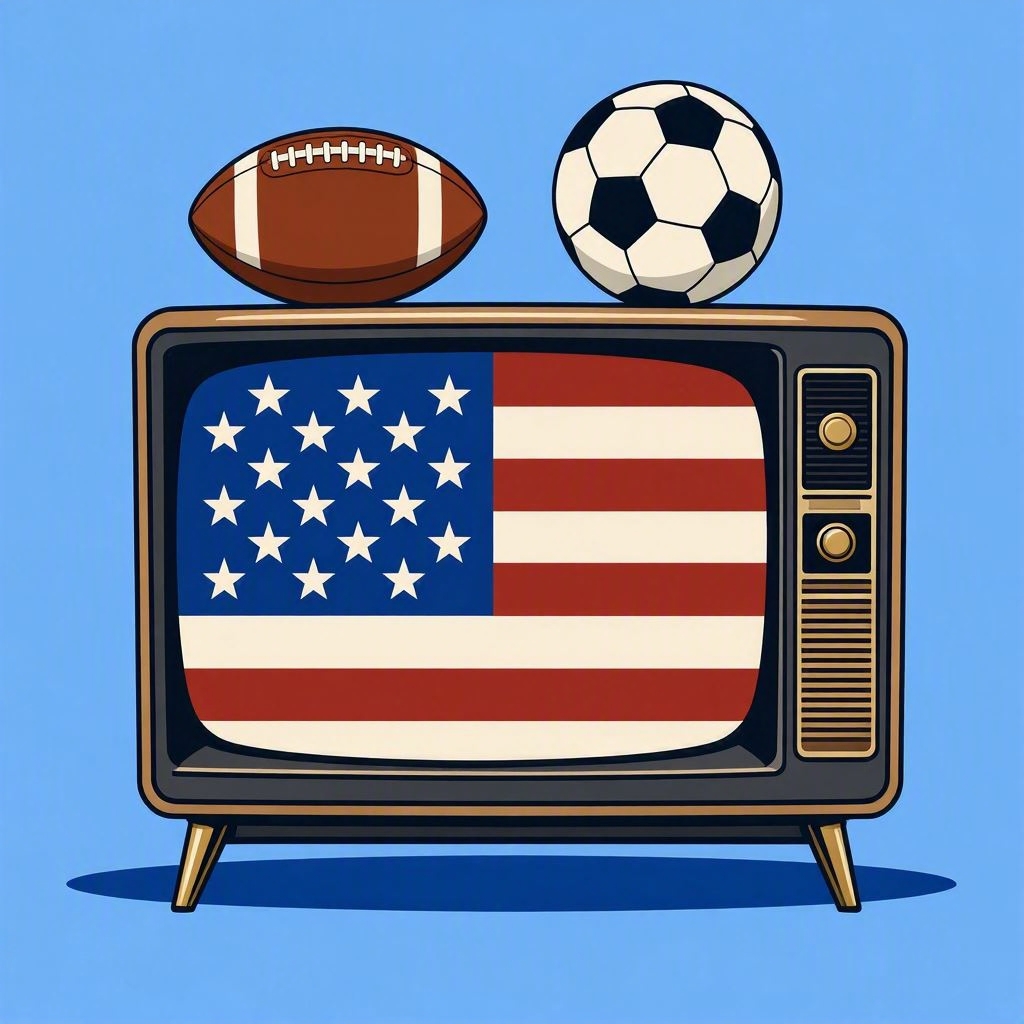
Every four years during the World Cup, Americans wonder why America isn’t good at soccer. The United States is not good at soccer because most children don’t grow up watching professional soccer on television. They don’t watch soccer on TV for the same reason football is the most popular sport in America. As Chuck Klosterman explained in his recent book Football, American football is the ultimate sport as a television product. The TV broadcasts of the games are what made the NFL so popular, overtaking baseball. Football is perfectly designed for television, to both the fans watching it, the networks broadcasting it, and the advertisers sponsoring it. Football is one of the rare sports that fans agree is better watched on TV than in person.
In football there is a constant back and forth between high-octane action and a dead-ball between plays with nothing happening at all. The clock time for an NFL game is 60 minutes (four 15-minute quarters), but the broadcast lasts 3 hours long. That’s two hours of no football being played during a game of football. Those frequent pauses in play seem like a flaw, but they are actually a benefit for television broadcasts, serving as a chance to show replays, analyze, talk, and argue about previous plays and/or upcoming plays, scroll, eat, drink, and most importantly air commercials.
The commercials are key in bringing money to the sport: to pay players, improve the stadiums, and reinvest in the league. The fact that football is a great TV product attracts more money to make it an even better TV product. It is a reinforcing cycle of profits, like an infinite money glitch, making ticket prices, TV ratings, and player salaries all go up and to the right, seemingly forever.
Soccer is not as popular as football in the US because it is an inferior television product—at least for the networks and advertisers. For viewers who hate commercials, soccer is vastly superior: two 45-minute halves of nonstop play with no ad breaks. But obviously the network and advertisers don’t like this, so soccer broadcasts don’t make as much money, therefore the teams don’t make as much money, therefore the players don’t make as much money, therefore the MLS doesn’t attract top soccer talent.
European soccer teams still manage to make massive amounts of money to pay the top athletes because their sports broadcasting networks are not ad-based, but subscription-based. For soccer to truly become popular in the US, you would need to change the entire business model of the television industry from advertising to subscriptions. That is starting to happen anyway, with streaming services like Netflix, Apple, and Amazon Prime getting into live sports broadcasts.
A decade ago, many people predicted the demise of football due to concussions and concern for player safety. But the NFL has only grown in popularity since then. The demise of football may still come, but it won’t have anything to do with the sport itself—it will be a byproduct of the demise of cable television.
Gen-Z will be the first generation to never pay for cable. They only use subscription streaming services. So when Zoomers raise their children (if they ever have children), that may be the generation where soccer truly starts to compete with football in terms of fan popularity. In Klosterman’s book, he also predicted that football would soon cease to be the most popular American sport, comparing it to horse-racing. It won’t happen for multiple decades from now, but eventually the US will compete with the rest of the world at soccer as the sport becomes more popular domestically. We might even start calling it football.

