
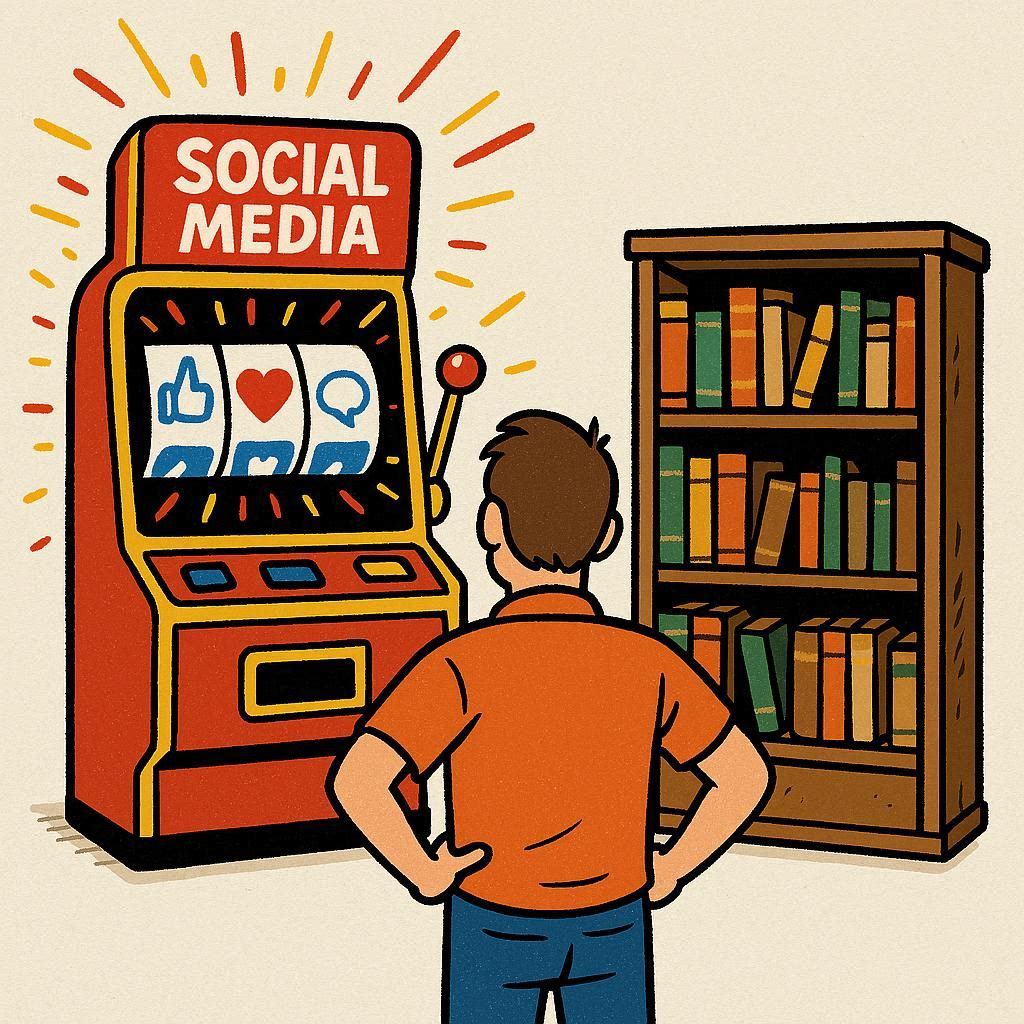
Never before in human history has the average person had access to such vast amounts of information, creating the capacity to learn anything about any topic they put their time and attention to. Yet, at the same time, the average person seems to be as dumb as ever—because they are not putting their time and attention to the proper information.
On the internet you can read the greatest books ever written for free in the public domain, but most people choose to watch ephemeral video clips on TikTok. Even among those who read, they choose to read short posts on Twitter/X, Bluesky, Threads, Facebook, and Instagram. Social media posts are often not well written, just a spur-of-the-moment stream of consciousness outrage-fueled rants and insults. Of course, there are still diamonds in the rough of social media to be found. But the problem with social media, as Marshall McLuhan would say, is the medium itself, more so than the content.
In the ancient past, information was rare and therefore valuable in itself. Before the internet (and even more so before the printing press), new information was hard to come by, so it could be sold, traded, and capitalized upon. Finding new bits of information was extremely valuable. But today, information is ubiquitous. Thanks to the internet, everybody has access to all information—too much information, in fact. The limiting factor is no longer information; the greater value lies in attention (or choosing which information is worth your time).
If you want to use this vast wealth of information to uplift your intelligence and well-being, you need to direct your time and attention wisely to the best information available. A good rule of thumb is, before choosing to read or watch something on the internet, pause to ask yourself, “Will this following information still be valuable to me ten-plus years from now?” If so, consume it. If not, ignore it.
I read a lot of books, which requires a lot of time and attention. The answer to that question for those books is “yes,” which is why I choose to spend that time reading them. The same is often the case with the blogs and essays I read, plus the YouTube channels and podcasts I subscribe to, which tend to be less current events/news-based and more evergreen-type content. So the answer to that ten-year question is—not always—but more often than not “yes.”
The problem lies in social media platforms that rely on “the feed,” because you cannot answer that question. You have no idea if the following content will be worth reading ten years later, because you don’t know what the following content will be. That is the nature of the feed, and that is the problem with social media as a medium.
Scrolling social media is like going to the library and grabbing a random book from the shelf to read. It might be good, but no one does that. They use reviews and recommendations to find books that they know will be worth their time. There are no such assurances with social media. The feed is random and unpredictable—though it is certain there will be slop. Algorithms are theoretically designed to feed you the best content, but “best” in this respect just means most viral that day. And virality is often fueled by base desires, not eternal truths.
The surprise factor of social media is its greatest allure, but also its greatest flaw. Feed-based content is inherently unpredictable, keeping you glued to the platform, scrolling through posts to see what will come next. Its addictive “slot-machine” nature causes you to spend far too much time reading and watching things that will not be worth your attention in the long run. There may be one post out of fifty that is truly valuable and worthwhile for years to come. But was that one nugget worth the forty-nine clumps of coal?
Maybe. I still use social media, but limit my daily time and attention to about a half hour per day (an hour at most), while I devote multiple hours each day to reading timeless books.
We are in an “attention economy” where time is the most valuable resource. If you value your attention, you should limit the time you devote to social media. Spend the majority of your attention reading great books that have already stood the test of time. Only spend time on modern content creators who have proven themselves to be purveyors of valuable information. Information is infinite now, but your time is not. So you must direct your attention wisely to the best information available and limit your exposure to slop.

