

They Had No Deepness of Earth (2021) by Zero HP Lovecraft
Zero HP Lovecraft (@0x49fa98) is an anonymous internet poster I originally discovered around 2016 when I was looking at the accounts Naval Ravikant (@naval) followed on Twitter. His name and bio (horrorist) intrigued me, so I read his short story, “The Gig Economy,” which was like a modern cyberpunk take on “The Call of Cthulhu.”

I instantly became a fan and read all of Zero’s stories as they originally came out on his WordPress site (now on Substack), and later assembled in this collection. I had been meaning to re-visit the stories because they deserve (and often require) re-reading. His fiction is like a combination of the cosmic horror of H.P. Lovecraft with the dense philosophical speculation of Jorge Luis Borges and the mind-bending science fiction of Ted Chiang.

If the original Lovecraft were alive today he would surely be writing about the horrors of modern technology—the internet, smartphones, VR, porn, and sexbots—which is exactly what ZeroHP does. He is an inspiration for me, writing some of the best fiction today, completely outside of the mainstream publishing system. His collection was published on the blockchain by canonic.xyz, though a pdf is available for free. The best stories are:
- “The Gig Economy” – about a NEET who performs random dayjobs for cryptocurrency and attempts to figure out who is funding these gigs.
- “God-Shaped Hole” – about the future horrors of sexbots.
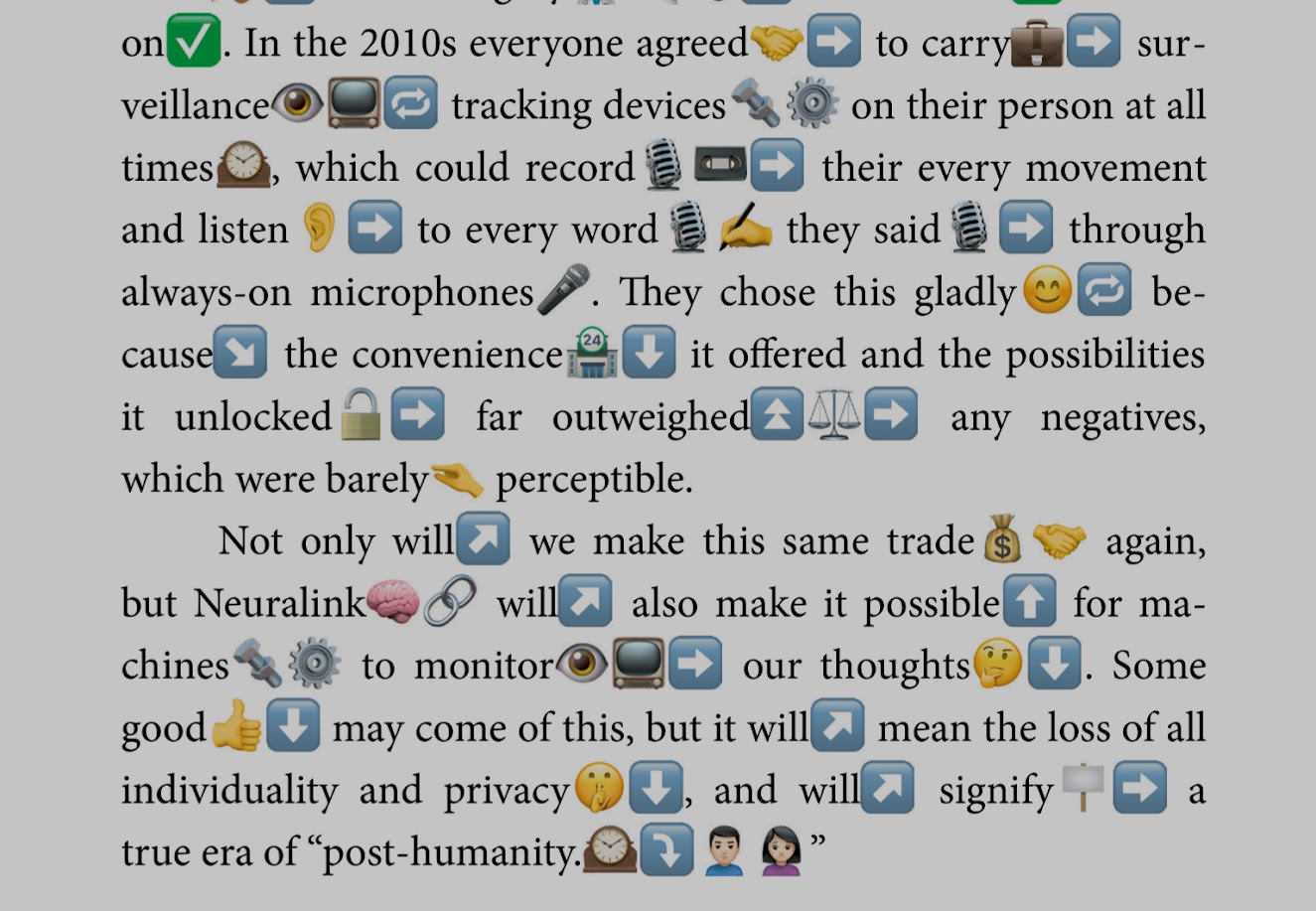
- “Don’t Make Me Think” – about the horrors of Neuralink brain-computer interfaces, written in emoji. Zero is also a master prose stylist and innovator of literary form.
Crime and Punishment (1866) by Fyodor Dostoevsky
This classic novel by Dostoevsky has been on my to-read list for a while, but I kept pushing it off, thinking it would feel like drudgery to read a 158-year-old Russian book. But that was a mistake. Crime and Punishment is not dated at all, but engrossing and engaging with crisply written prose. The only difficult part was reading all the Russian character names. The book does not feel like it was written in 1866 because Dostoevsky was fresh and original for his time and enormously influential on all writers that came after.
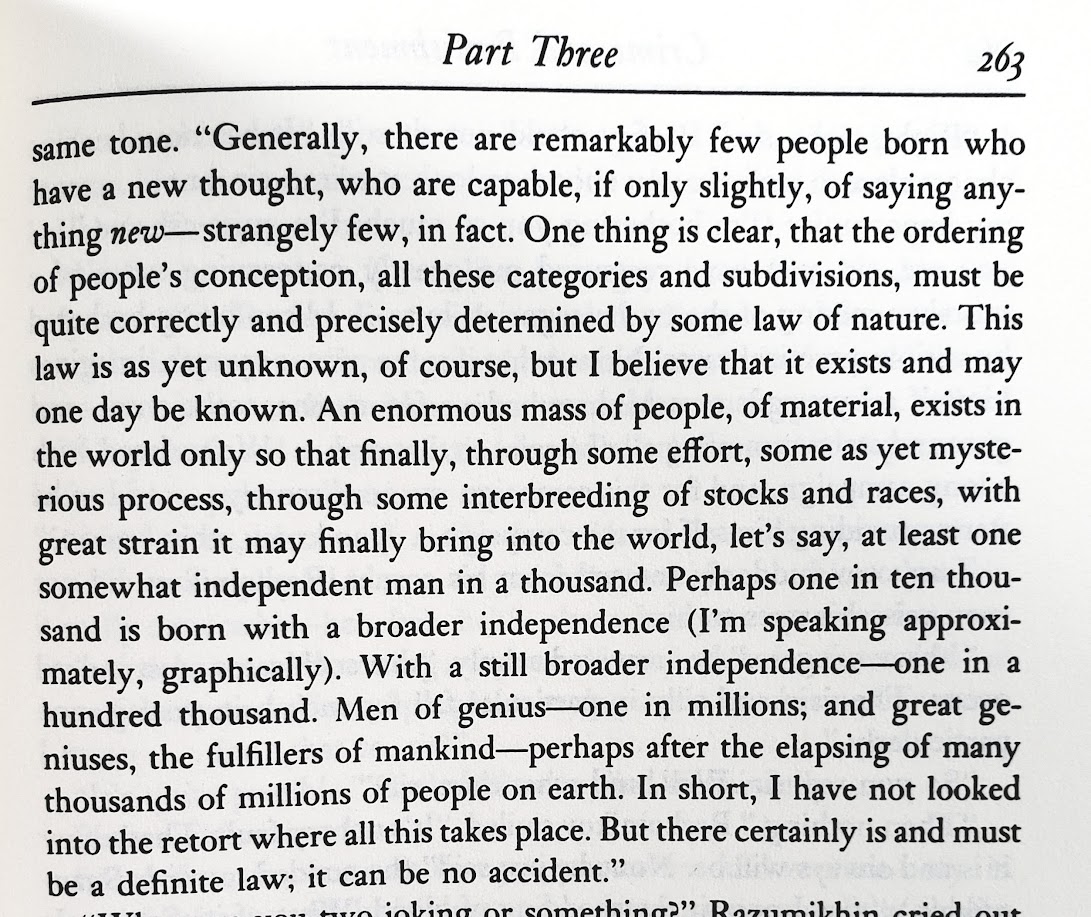
This book is about a young man who devises a plan to kill an old woman for money, but it’s not a typical crime/mystery book. It is a deep psychological character study of the murderer, Raskolnikov. We go deep into his consciousness, following his every thought before and after the murder, and how he rationalizes the crime in his mind. It feels extremely authentic, so much so it makes you wonder if Dostoevsky committed a murder himself as research for the book. I do not actually think this, but it just goes to show the mastery of Dostoevsky—not only as a storyteller but as an observer of human nature (which all storytellers should be).

In addition to being deeply psychological, the book is deeply philosophical, exploring the growing worldviews at the time—rationalism, utilitarianism, atheism, and nihilism—including the pitfalls of each, and how they are all related, with one leading to the other. In the epilogue, Raskolnikov has a dream sequence of the future in which Dostoevsky basically predicts how these ideologies will lead to the bloody chaos of communism, fascism, and World War II.
Scanlines (2020) by Todd Keisling
A haunting horror novella reminiscent of The Ring. In the present day, a man recounts his experience as a teenager in the 1990s when he and his friends accidentally downloaded a video of a politician blowing his brains out on live TV. The boys become haunted by the video, which makes them want to commit suicide in a similar manner and spread the video to others. Scanlines would make for a great movie. It’s the ideal length of a story for me, tight and focused, not overlong with superfluous subplots. The story (and cover) is dark and disturbing, but I loved it, especially the 90s nostalgia.
The Quiet Boy (2021) by Ben H. Winters
I’ve written before of my love for Ben H. Winters and his unique mystery novels, often speculative, but always grounded. This book has some sci-fi/metaphysical aspects, similar to The Revelations by Erik Hoel. The thrust of the story is a legal drama reminiscent of the movie The Verdict, with a down-on-his-luck injury lawyer trying to win a big case against a hospital for medical malpractice. A teenage boy suffered a head injury, and after surgery he became a hollow shell of a human being that would walk in circles nonstop 24/7, never eating, drinking, sleeping, talking, or aging, with seemingly no explanation or cure. The second mystery is trying to figure out what happened to the boy. No spoilers, but there’s also a tinge of cosmic horror.
Give up the Ghost (2024) by P.C.M. Christ
This is a novella by an anonymous writer I’d been following on Substack and Twitter for a couple of years. He describes the book as a “Dixie Noir.” I would describe it as a cross between True Detective (season 1) and Cormac McCarthy’s Blood Meridian. A young man seeks vengeance for the murder of his cousin, a young girl, who appears to be one of many victims of a satanic cult.
Flow My Tears, the Policeman Said (1974) by Philip K. Dick
A Kafkaesque novel by PKD reminiscent of The Trial. Set in a future authoritarian police state, a world-famous television show host wakes up one day to discover his identity has been erased and no one remembers him. He tries to evade the police, who are on his trail because he has no valid ID, while trying to uncover the mystery of his missing identity himself. The book is less focused on the sci-fi plot and is more centered around developing the character of the protagonist Jason Taverner, the cop hunting him, and the women who help Taverner along the way. This was more literary and well-written than the last PKD book I read, likely because it was not written in two days under the influence of amphetamines.
Casting the Runes and Other Ghost Stories (1911) by M.R. James
M.R. James is a master of horror and one of the foundational inspirations of H.P. Lovecraft, who described James as “a literary weird fictionist of the very first rank… and will certainly stand as one of the few really creative masters in his darksome province.” James was a professor of medieval manuscripts and cathedral history, and his horror stories often involve scholarly men similar to himself studying ancient manuscripts or visiting old churches and discovering some occult knowledge or summoning a supernatural entity. James’s stories feel realistic and believable, which reminds me of a quote from Lovecraft: “No weird story can truly produce terror unless it is devised with all the care and verisimilitude of an actual hoax.” Lovecraft also explained how James was able to achieve such verisimilitude in his stories, by approaching “his themes in a light and often conversational way. Creating the illusion of everyday events, he introduces his abnormal phenomena cautiously and gradually; relieved at every turn by touches of homely and prosaic detail.” The terror of M.R. James is more cerebral than visceral, or as Lovecraft said, he “reaches the emotions more often through the intellect than directly.” The ultimate effect of these ghost stories is best described by James himself: “If any of them succeed in causing their readers to feel pleasantly uncomfortable when walking along a solitary road at nightfall, or sitting over a dying fire in the small hours, my purpose in writing them will have been attained.” Mission accomplished, Montague.

A Universal History of Iniquity (1935) by Jorge Luis Borges
If I was stranded on a desert island for the rest of my life and could only bring one book, it would be the complete collected fiction of Jorge Luis Borges.1 A Universal History of Iniquity is an early work by Borges, his first collection of fiction ever published, though it blurs the line between fiction and nonfiction. The stories are all brief biographies of infamous figures from history, such as pirates, mobsters, Western outlaws, evil sorcerers, and other types of criminals. It’s not as good as Borges’ later work, which he admitted himself, describing these stories as “the irresponsible sport of a shy sort of man who could not bring himself to write short stories, and so amused himself by changing and distorting (sometimes without aesthetic justification) the stories of other men.” While not great in itself, there is some foreshadowing of the great stories Borges would later write.
Trouble Is My Business (1950) by Raymond Chandler
Chandler has been one of my favorite writers since the first time I read him, but it had been a while, and this was the first time I read this collection of four long short stories. It instantly reminded me why Chandler is one of my all-time favorite writers. I love the hardboiled noir aesthetic and his witty one-liners and poetic metaphors. My favorite story in the collection was “Goldfish,” about private detective Philip Marlowe trying to find stolen pearls, featuring a final shootout scene that must have inspired Reservoir Dogs.
Dead Eleven (2023) by Jimmy Juliano
I was intrigued by the premise (and cover) of this horror mystery novel about a small island of people stuck in the year 1994. As I’ve said before, I am hugely nostalgic for the 1990s (I wrote my own horror novel set in 1998 and plan to write more period pieces in the 90s2). Dead Eleven is a well-told mystery story, building intrigue and slowly uncovering layers while introducing more and more horror along the way. The audiobook was particularly well done, with different narrators for each chapter, depending on which character’s perspective it was from.
Burn the Negative (2023) by Josh Winning
A gripping horror mystery novel about a film journalist from the UK who goes to LA to do a story about a new horror TV series, It Feeds, based on a cult horror movie from the 1990s called The Guest House featuring the killer known as “The Needleman.” Many believe the movie was haunted because several people involved in making it have mysteriously died—then the people making the TV series start dying too.3 The twist (revealed early on) is that the journalist was a former child actress who starred in The Guest House but quit acting due to the traumatic experiences around that movie. The author threads the needle (no pun intended) between natural and supernatural explanations for the deaths throughout the book, until the final chapter when the truth is revealed.
Black Mountain (2019) by Laird Barron
This is the second book in the Isaiah Coleridge series, the first of which I reviewed last year, about a former mob enforcer from Alaska turned private investigator in the Hudson Valley, NY. This time, Isaiah is hired by the mob to find a serial killer who has been targeting mobsters. The mystery plot felt less focused this time, but it was still fun spending time with Isaiah and company in the criminal underworld of the Hudson Valley.
Chasing the Boogeyman (2021) by Richard Chizmar
A horror novel written in the form of a true crime book about a serial killer. The author includes himself in the story, basing it on his own life and hometown, and the book includes photos of the town and people involved, which adds to the verisimilitude. I was hoping it would go in a more supernatural route, (spoiler alert — it does not), but it was very well done for what it was: a fake true crime book.
Burning Chrome (1986) by William Gibson
This was Gibson’s first collection of short stories in which he basically invented the cyberpunk genre. It is ironic how he was able to foresee the internet and AI but not the end of the Soviet Union. The titular (and final) story was the best, set in the Sprawl universe of Neuromancer. I love the ideas and worldbuilding in Gibson’s work but find his writing style difficult to parse. He uses a lot of invented futuristic lingo and technical jargon without thoroughly explaining what the words and phrases mean. While I admire this aesthetically, as it adds to the verisimilitude of the futuristic atmosphere, it unfortunately also makes the story difficult to understand—which is the same problem I had with Neuromancer (though I plan to re-read that book).
Spire (2022) by A. Cuthbertson
A fusion of cyberpunk and cosmic horror, about miners on an alien planet with a mysterious giant black spire growing out of the ground.
Prey (2002) by Michael Crichton
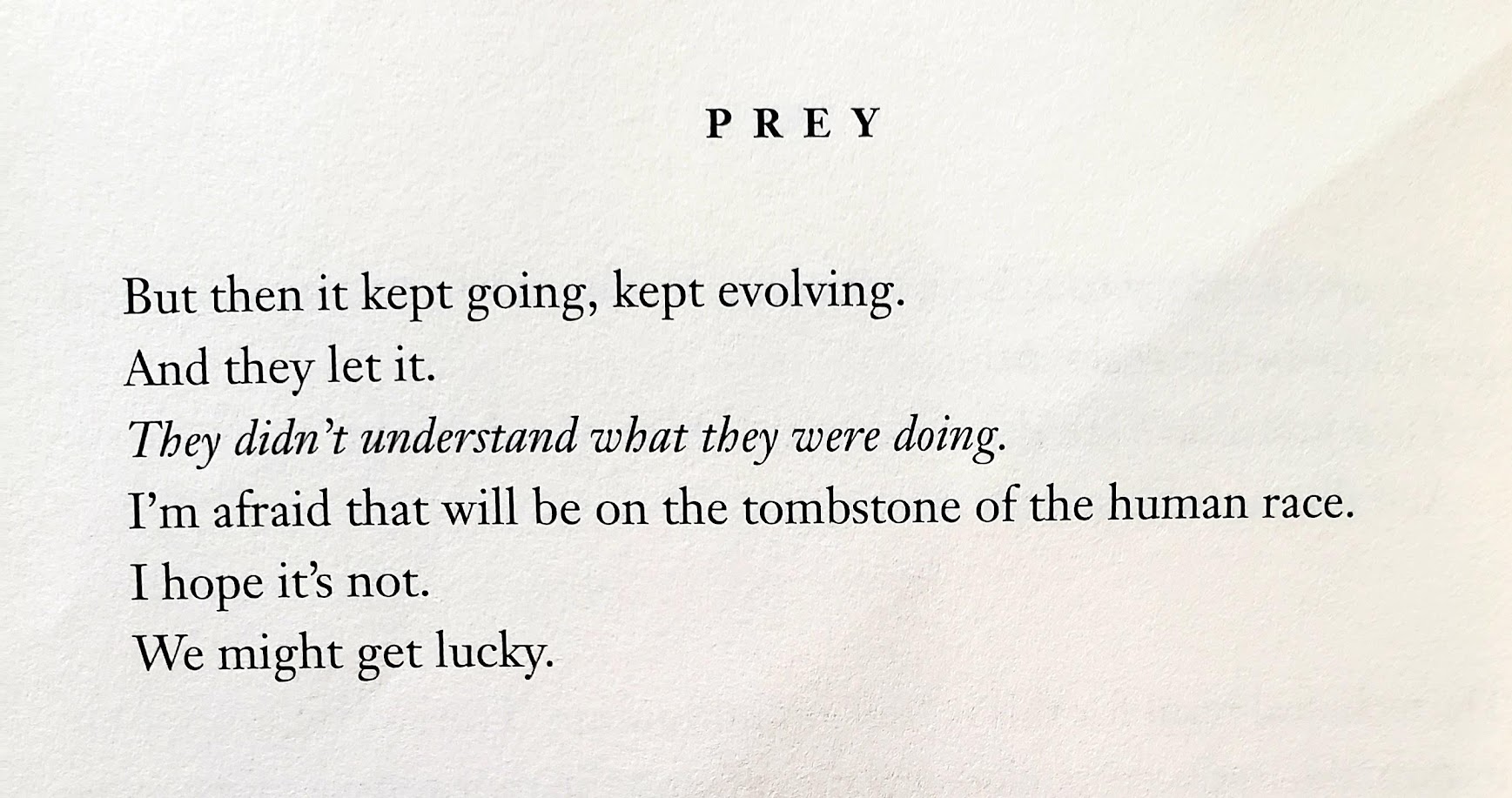
Crichton was a master of the high-concept story. All his best books are based on a fantastic speculative science idea, the ultimate example being Jurassic Park. This book centers around artificial intelligence and nanotechnology, resulting in autonomous swarms of microscopic machines. Crichton excels at concept and plotting, though some of his characters are a bit two-dimensional, and much of the dialogue is “on the nose.” The only good (or at least entertaining) dialogue was the children’s—specifically the inventive insults they called each other, such as “weasel puke.” Nevertheless, the book is a gripping page-turner, about AI and nanotech, but the story focuses on the family drama of a stay-at-home husband dealing with his three kids and his wife who is busy at work for the nanotech company. It’s a shame Crichton passed away so young. I’d be interested to see what kind of techno-thrillers he’d be writing today.
House of Sleep (2021) by Brad Kelly
A novel by the co-host of the great “Art of Darkness” podcast, about a cult where people experience each other’s dreams.
The Castle of Crossed Destinies (1969) by Italo Calvino
A series of interconnected short stories based on Tarot cards threaded together into a novel. It’s more interesting conceptually than as an engaging narrative.
A Methodology of Possession: On the Philosophy of Nick Land (2020) by James Ellis
From the host of the Hermitix podcast, I originally thought this was nonfiction, but it’s actually fiction—though heavily philosophical (aka theory fiction). The book is like a fever dream detailing a person’s psychological journey upon consuming the extremely nihilistic accelerationist philosophy of Nick Land. Like Fanged Noumena there is some heavy philosophical jargon that went over my head.
Kafka on the Shore (2002) by Haruki Murakami
A bizarre dream-like Japanese novel. Insightful and entertaining at moments, but also boring and meandering at other times. Could have been stronger if it was shorter.
Free Space (1997) edited by Brad Linaweaver and Edward E. Kramer
Ever since I heard about this collection composed of science fiction stories incorporating themes of libertarianism, I was desperate to read it. But the book was out of print and difficult to find. So I was ecstatic when I found a hardcover copy at a used book sale at a local library for $1. Like any collection, there were hits and misses, but unfortunately the collection as a whole did not meet my sky-high expectations. It is still a great idea for a collection (libertarian science fiction stories), and I would like to see a new version (my “Satoshi Revealed” could be included.). The best stories from Free Space were “Demokratus” by Victor Koman, a satirical critique of democracy on an alien planet where citizens must vote on everything, illustrating how that strips everyone’s freedom through mob rule, and “The Hand You’re Dealt” by Robert J. Sawyer, a sci-fi noir murder mystery set in a future where people’s futures are predicted based on their genetics.

The Broken Room (2022) by Peter Clines
I became a fan of Peter Clines after reading his first book 14, and became a bigger fan while living in Los Angeles when I got to meet him in person at the monthly Writers Coffee House meetups in Burbank. The Broken Room is similar to Stranger Things with a young girl escaping from a secret government lab that tested supernatural psi-phenomena on children. I was worried it would be too similar to Stranger Things until the nature of “The Project” was revealed. [Slight spoilers] In a certain location (called the broken room) children are able to access the voices of deceased people throughout history and gain knowledge from them—sort of like the Akashic Record, or a science fiction approach to ghosts.
The Kafka Effekt (2001) by D. Harlan Wilson
A collection of Kafkaesque short stories, mostly flash fiction. Though Kafka is in the title, the stories are more bizarro and comedic than Kafka’s own. Some parts are so random and absurd that they feel like they were written with Mad Libs.
The Beast You Are: Stories (2023) by Paul Tremblay
My thoughts on Tremblay’s new collection of short stories echo those from his previous collection I read: “While I normally prefer short stories, I like Tremblay’s novels better.”
Illuminations: Stories (2022) by Alan Moore
A mixed bag of stories by the great comic book writer Alan Moore. My favorites were “Cold Reading”, written from the perspective of a charlatan medium, and “The Improbably Complex High-Energy State”, the history of the universe from the perspective of a Boltzmann brain.
Upgrade (2022) by Blake Crouch
Blake Crouch is like the modern heir to Michael Crichton—he chooses great concepts for his techno-thrillers—but I have mixed thoughts about the ending of this book, which I will reveal in a longer review to be published soon. [Update: here it is.]
Maeve Fly (2023) by C.J. Leede
An “extreme horror” novel, like a female American Psycho, set in Hollywood, with a woman who plays a Disneyland princess by day and—well, you don’t want to know what she gets up to at night.
The Silence (2020) by Don DeLillo
A short novella about… I’m not even sure what this was about. It was difficult to follow because of the fragmentary style in which it was written, extremely terse, like Hemingway on steroids. No one ever speaks in complete sentences, just random half-thoughts that don’t make sense.
More Best Fiction Lists:
- That sounds like the premise of a Borges story. ↩︎
- The initial premise sounded similar to a book I’m developing, but thankfully the stories turn out very differently. ↩︎
- Similar to my Friday the 13th story, “Camp Blood Gore Tour“. ↩︎
 T.Z. Barry