Tag Archives: bitcoin

Best Nonfiction Books I Read in 2024

Man and His Symbols (1968) by Carl G. Jung

I have been wanting to read Jung for a while after hearing so much about his work second-hand through podcasts, blogs, and books. Jung has been highly influential on so many writers, thinkers, and artists I admire—and I can see why. His symbolic and mythological approach to psychology is sorely needed in our overly reductionist materialistic world. This book serves as a great introduction to Jung’s work. It features one chapter by Jung himself while the rest are written by his associates. The book also features lots of images to help illustrate the points about symbols because visual symbols are so powerful. Jung writes about the unconscious and the role of the artist:

Continue reading

Why Isn’t Bitcoin Fixing This (Yet)?

A common meme among Bitcoin enthusiasts is the phrase “Bitcoin fixes this,” used in response to any current societal problem. Whether it’s an economic issue, political conflict, or social ill, many bitcoiners believe the root cause is the money supply and the Federal Reserve’s inflationary policy—therefore a decentralized cryptocurrency like Bitcoin can provide the solution. “Fix the money, fix the world” is another popular meme phrase among bitcoiners.

However, Bitcoin and its supporters have their critics. Many do not care for the “Bitcoin maximalists,” their toxicity, and their repeated claims that “Bitcoin fixes this” for every societal problem. I cannot claim to be a full-on Bitcoin maximalist since I hold several alt-coins, but I am a Bitcoin mostlyist—as the majority of my crypto hodlings are BTC, and I think Bitcoin is the best and most important cryptocurrency in the world. I agree with the Bitcoin maximalists on most things, including that bitcoin will fix many of society’s current problems, which are often economic in nature. (Read Robert Breedlove for more on this.)

Continue reading

Content Creation in the Coming Attention-Based Economy

Writers have always struggled to get adequately paid for their work. Before the internet, publishing companies (for books, newspapers, and magazines) had the power as gatekeepers to take advantage of writers who had no other means to get their writing to the public. Publishers would take a large percentage of the pay—because they could. Today, the internet provides a way around traditional gatekeepers, but some writers still struggle to get paid. This could change in the future with the development of currently existing technology.

Continue reading

Best Nonfiction Books I Read in 2022

1. Time Loops: Precognition, Retrocausation, and the Unconscious (2018) by Eric Wargo

This is a fascinating book about the type of precognition often experienced in dreams, built off the work of J.W. Dunne. Author Eric Wargo provides numerous famous examples of precognitive dreams, often about traumatic events such as plane crashes or the sinking of the Titanic. Wargo claims such cases of precognition are actually “prememory”: your unconscious mind remembering a future memory, not of the event itself, but of your emotional reaction to learning news of the event. Both the author and I are aware of how crazy and “woo” this all sounds, but Wargo’s research is scientifically rigorous, and he walks a fine line of being both skeptical about paranormal claims but also open-minded to their possibilities (something I wish more on both sides of the paranormal/skeptical debate were willing to do).

Continue reading

Time is Money is Bitcoin

The idea of money is warped in most people’s minds. Cash has no inherent value. Neither does gold, diamonds, or anything else used as currency. The only thing in the world of true value is time. In that respect, every human being on the planet is born of equal worth. We all have an average of 80 years, or 30,000 days, or 720,000 hours, and every second of those hours is extremely valuable.

Continue reading

Best Nonfiction Books I Read in 2021

Note: The books from this list that aren’t available online for free are available for purchase through my Bookshop.org page.

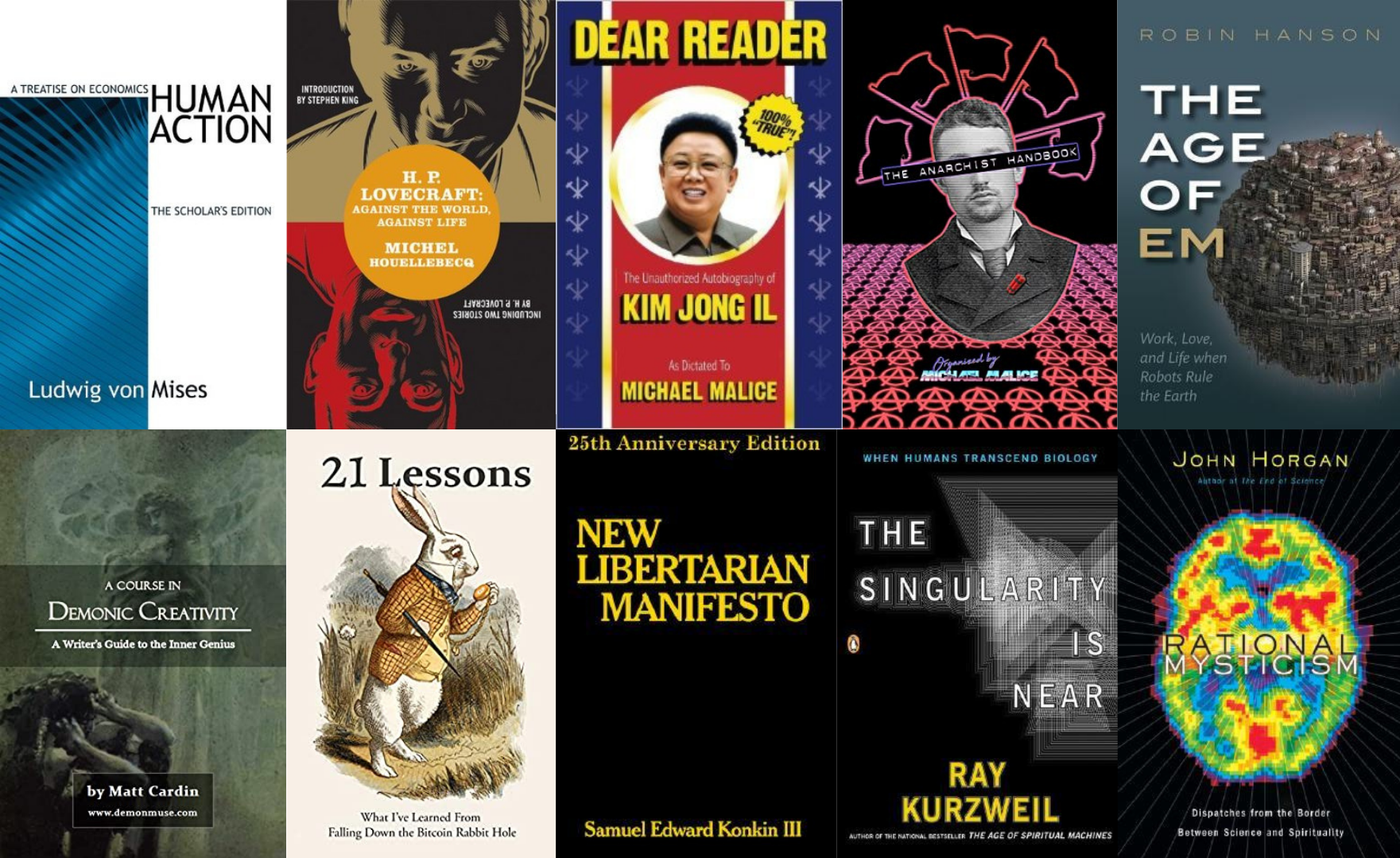
1) Human Action: A Treatise On Economics (1940) by Ludwig von Mises

This is the bible of Austrian economics by the grandfather of Austrian economics, Ludwig von Mises. Human Action is Mises’ magnum opus on economics, philosophy, and history—or more precisely, it’s about what Mises terms “praxeology”: the study of human action, which all economic activity boils down to. This is a long book (it took me half the year to get through, which is why there are fewer honorable mentions this year) but it was worth it. You will better understand the world today by reading this 82-year-old tome than by reading today’s newspapers.

Continue reading