
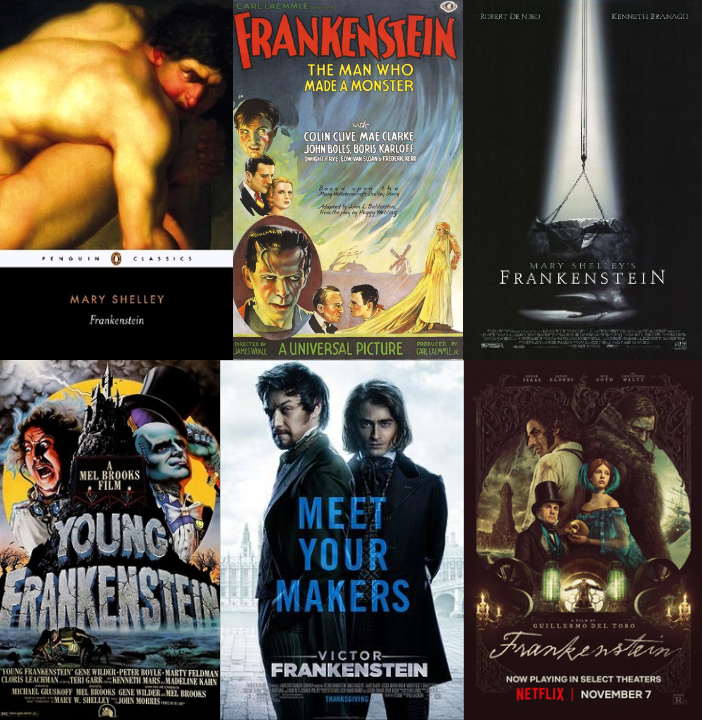
Frankenstein is one of those classic books that I felt like I knew all about despite never having read it because the story has so thoroughly permeated pop culture through movie and television adaptations plus countless parodies. It was time I finally went back and read the source material myself. The 1818 novel by Mary Shelley was not quite what I expected—but in a good way.
Frankenstein; or, The Modern Prometheus is not a simple monster story, as so many of the film adaptations are. The novel is philosophically complex—exploring the subjects of science, technology, morality, and occult alchemy. Frankenstein’s creature is not some mindless monster. Though he may look grotesque, he is highly intelligent and gives long Miltonian monologues. Contrary to common misconceptions, the scientist is named Victor Frankenstein, and the monster has no name, referred to as creature, fiend, spectre, dæmon, wretch, devil, thing, being, and ogre.
Shelley’s novel deeply explores the famous line from Jurassic Park: just because humans can build something, doesn’t mean they should. That question is always relevant to science and technology, but especially more so with artificial intelligence. Victor Frankenstein was attempting to create artificial life, which is what many believe we are doing with AI, and some fear it will have similarly disastrous consequences as in the book. I am more hopeful about the future potential of AI, but it is nevertheless important to think about the themes from Frankenstein with any burgeoning technology in order to prevent the worst-case scenarios from coming true.
Aside from the obvious AI allegory, Frankenstein could also be read as a proto-incel story. All the creature really wants is a girlfriend, but everyone rejects him, causing him to lash out in violence. The great thing about a mythic story like this is that its themes can endlessly be analyzed and applied to different societal issues in the future.
In addition to the fascinating subject matter, the novel was also written in an interesting way, through epistolary letters, with multiple embedded stories within stories, beginning and ending in the North Pole. I can’t call the book a flawless literary masterpiece, however; because the prose was a bit overwritten at times, parts of the plot were contrived with too many coincidences, and the characters were overly melodramatic.1 But Frankenstein is still worth reading as a classic for its time, and for its philosophical themes that are timeless.
After reading and enjoying the book, I wanted to watch the various film adaptations of Frankenstein for comparison, as I did with Dune.
Frankenstein (1931) directed by James Whale
The first Frankenstein movie remains the most memorable, the 1931 black-and-white classic directed by James Whale. His image of the monster is what most people think of: a tall stiff figure with pale green skin, short black hair, and bolts in his neck. The story strays somewhat from Mary Shelley’s plot, removing most of the deep philosophical themes, and turning Frankenstein into a simplistic monster story. Which is a shame because that story from the movie became more popular than the story from the novel in most people’s minds. I had never seen this movie before, but I somehow already knew the entire story (ending with the villagers chasing the monster with pitchforks and fire), likely from countless spoofs and animated remakes I’d seen as a child. Whale’s Frankenstein is incredibly impressive for 1931, with some iconic visuals, but the movie is a bit dated for 2026. It’s successful as a groundbreaking influential Hollywood horror movie, but it fails as a faithful adaptation of Mary Shelley’s novel.
Frankenstein (2025) directed by Guillermo del Toro
After watching the oldest Frankenstein movie, I watched the newest one, directed by Guillermo del Toro. This was more faithful to the book than the 1931 version, but del Toro still changed too much. I did not expect a direct adaptation because that wouldn’t work as a film. Some changes needed to be made to become more visually dynamic, and there are certain plot flaws in the novel that should have been fixed, but I did not like the particular changes del Toro chose, specifically around the characters of Victor Frankenstein and the creature. In the book, Victor is a flawed hero, and the creature is a sympathetic villain. Victor is certainly to blame for creating the monster, but the creature consciously chooses to murder innocent people as revenge against his creator. In del Toro’s movie, the creature becomes a sympathetic hero, while Victor is an unredeemable villain, completely subverting the dynamic of Shelley’s novel. There was some ambiguity in the book as to who was the true villain. Neither Frankenstein nor the monster were wholly good, nor wholly bad—both were flawed but sympathetic figures. However GdT’s movie makes the creature the totally good hero and Victor the totally evil villain. There is no ambiguity left, removing all the philosophical nuance from Shelley’s story. At least GdT has the visual style to make the movie look cool, I guess. Though I don’t know how Victor managed to build a skyscraper castle full of massive technology in the early 1800s, only to burn it all down. Judging from this adaptation, I hope GdT never directs At the Mountains of Madness because he will undoubtedly change Lovecraft’s story for the worse. Cthulhu was the good guy all along…
Mary Shelley’s Frankenstein (1994) directed by Kenneth Branagh
This wins for being the most faithful adaptation of the novel—at least until the end when Victor brings back his sister/wife from the dead. But faithfulness to the plot does not make it the best film. Some of the directing and acting choices were off in tone. Robert DeNiro, while a great actor, does not work as the creature. No film quite got the monster right. He’s supposed to be 8 feet tall and look so horrifically repulsive that people run away in fright at first sight. DeNiro looks more like a normal man with stitches and scars—ugly, but not terrifying. I’d place GdT’s monster in a similar category. The creature should look more inhuman and frightening, like a patchwork humanoid. I think Whale’s original 1931 film still has the best monster, even if his appearance and behavior stray far from the book. I would have liked to have seen a version of this movie that stayed true to screenwriter Frank Darabont’s original script, which was apparently much better.
Victor Frankenstein (2015) directed by Paul McGuigan
I saw this around when it first came out, as I was a fan of the screenwriter Max Landis, but I was disappointed at the time, rating it 5/10. I barely remember any details from the movie, but didn’t think it was worth re-watching, especially considering it is told from the perspective of Igor, a character that is not in Mary Shelley’s book.
Young Frankenstein (1974) directed by Mel Brooks
This was the first Frankenstein movie I saw, several years ago, and it remains my favorite of them all. It is a parody of the James Whale movies. While not at all faithful to Mary Shelley’s book, it is entertaining and funny.
There are many more movies and television shows that feature Frakenstein’s monster (or something inspired by Mary Shelley’s book), too many to list and review. But the greatest modern retelling of the Frankenstein story may be Alex Garland’s Ex Machina (2014). While it deviates wildly from the plot, characters, and setting, it stays true to Mary Shelley’s deep philosophical themes, and is increasingly relevant in the age of AI.
- Some speculate that Mary Shelley’s husband, the famous poet Percy Shelley, or his friend Lord Byron, actually wrote Frankenstein, but the book was clearly written by her because only a woman would write male characters who are so hysteric and melodramatic (including the creature). ↩︎

