
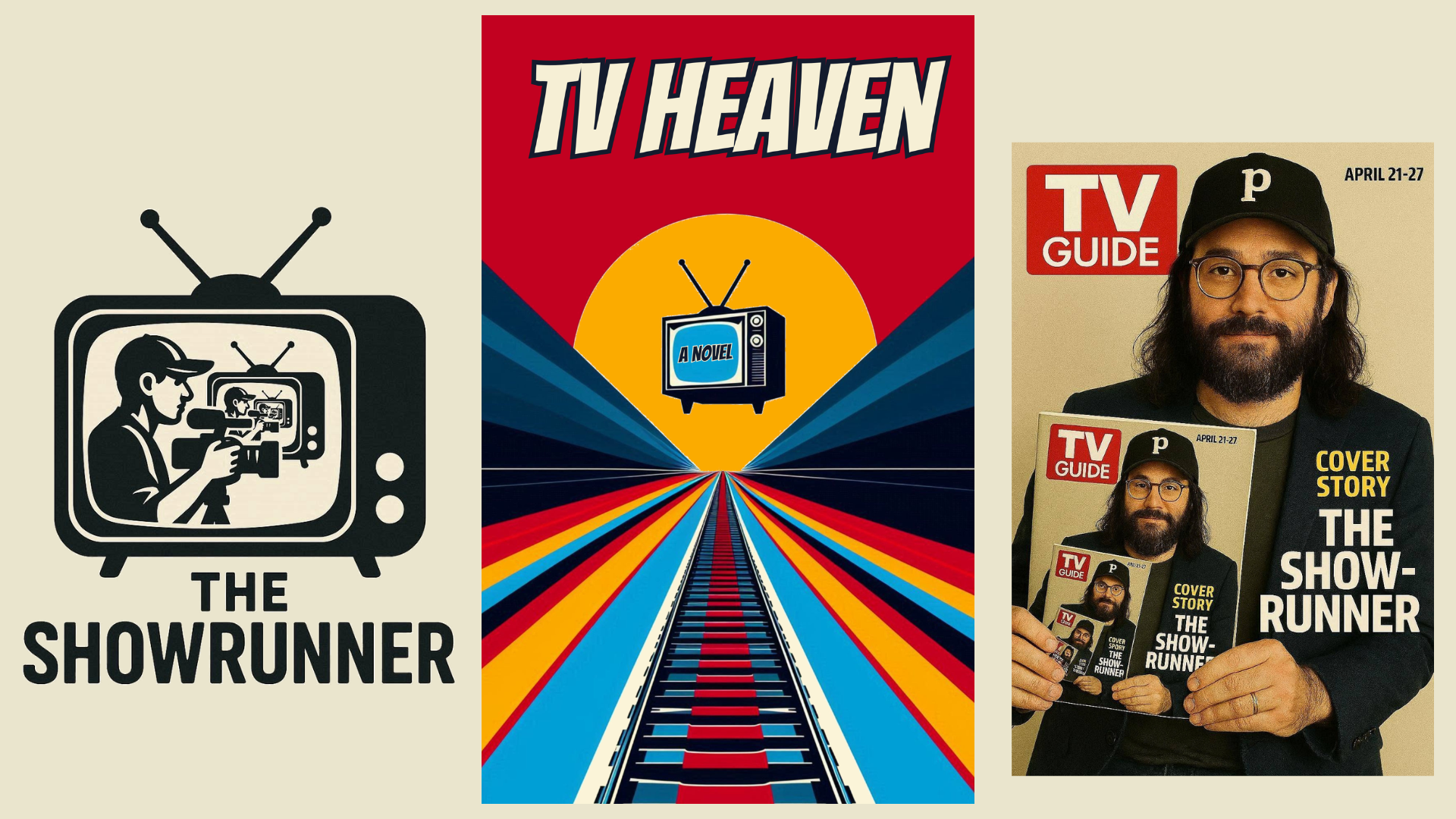
TV Heaven, now a novel, was originally a screenplay that I wrote in 2012. I forget the precise impetus for the idea (about a magical town full of the greatest characters from television history), but I know I conceived of it while bored one day at work (at my old job, which ironically, involved watching television). The story was partially inspired by some of my favorite meta Hollywood movies, like The Truman Show, Pleasantville, Adaptation, Stranger Than Fiction, and Who Framed Roger Rabbit.
I loved the aesthetics of Pleasantville, mixing black-and-white characters with color, plus using magical realism to go inside a classic television show. I took the idea of animated characters interacting with real people from Who Framed Roger Rabbit. The meta concept of going behind the scenes of the making of a movie/TV show came from Adaptation and Synecdoche, New York. In many ways, TV Heaven was intended to be my version of a Charlie Kaufman movie, as he was one of my major inspirations as a screenwriter. Like The Truman Show, TV Heaven is about a character trapped in a fabricated town, trying to escape to the real world. And like Stranger Than Fiction, the main character slowly comes to discover that he is a character in a fictional narrative.
Despite writing TV Heaven as a screenplay, I knew it was impossible to ever be made into an actual movie (due to the preponderance of copyrighted characters, both alive and dead). To break into Hollywood, you need to write a spec script. For movies a spec script is an original screenplay; for TV it is an episode of a pre-existing show. But most spec scripts (in both TV and movies) do not get made. (At least not anymore. Back in Hollywood of the 1980s and 90s, spec scripts sold and got made all the time. But now studios are hesitant to make original movies.) Today, spec scripts merely serve as writing samples to get hired to work on a television series or write a franchise movie. When you look at the “Black List” (an annual list of the best unproduced screenplays), the most viral scripts that get attention are usually based on pre-existing material, often historical figures and ripped-from-the-headlines stories. If nothing else, I figured the unique concept of TV Heaven could serve as a good writing sample. I submitted my screenplay to some agents, managers, and competitions at the time, but nothing ever came of it.
Years later, when I shifted from writing screenplays to writing novels, I decided to adapt some of my old scripts into books. My novel adaptation of TV Heaven started around 2021. The original first draft of the novel (then a novella) was 22,000 words, a sparse adaptation of the script that basically just converted the screenplay into prose format. I set the manuscript aside for a while to work on other projects, then would periodically return to edit TV Heaven further. I gradually expanded upon the minimalist screenplay-like prose to transform it into a fully realized novel.
The final word count is just over 50,000 words, more than double the first draft. The basic story has never changed since the original screenplay in 2012, but I developed the characters further, extended certain scenes, and wrote some entirely new ones. Plus I added a lot more TV characters and references to old shows. I have seen many (but not all) of the television shows referenced in the novel (there are hundreds).
It had been five years since I published my last book1, which I did not intend to be so long. While I have been busy publishing short fiction on my Substack, I would like to publish long-form books more frequently, ideally one per year. I have seven book-length manuscripts completed, but they all require intensive editing before being publishable. I knew from Trick or Zombie Treat and Work For Idle Hands that those final edits can be quite time-consuming, so I kept procrastinating, pushing them off to focus on shorter projects. Before I knew it, another year passed without a book. Then another. And another. I need to be more diligent about completing my old projects rather than continually jumping on to the next new thing.
At the start of 2026, I made a resolution that I would get at least one book published this year. The only question was which of those seven manuscripts to publish first. Three of them are about AI, so I would like to publish them ASAP, as AI has become increasingly relevant in the world. Except the developments in AI have forced me to change a lot of what I previously wrote. All three were written before the first version of ChatGPT was released. Had I published those books when I originally wrote them, I could have gotten credit for predicting the rise of AI, though some of the details were wrong. I still intend to publish those books, but they will require more rewriting and editing to accommodate the real-world developments in AI. Of my other manuscripts, TV Heaven seemed to be the closest to completion, requiring the least amount of rewrites, so I decided to do that first.
The final piece of the puzzle was the cover. I am constantly playing with AI image generators, creating concept art for my various works in progress, hoping to create an ideal cover (or at least the basis for a cover that I can iterate upon and edit). I had created some mock covers for TV Heaven that were decent, but when I created this one, I instantly knew that was it. Once I had my cover, I was ready to publish the book. Another reason I’ve delayed those AI books is that I haven’t managed to create good enough cover art yet.
While I did use AI to help create the cover art, no AI was used in writing the book. I adapted TV Heaven from screenplay to novel in 2021 before the release of LLMs, so I couldn’t have used AI even if I wanted to. I am curious to see how AI is at adapting a screenplay into novel form (I have several other old scripts I could try it on), but I would only do that if the quality of the writing is high enough. So far, I’ve found AI to be useful for certain types of short stories, but it gets worse the longer the text. So AI is not ideal for a novel. But if I already have a screenplay to draw from, AI might be helpful at adapting it scene by scene in smaller chunks. But before that, I’ve got six other manuscripts to work on (three are about AI, but all fully human-written).
As I said, TV Heaven began as a screenplay that could never be produced. But ironically, there is now a possibility of it one day becoming a movie—with the help of AI. AI video generators are the only way this story could ever be “filmed.” With tools like Seedance, I can see the seeds of a film adaptation of TV Heaven being possible, though it’s still probably a few years away.
In the meantime, I am continuing to publish short fiction over at Time Zone Weird. My current posting schedule is every other week, alternating with essays on my blog (also every other week), meaning I publish something at least once a week. That has seemed to be manageable while leaving me enough time to work on my longer-form projects, such as TV Heaven. Despite my lack of published books in the past few years, I have been working on them. I just need to be more deliberate about carving out the time to take those manuscripts to the finish line. It is those last five yards that tend to be the most tedious and time-consuming.
The paperback edition of TV Heaven is available on Amazon. The ebook version is exclusively available on my Substack: Time Zone Weird. Everyone can read the first five chapters of TV Heaven here.

