
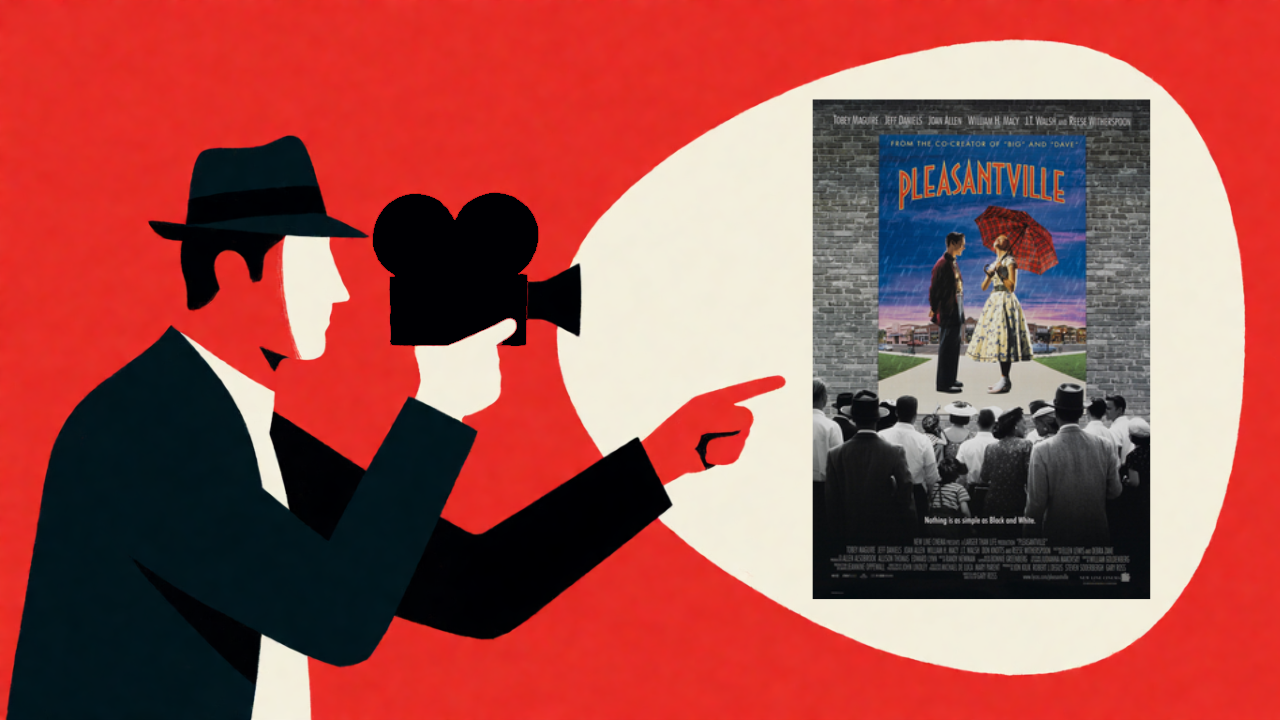
One of the primary influences for my novel, TV Heaven, was the 1998 movie Pleasantville, directed by Gary Ross. I initially saw Pleasantville around when it first came out and liked it, though being only 12 years old at the time, I didn’t fully understand it. I rewatched Pleasantville around ten years later and appreciated it more deeply, with it becoming one of my favorite films.
I loved the meta fantasy concept of modern teens being transported into a 1950s TV show. And I loved the visual aesthetics, mixing black-and-white cinematography with color. That idea of visually mixing characters from different eras inspired me to write TV Heaven, originally a screenplay. While editing the novel adaptation, I rewatched Pleasantville again this past year, and I still enjoyed it, but noticed some issues I hadn’t picked up on before.
First, the mechanics of how the teens get transported into the TV world makes no sense. That isn’t a major issue for me—I can just accept it as pure fantasy. But the illogical inconsistencies of how people and things become colorized in the grayscale TV world are a deeper flaw. I can accept magic in a fantasy world, but there should be some internal consistency with how the magic works.
Finally, the movie gets a bit too overly melodramatic toward the end. The entire story is like a self-mythologizing Baby Boomer fantasy that idolizes themselves as the hip young generation that fixed the crusty old America of their parents. That may have played better in the 1990s, but in the 2020s, a return to that classic small-town America of the 1950s (a more innocent and wholesome world where everyone knows each other’s name) seems a lot more appealing than modern Pleasantville after the revolution.
A subplot in the movie is the mother in Pleasantville leaving her husband and children to have a love affair with an artist—and this is depicted as a fully positive self-empowering decision. Then again, her “daughter,” Reese Witherspoon’s character, was a promiscuous teenage slut in the 1990s who initially hated the overly conservative 1950s Pleasantville. But in the end, she decides to abandon her nihilistic modern life and stay in Pleasantville to read classic books and go to college. So maybe the message of the movie wasn’t so black-and-white (pun intended).
Pleasantville was made by Boomers as part of a revisionist history movement that critiqued the post-World War II 1950s suburban America (itself mythologized in television shows like Leave It to Beaver) as not being as great as everyone remembered.1 That revisionist worldview was based on a hatred of order and homogeneity. But now there is a revisionist history movement critiquing the Boomers’ revisionism and their free love globalization that destroyed small-town America and traditional family values.
Regardless of Gary Ross’s original message, Pleasantville can be interpreted through either lens (Boomers’ revisionism of their elders, or modern revisionism of Boomers). The great thing about true art is it doesn’t matter what the artist’s intention was—art can be endlessly reinterpreted by the audience. Nearly 30 years later, I still think Pleasantville is a great film—I just have a different interpretation of the “happy” ending.
- At least the liberal Boomers inspired by the hippie movement. ↩︎

