
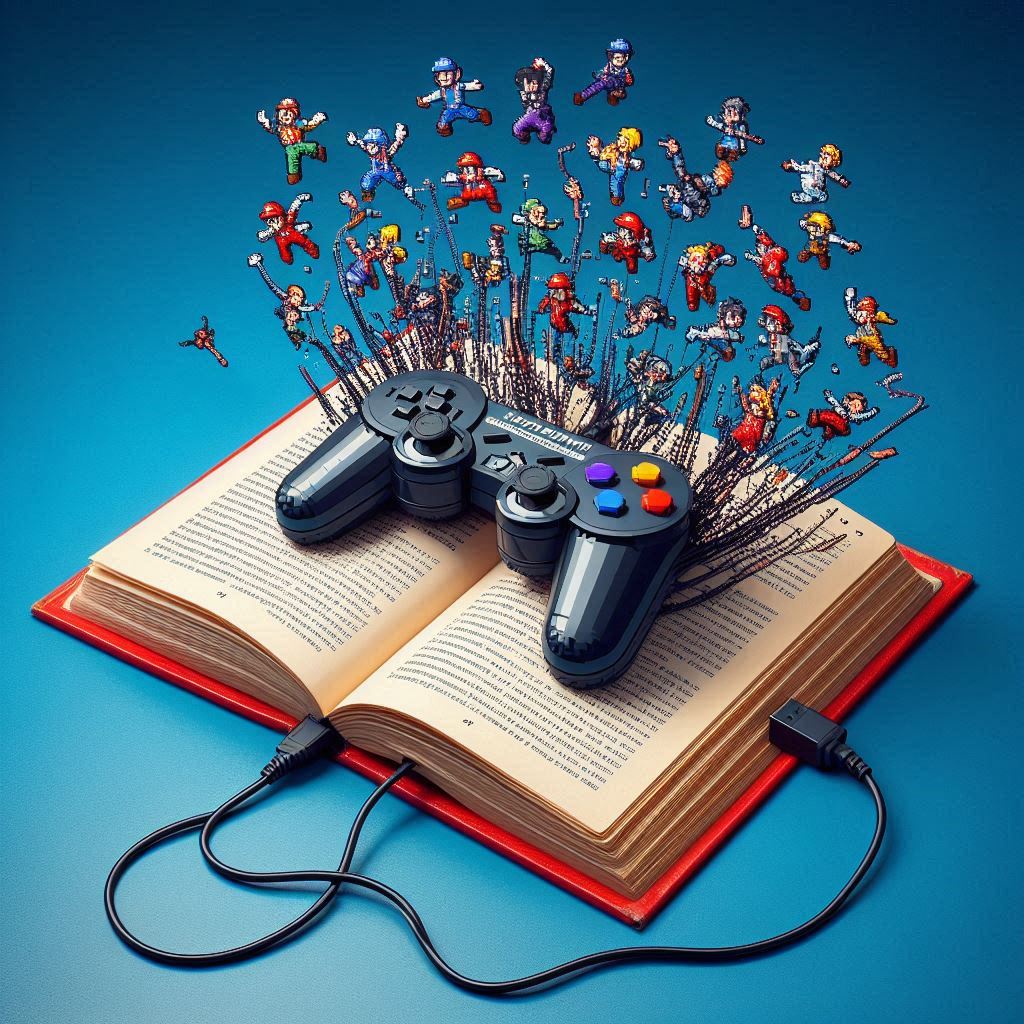
Stories can be great, and video games can be great, but video games are not the greatest medium for stories. This realization came to me after seeing the television adaptation of The Last of Us. I played the post-apocalyptic video game around the time it first came out in 2013, when it was hailed as one of “the best video games ever.” While I had some fun playing the game, I thought it was overrated and undeserving of its massive hype. The gameplay itself didn’t feel all that fun or inventive. Instead, what was so critically acclaimed was not the gameplay but the story.
By the time The Last of Us TV series was released ten years later, I had completely forgotten the details of the story. As a result, the show felt fresh and surprising. I had no idea where the plot was going even though it was a fairly close adaptation of the game. I loved the TV show and thought it featured fantastic storytelling with great characters and plot twists. The ending especially was bold and powerful. I now realize that the controversial ending is what led to such critical acclaim for the video game. As I said before, the ending can make or break a story, and it made The Last of Us great.
I’ve also written about how “the story” is the most important part of a story, be it a novel, movie, or TV show. But the story is not the most important part of a video game—the most important part of a game is the gameplay. Keep in mind, this is coming from an admitted “story addict.” I cherish storytelling and built my entire life around writing stories of my own. I love stories in all different formats: novels, short stories, television series, miniseries, movies, short films, comics, and more—including video games. But video games are not the ideal medium for telling a story because the gameplay becomes distracting from the story—or vice versa, the story becomes distracting from the gameplay. This is not necessarily a problem for video games because the entire point of a video game is the game. In games, the gameplay is more important than the story.
This idea was further reiterated to me with the most recent video game I played, Control. I don’t play video games as much as I used to—not daily anymore, just every so often. Although if it’s a game I truly love, I’ll play more frequently. But this game was such a slog to get through, I rarely felt the urge to play it. I wasn’t sure if my disinterest in video games was exclusive to Control in particular, or if I had simply outgrown video games altogether—perhaps a bit of both.1 Whatever the case, I preferred to spend my precious free time watching a movie or TV show. As a result, Control was the only video game I played in 2023, and it took me the entire year (and then some) to finally finish.
My ambivalence toward Control is ironic because the story was actually intriguing. It’s set in a secret government facility studying psi-phenomenon. I would even like to see a movie or TV series based on the game. But it was the gameplay that I found tedious, a distraction from the story. Sure, there were some inventive powers and weapons, which were kind of cool, but it got too repetitive having to continually kill the same mindless NPC enemies over and over again, especially as they got increasingly more difficult throughout the game, eventually becoming so hard that it made me want to give up because it wasn’t fun anymore—all despite having a good story that I genuinely wanted to see through to the end. But having to repeat all the monotonous gameplay to get there felt more like homework than fun. I had a similar experience with The Last of Us. The video game had a good story, but the narrative flow was interrupted by requiring you to complete mindless tasks of defeating NPCs just to get back to the story. I’d rather sit back, relax, and have the story unfold in full like a movie without the intermittent tedious tasks you must complete in between.
This is not a complete condemnation of video games as a medium. Some of the best video games have little to no story at all, such as Super Mario Bros or Limbo. There are no voice actors “telling” you the story like a movie scene; instead the story unfolds in the background through the gameplay. The main focus of the game is always on playing the game through fun puzzles and other interactive elements.
Nor is this a condemnation of video games as a method of storytelling because different types of video games that are more story-based can actually work quite well. For instance, the game I played and loved in 2022, Conarium, was a more engrossing story-based experience. There were no weapons or shooting of enemies. Instead, the gameplay was exploration and discovery with the story being conveyed through interactive elements in the game. The same for my favorite game of 2020, observer_. This is in contrast to games like Control and The Last of Us where the gameplay is composed of story-less action scenes where you must kill enemies, then the story is told in interspersed cutscenes that aren’t interactive at all.2 Such cut scenes are like watching a movie with poor acting and mediocre animation.
Storytelling in video games works best when the story is organically intertwined with the gameplay. But if you just have story-less action then action-less story, both become boring. Your mind drifts during the cutscenes and you just want to get back to the gameplay. This is what happened to me with The Last of Us, and it is why I didn’t remember the story afterward—though I remembered the gameplay which wasn’t that great—simply killing fungoid zombies. Even that so-called “great” ending to the game would have been better if the player got to decide how it would end. What makes video games unique as a storytelling medium is the individual choices the player can make.
My critique of storytelling in video games is a flaw specific to the types of games that try to be both movies and video games. They’re not as good at story as great movies and they’re not as good at gameplay as great video games. If it’s a story-based video game, it should fully focus on the story and forget about the action. But if it’s an action-based game, it should forget about the story and focus on the action, gameplay, and puzzles. Games like The Last of Us and Control try to do both story and action but neither works well—the action detracts from the story and the story detracts from the action.
The combination of action gameplay with narrative storytelling can work: examples are Bioshock and Dead Space, two of my favorite games of all time. Though I couldn’t really tell you the full plots of those games, aside from the basic premise and setting. The unique worlds are what made those games great. The story was more of a means to get you through the amazing worlds they built and the inventive gameplay. However, in Control there were just boring action scenes where you had to shoot dozens of mindless enemies over and over again, which becomes boring after a while—you just want to get back to exploring the world and continuing the story. But if the story is told exclusively through noninteractive cutscenes, you might as well watch a movie.
The point of storytelling in video games is to tell the story interactively. That is what other mediums, such as films cannot do. But games like The Last of Us and Control don’t make the story parts interactive at all. They just let you kill things in between the storytelling parts, at which point it ceases to be a game and turns into mere video. There is zero interactivity; you just watch the cut scene—or skip through it to get back to the game. They try to have the best of both worlds by combining movies and video games, but they end up with inferior forms of each.
- I spend my day reading, writing, and working out—the necessities—so that leaves me about three hours at night to devote to leisure activities, such as watching YouTube, browsing Twitter, watching movies/TV shows, or playing video games. I tend to spend at least one hour on YouTube and Twitter, which can sometimes extend longer, depending on the quality of the content that night. Then I’ll have another one to two hours for a movie or TV show before bed. It’s more difficult for me to find time to play video games—that would mean forgoing the YouTube/Twitter time or the TV/movie time. Honestly, I’d rather watch a movie than play a video game because it’s a better medium for storytelling—and for me, story is king. I’ve cut back on my Twitter use too, but I enjoy watching YouTube, as there are so many interesting channels from indie creators, the kind of content that you cannot get from corporate streaming platforms like HBO and Netflix. I’m obviously not going to sacrifice reading and writing time during the day, so video games are just a sacrifice I’ve had to make. There are some (story-based) games I would still like to play, but there are only so many hours in a day, and I have higher priorities. ↩︎
- This is the same critique I had of The Matrix sequels. The original movie told the story through action, but the sequels would have tedious talking-head exposition scenes interspersed with mindless action scenes—just like a video game. ↩︎
 T.Z. Barry