
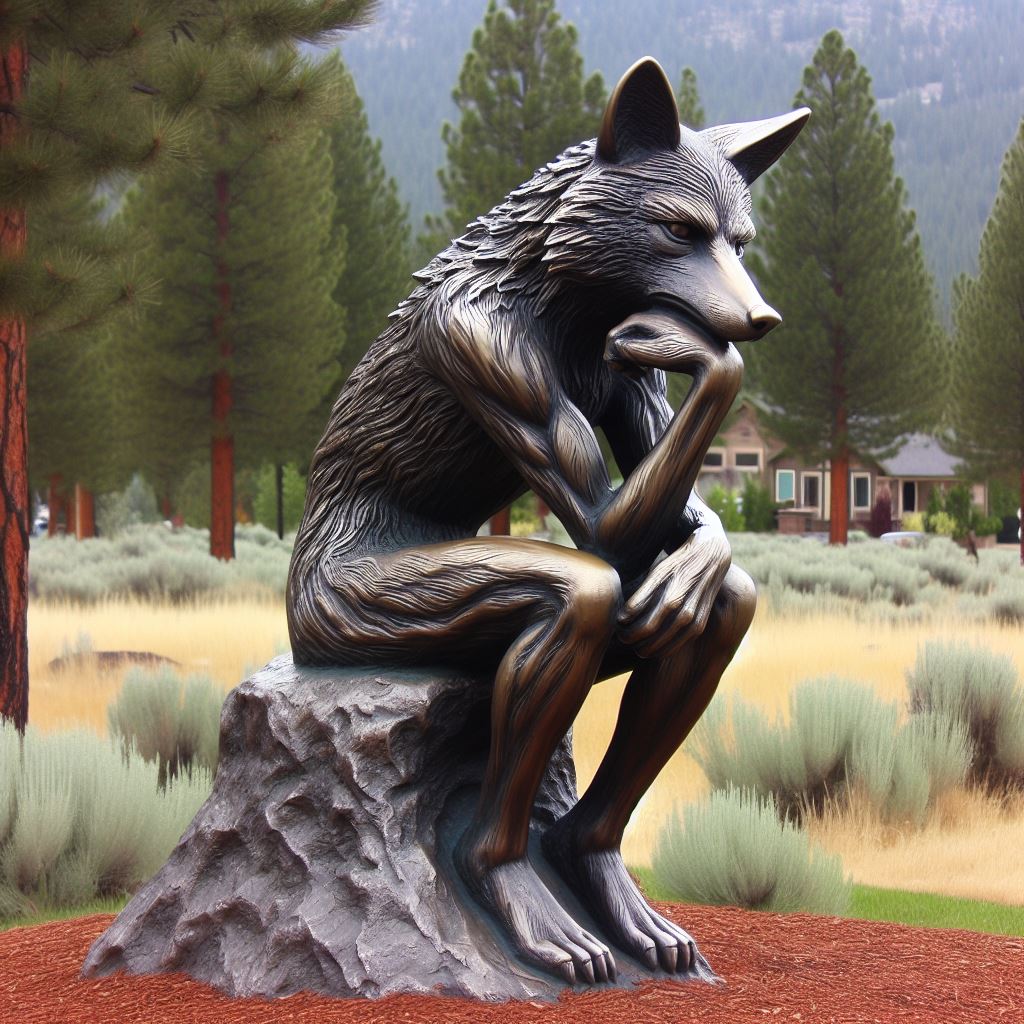
One day while hiking I encountered a couple of coyotes along the trail. At first I got frightened, wondering if they were dangerous. But the coyotes just stood still, watching me from a distance and minding their own business. I walked away, continuing along the trail, while googling for information on my phone. With relief, I learned coyotes rarely ever attack adult humans—only small pets and children. (So don’t leave them out alone in coyote-populated areas.)
I then started wondering what it feels like to be a coyote. What was going through that creature’s mind as it watched me hiking by. Is anything going through its mind? What I mean to say is, are coyotes conscious? But not just consciousness as subjective experience, or the classic definition by Thomas Nagel—that there is something that it is like to be that thing. I mean are coyotes—or dogs, cats, and any animals other than humans—conscious in the same way humans are, with self-awareness, an inner monologue, and imagination? Does any species besides Homo Sapiens possess “sapience?”
That may be impossible to say. We assume animals are not conscious to the same extent we are because if they were, they would be like us: civilized with language, culture, art, technology, and cities. Which might be true to some extent. But sapience may not have anything to do with civilization and technology. Those things may have more to do with intelligence.
Intelligence is certainly a part of human civilization’s success, but I think consciousness plays a vital role as well. Without consciousness, we couldn’t have language or pass on knowledge to build technology. Nor could we create fictional stories in our imaginations like money, art, technology, religion, governments, and corporations. We wouldn’t be as intelligent as we are if we weren’t as conscious as we are. Therefore, sapience, or what truly makes humans different, is our combination of high intelligence and high consciousness.
Which brings me back to the coyote. Dan Flores has studied the species extensively and uncovered a ton of fascinating information in his book Coyote America: A Natural and Supernatural History. He explores how coyotes have thrived across America despite human efforts to control or eradicate them. In fact, attempts to limit coyotes often lead to an increase in their population. In the war between humans and coyotes, coyotes seem to be winning.
Another time while hiking I didn’t see any coyotes, but I heard them. They use loud howls as a long-distance communication method to mark territorial boundaries, locate pack members, and attract mates. So, like humans, coyotes have some kind of language, and they have strong social cooperation. Coyotes are clearly intelligent and conscious to some degree. But are they sapient? Is any animal other than homo sapiens sapient?
That may be impossible to determine. All animals are conscious to varying degrees, but not in the same way humans are conscious—that is with metaphorical language, self-awareness, and metacognition. Those types of mental processes require a large developed pre-frontal cortex which other species lack. A coyote may be intelligent and experience emotions and feelings similar to humans, but they likely have no meta-awareness of those feelings.
If you were to inhabit a coyote’s mind, you would have subjective experience—there would be something that it is like to be that coyote—hence coyotes are conscious. But the coyote’s subjective experience likely does not include an inner monolog creating stories about itself and others. In the words of the great book I read last year, humans are The Storytelling Animal. So far as we know, no other species creates fictional stories like us. It is those stories that allowed us to create a globe-spanning technological civilization. And coyotes’ lack of storytelling has prevented them from doing the same.
While coyotes may not be able to write novels, paint artwork, or play music, humans cannot experience their heightened perceptions of smell and sound. Humans are more conscious in some ways, but coyotes are more conscious in others—just as all other species are conscious in differing ways due to their unique modes of sensory perception.
Just because coyotes (or any other species) do not share humans’ specific type and degree of consciousness does not necessarily mean they are “less” conscious than humans—they are just differently conscious. Coyotes don’t suffer from the myriad mental health problems that plague human consciousness: anxiety, depression, schizophrenia, etc. Human consciousness may be overrated by humans. We are biased to believe our form of consciousness is superior, but we have not experienced any other type of consciousness to compare it to. Regardless, I am glad I’m a human and not a coyote. After all, when hiking by a coyote, I can imagine what it is like to be him, but he cannot imagine what it is like to be me.
 T.Z. Barry