
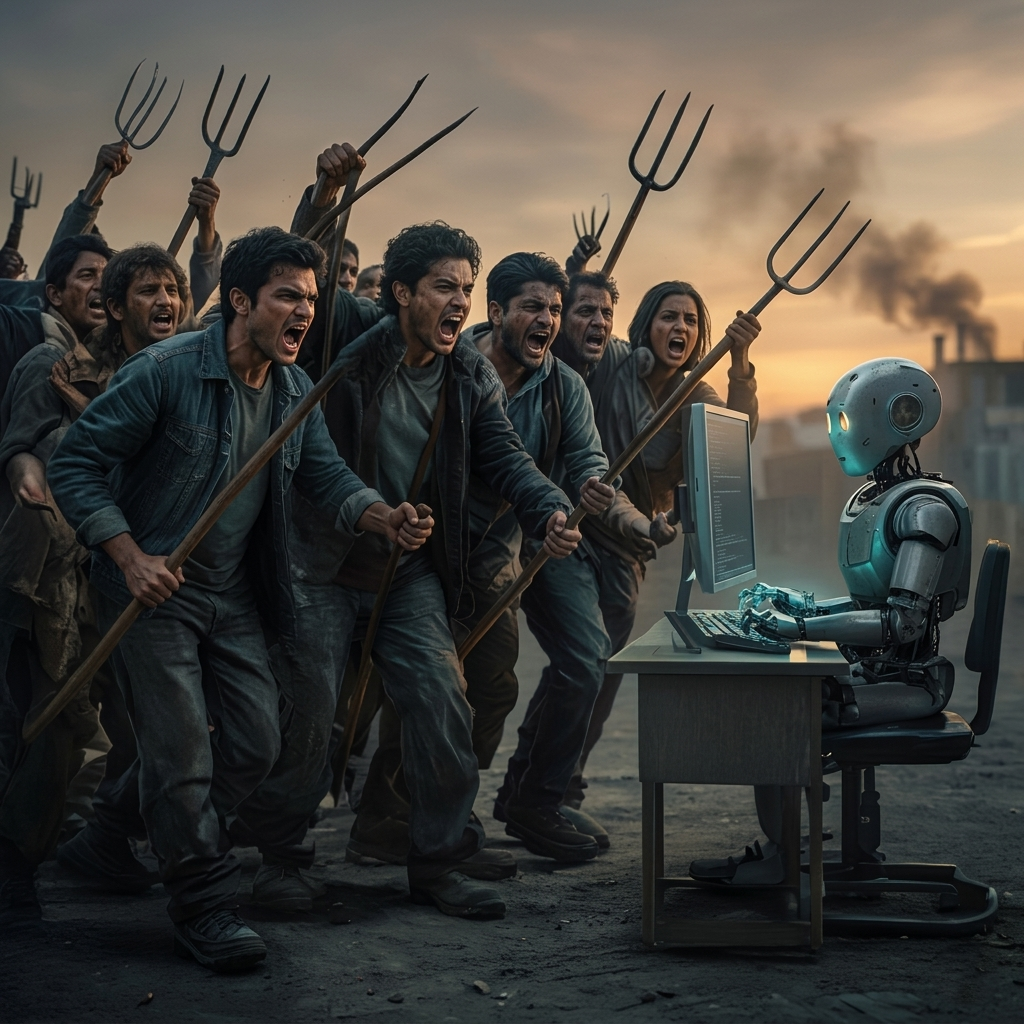
The anti-AI sentiment within the writing community is rabid. Many writers say that all AI writing is slop, and you should never use it. But I think that’s mostly denial and cope. LLMs are getting better by the day, and while I still mostly stand by this piece about the limits of ChatGPT at writing fiction, AI (Claude in particular) has gotten orders of magnitude better at writing fiction over the two and a half years since I wrote that—and it will only get better in the future. If you think AI cannot contribute to good writing, you’re not trying hard enough (or prompting well enough).
Ironically, the AI hate among writers has only grown as AI has gotten better at writing. That may seem counterintuitive, but it actually makes complete sense. Writers have a subconscious fear of AI and the fact that it could write so fast and so competently. They are afraid that AI will make them obsolete and completely replace them. So they are lashing out against AI and anyone who uses it. They don’t hate AI because it is bad at writing, but because it is good at writing—or at least it is good enough. I maintain that the best human writers are far better than AI and always will be, but great human writers are few and far between. AI can write as well as an average writer and much better than sub-par writers (and the majority of human beings are sub-par writers). It is the average and sub-par writers who most vociferously hate AI, while great writers feel no threat from AI at all.
The type of people who hate AI spent years writing before the advent of LLMs, took satisfaction in the words they wrote and the time they spent writing them. Publishing a novel required hundreds of hours of hard work, regardless of how good the actual story was. With LLMs, that is no longer true—a full novel can be produced in seconds. Older writers resent newer “writers” who don’t have to work as hard to produce a book. Such writers have a misguided Marxist theory of value based on labor. The fact that they spent so much time writing something means that it must be valuable.1 Therefore, if AI can write something instantly, it cannot be as valuable because the AI (or prompter) didn’t spend as much time laboring to produce it. However, the Marxist labor theory of value is false. Spending ten hours digging a hole by hand is not more valuable than using an excavator to dig a larger hole in ten minutes. There is more value in doing labor more quickly and easily, so long as it is still done well. The analogy to writing is not perfect, because value is more subjective when it comes to art, but the analogy still stands in this sense: just because you spent more time writing something does not inherently make it better.2
The intense fervor against AI writing is another case of old people being afraid of a new technology, just like Plato was afraid of the invention of writing itself 2,400 years ago because it would weaken memory and prevent true understanding.3 Plato’s worries about writing were almost exactly the same as people’s worries about AI writing today—yet those people do not think the invention of writing was a mistake. I am not naive enough to believe there won’t be any negative externalities that come from AI writing. Relying too much on AI may make human writing worse, and it may indeed weaken memory and prevent true understanding, as Plato feared. But the writers who forgo AI entirely are going to be left in the dustbins of history—like the orators after scribes, and scribes after the printing press.
Young people coming up now do not share the “sunk cost fallacy” of established writers. They do not hold the labor theory of value toward writing because they have not spent years writing without the aid of AI. They have no fear of AI replacing them because they have no established careers for AI to take. In fact, they may need to use AI in order to displace the older establishment. So young people are going to take AI and run with it, using it to do all kinds of creative things. Millennials who now think AI is a fad sound like the Boomers in the 90s who thought the internet was a fad. Millennial teens embraced the internet and did things with it that their Boomer parents never could have dreamed of. Eventually the Boomers gave in and got online. It’ll be the same with AI.
This doesn’t mean you must use AI. I applaud those writers who abstain from AI entirely and write every word themselves. I’ve done that in the past, and depending on the project, will continue to do so in the future. I didn’t use AI to write this or any other essay on my blog, because they are my personal thoughts and opinions. AI does not know my thoughts and opinions, so how could it generate them? But if I were to write a more scientific or historical essay, I might use AI to help write some of the technical details—because those technical details are not my personal thoughts and opinions. I cannot summon them from my subconscious. Outside help is needed to produce that text.4 I could spend hours researching online and reading books, or I could have AI generate the information instantly. A human historian or scientist who has spent years studying a topic will likely be more knowledgeable than AI, but as a fiction writer, I rarely need that deeper knowledge. The more research I can outsource to AI, the more time and effort I can devote to my expertise—writing fiction.5
I have no issue with writers who choose not to use AI, but I do have an issue with them attacking writers who do. Among a certain group of writers (and readers) there is a blind hatred for the idea of using any AI at all, without even considering the merit of the final product. If humans are able to use AI to create artistically valuable works of literature, then more power to them. If you don’t think AI can be used to create artistically valuable works, then you have nothing to worry about (except an exponentially expanding deluge of slop, which is more annoying than threatening—you can still find the good stuff). But, whether they admit it or not, people are worried because they fear AI can create artistically valuable works of literature.
There is a false binary where people think human-created work is Art, and anything AI creates is slop. But humans are perfectly capable of creating slop all by themselves, and AI can be used to create artistically valuable content. It is not a binary. Humans can make bad art, and AI can make good art. And humans can make good art, and AI can make bad art. I’m less concerned about who and how art is made. Ultimately, what matters is if the art is good. I don’t go on tirades and protest against people who write crappy fiction—I just ignore it, not for me. If you don’t like AI writing, that’s how you should treat it. This is not a defense of slop. I hate all slop, whether it is made by AI or humans. The point is, AI can be used to create non-slop, though that is less common. But true art has always been rare.
- This mirrors my past critique of National Novel Writing Month (NaNoWriMo). I did not think it was some great accomplishment to rush to finish a crappy novel in one month. It promoted a worship of mere word count. I said it would be better to write a 4,000-word short story that is actually good, rather than a long, bad novel that nobody would want to read. Now AI has essentially killed NaNoWriMo. The mere act of writing 40,000 words is not an accomplishment worthy of congratulations—a monkey with a typewriter could do that. Shakespeare writing Hamlet is impressive. And if a modern Shakespeare uses an LLM to compose an impressive literary work, that should be worthy of congratulations as well. ↩︎
- Though the way to get good at writing is to read and write. So the time and labor spent writing is valuable to you personally, insomuch as it improves your writing skill. But that doesn’t mean everything you write in the process is valuable to others. ↩︎
- From Phaedrus (370 BC) ↩︎
- For instance, I used AI to look up the details of Plato’s argument against the invention of writing. ↩︎
- And yes, that em dash was purely human. ↩︎
 T.Z. Barry