
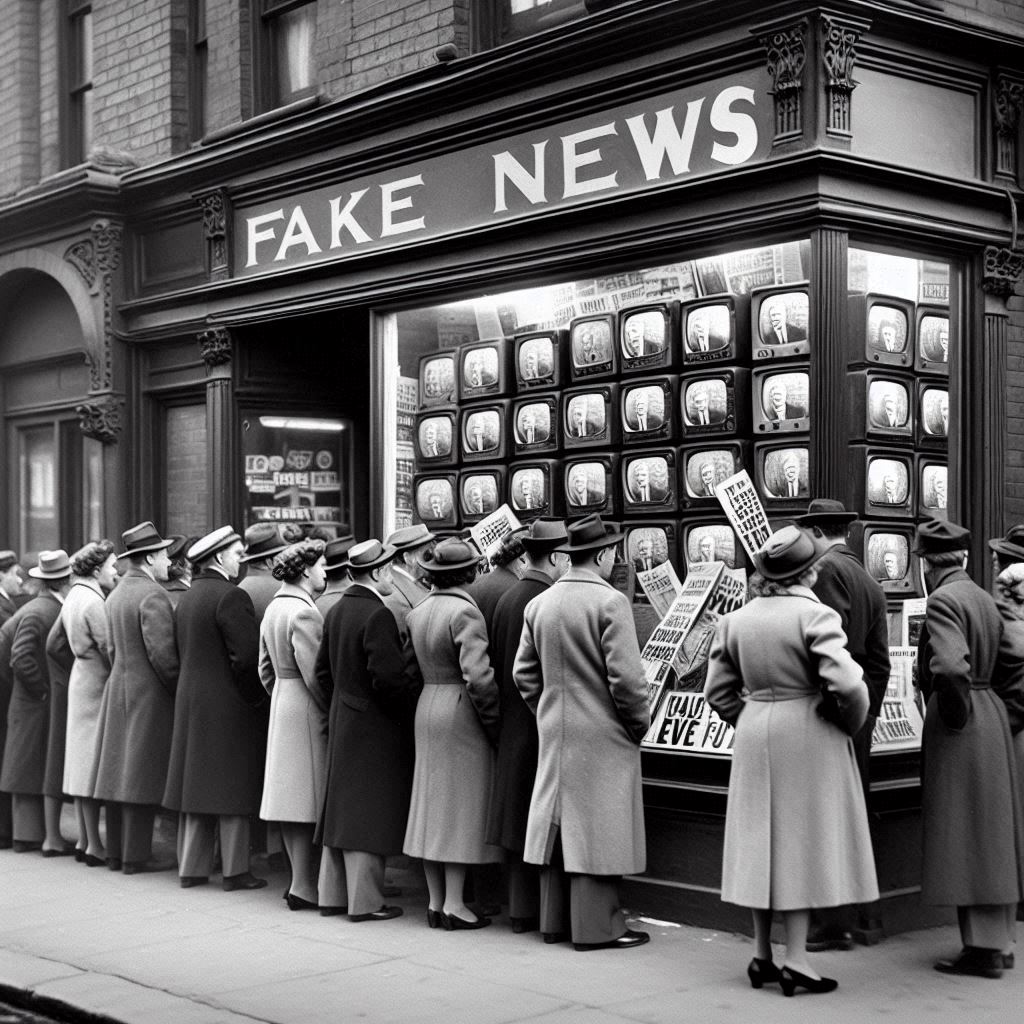
Many people today think America is more polarized than ever due to social media and the proliferation of fake news on the internet. But the country was just as polarized (if not more so) in the 1770s and 1860s when there were major wars fought between fellow citizens on American soil. Those were times before television and radio, when newspapers were the only form of media. The early American era was more akin to the present, with rival sources from each side of the political spectrum giving biased news to their bases. The difference then was political conflicts were more localized. Each town had multiple competing local newspapers, so political attention was more regional, as opposed to a national bipolar culture war between two diametrically opposed tribes. The advent of decentralized mass media on the internet allowed that.
The early radio and television eras of America, during the First and Second World Wars, were a brief period of time in the country’s history when there was relative peace between the political left and right, with their animosity instead directed outward. But, contrary to popular belief, this was not because there was a war and foreign enemy for them to unite against—it was actually the other way around. Massive media propaganda was needed to generate the will for Americans to want to join a foreign war that didn’t involve them. Before such media campaigns, most Americans preferred to not get involved and spent their time and energy battling domestic foes.
People are naturally inclined to care most about their personal lives and things that impact them directly. If you live in Ohio, your neighbor across the street with different politics affects you much more than a European across the globe with different politics, even if the European’s politics is far more different than your neighbor’s. It makes sense for American Democrats and Republicans to hate each other more than people from foreign countries, even supposed enemies, because political opponents within your own country have more of an effect on your daily life. The local matters more than the global.
It takes a proactive effort to convince someone to risk their life for strangers thousands of miles away on the other side of the planet. It is only because of the specific technological capacities of media in the early to mid-20th century that this was possible. Radio and television allowed news to be broadcast across the entire continent—but at the same time, TV and radio were also highly centralized with only a few channels. The government controlled the messages those networks released, ensuring they were all on the same page: pro-war propaganda.
People think there is more fake news today due to the internet—and admittedly there is a ton of fake news, more than ever before in history. But people are mistaken to believe that the news broadcasted in the past was less biased and always true. Or as someone on the internet once said, “If you think the news is fake, you should see history.”1 The news has always been full of lies and propaganda, but most people in the past never realized it because there were no alternative sources to critique those lies and reveal the truth in real time. Sure, the internet today is riddled with an influx of fake news, misinformation, disinformation, and propaganda, but buried within that, perhaps for the first time ever, is also the truth. For those who seek it, the truth is out there—you just need to learn where to look.
- Though I don’t remember the source of that quote, so maybe it’s fake. ↩︎
 T.Z. Barry
Yup. The American government hired Edward Bernays to do their public relations for WWII. Edward Bernay’s methods inspired the Nazi propaganda director, and his techniques allowed the Nazi’s propaganda to be so effective.
What’s ironic is that while Americans criticized the illicit tactics Germany used to control their people, America is the country where the German’s methods came from. And not only that, but the US government used the same propaganda techniques to convince citizens to join WWII.
We call the Nazi’s methods “evil” and “deception,” but our country has done the same thing for an even longer time. And yet we think we were and are better than them.