

In “E Unibus Pluram: Television and US Fiction,” David Foster Wallace’s brilliant 1990 essay1, he hypothesized that fiction writers (like himself and myself) are natural oglers or people-watchers. Writers used to have to observe people in the real world, in public, to get the material for their fiction. But fiction writers (like him and me) are often self-conscious types with social anxiety, which was why television was such a godsend for people like him. With TV, self-conscious writers could ogle and people-watch from the comfort of their own homes without the other people seeing them. In this sense, DFW argued, television is a form of voyeurism.
DFW saw the rise of television negatively impacting how people wrote fiction. Writers began to base their stories on people from television, not on people from real life. In other words, they wrote fiction based on fiction. Even when watching a reality show or documentary, those “characters” are still constructed—the reality show stars are aware they are being filmed, so they are performing. Reality TV is not the same as pure unfiltered reality.
This phenomenon of people viewing artificial realities in media accelerated massively with the advent of the internet. In 1990, DFW prophetically predicted how technology would naturally evolve television into more interactive forms of video such as YouTube, Snapchat, Instagram, and TikTok.
“The user-friendly microchip, which consolidates the activities of millions of transistors on one 49 [cents] wafer, and whose capacities will get even more attractive as controlled-electron conduction approaches the geodesic paradigm of efficiency, will allow receivers — TV sets — to do much of the image-processing that has hitherto been done ‘for’ the viewer by the broadcaster. In another happy development, transporting images through glass fibers rather than the EM spectrum will allow people’s TV sets to be hooked up with each other in a kind of interactive net instead of all feeding passively at the transmitting teat of a single broadcaster.”
– David Foster Wallace predicting YouTube/TikTok in 1990
DFW accurately predicted how “TV-sets” (or computer monitors) would be connected through the internet, but not even in his wildest imagination did he envision that such interconnected video-broadcasting devices would be on a pocket-sized phone with every human on the planet 24/7. At least you could escape from your television by going outside. Now the internet is everywhere.2
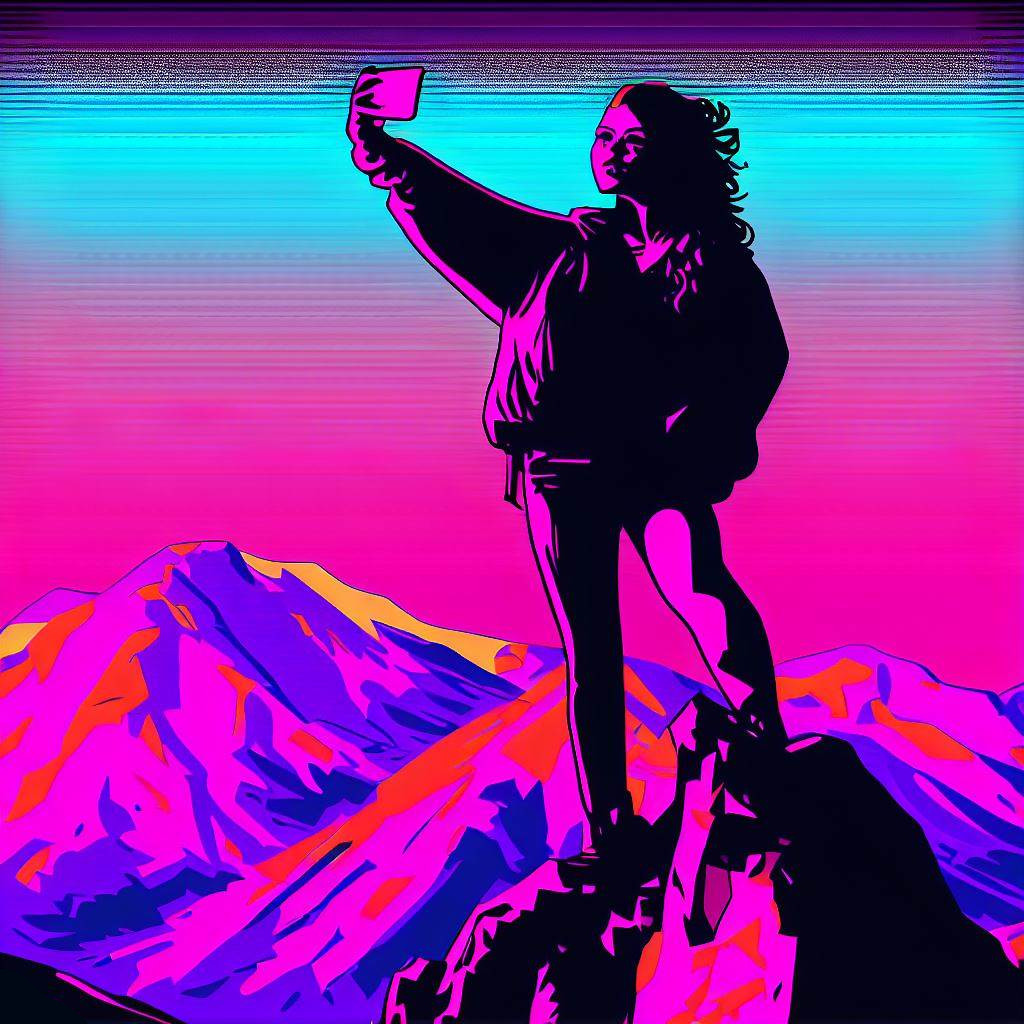
A common modern refrain states, “Twitter is not real life.” This is usually meant in the sense that the discourse taking place online is a small subset of the population not representative of the larger whole. But the refrain is also true in the sense that, even within that subset of the population, most people don’t really believe what they say online. They would never say those same things in the same way to someone’s face in real life. Everything people post on social media is a performance. The average person posting a selfie on Instagram is “acting” just as much as a TV star. They are carefully constructing the scene, the camera angle, their facial expression, the filter, and the caption. Social media is not real life.

Everyone in the world now has their own television camera with them 24/7. Every ogler has millions of people whom they can choose to voyeuristically watch at any given time, often live on YouTube, Twitch, or OnlyFans. Yet few internet videos capture genuine human moments. Twitch streamers and YouTubers are not their same perky enthusiastic selves when the cameras turn off. While broadcasting, they are “always on,” performing for the audience that they know is watching.3 There is a cliché of former child stars going crazy when they get older because they were not mentally equipped to deal with worldwide fame and attention at such a young age. But with social media, everyone in the world is essentially a child star, broadcasting to the entire world on the internet. What will happen when today’s young TikTok influencers come of age?4

Fiction at its best portrays truth. There is more truth in a Dostoevsky novel than most newspaper articles—or even scientific textbooks. News gets retracted and debunked, textbooks get updated and rewritten, but the truths about human nature portrayed in Crime and Punishment are eternal. Fyodor Dostoevsky5 was a student of human nature, as all great artists are. He studied real humans and conveyed the truths he observed through fictional characters in his novels. To be great, artists and writers today must do the same.
If fiction writers today base their characters on the “reality” of livestreamers and social media discourse, that is a false reality—it is simulacra. Yet most writers are basing their perception of reality through the filters of TV, the internet, and social media. Fiction is going deeper and deeper into simulations of simulations6, which is why so much modern fiction, whether written or filmed, is falling flat artistically—because it is not art. Art, even when surreal fantasy, portrays truth, even if symbolic or metaphorical. True art reveals the truth of human nature. But the “human nature” expressed online is rarely true—it is acting, a performance, a simulation of reality.
- Though long, I highly recommend reading it in full, free online here, and also included in Wallace’s 1997 book A Supposedly Fun Thing I’ll Never Do Again. ↩︎
- For now you can still leave your phone at home, but just wait until you have a Neuralink chip implanted in your head. ↩︎
- “Hey guys! Don’t forget to like and subscribe!” ↩︎
- “YouTuber burnout” is already a thing. ↩︎
- And David Foster Wallace. Though he watched TV himself, he was at least conscious of its negative effects and was able to incorporate that into Infinite Jest. ↩︎
- Not to mention AI-generated fiction based on fiction, which will soon become AI-generated fiction based on AI-generated fiction. Simulations all the way down. ↩︎
 T.Z. Barry