
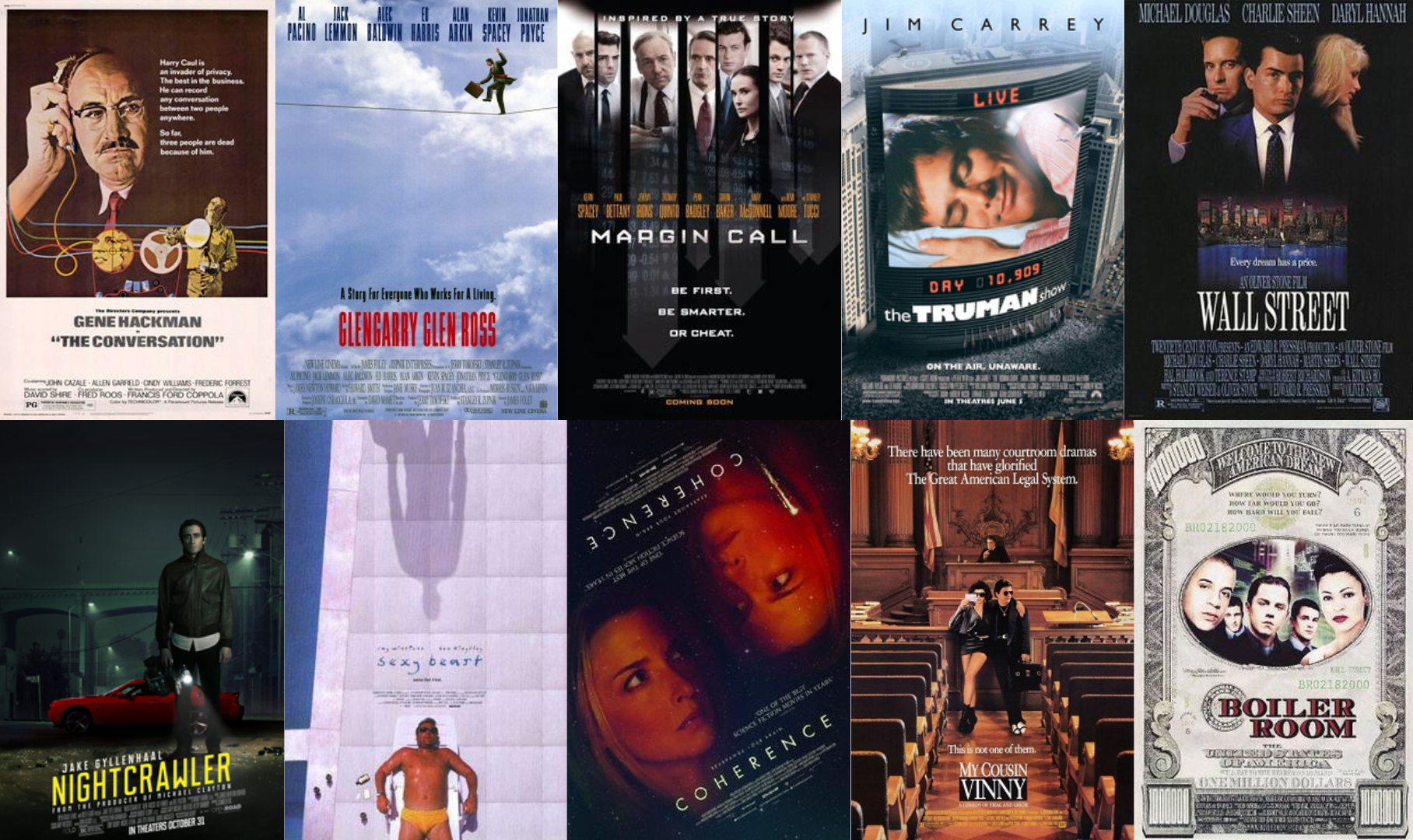
With 2025 winding down, it is time for my annual list of the best movies at least a decade old that I watched this past year. Once again, the list is somewhat random and arbitrary, based on the movies I happened to choose to watch (or re-watch) over the course of the past year. The films are sorted into five tiers and listed alphabetically within each tier. (In case you missed it, I made a separate list for the best horror movies I watched in 2025.)
Tier 1: Cinematic Masterpieces
The Conversation (1974) directed by Francis Ford Coppola
I saw this movie years ago when I first started studying screenwriting and decided to watch all the greatest films from history. I remember being blown away by The Conversation at the time, but over the years I had forgotten the plot details, so I had been planning to re-watch it. The recent passing of Gene Hackman propelled me to do so—and I feel the same way as the first time around—that it is an absolute cinematic masterpiece. As the title implies, The Conversation is built entirely around a conversation that Hackman’s character (a surveillance technician) records. A gripping noir plot follows, with twists and turns, but equally fascinating is the psychological study of Hackman’s character, Harry Caul—a lonely man who devotes his life to perfecting his craft of audio surveillance and wiretapping—but as a result, he feels great guilt for the repercussions of what his clients do with his tapes, and he lives in constant paranoia of who might be listening to him.
Glengarry Glen Ross (1992) directed by James Foley
I saw this movie once about a dozen years ago and liked it, but I liked it even more this second time around. There isn’t much plot, and there’s zero action, yet it is thoroughly engrossing. Based on a play by David Mamet, this movie is all about his fantastic dialogue, performed by great actors like Al Pacino, Jack Lemmon, Alec Baldwin, Ed Harris, and Kevin Spacey. Baldwin especially, in just one scene, steals the movie. It’s about a group of salesmen cold-calling leads, trying to sell real estate investments for commissions. It shows their desperation and the lengths they’ll go, lying, cheating, and stealing, to come out on top.
Margin Call (2011) directed by J.C. Chandor
I thought I had seen this movie when it first came out, but actually I had only read the script. I was studying screenwriting at the time and read the screenplay, which was quite good. I felt like I had already seen the movie after reading the script, so I had no urge to actually watch it. I’ve gotten deeply interested in the stock market recently, so I wanted to watch movies related to Wall Street (see more below). This film, about the 2008 financial crisis, was fantastic. It’s told in a thriller fashion, with the financial analysts discovering the impending subprime mortgage collapse. But they don’t get bogged down in the details at first, and instead just convey this sense that whatever is coming is going to be monumentally catastrophic. Towards the end, they reveal more of the financial specifics, but the movie works well for those who don’t understand economics, while also getting the details right to please those who do. It’s tough to label this movie with a specific genre (other than drama) because it has elements of a mystery thriller and dark comedy, but ultimately it may be best described as a “disaster movie.” There is this constant dread throughout the film of an impending disaster, but in this case it is not a natural disaster like a volcano erupting, asteroid striking, or ship sinking—rather, it is an economic collapse, the repercussions of which are just as disastrous (and still being felt).
The Truman Show (1998) directed by Peter Weir
This has long been one of my favorite movies of all time, but I had not seen it in years, so I wondered if it would still hold up. And it does. In many ways The Truman Show was ahead of its time, predicting the reality TV and livestreaming craze before it happened, making the film even more relevant today. The Truman Show is praised for presciently predicting reality TV culture—and rightfully so—except they got the negative effect backwards. Reality TV is not bad because it distorts reality for the people on the show, but because it distorts reality for the people who watch the show. Though I loved the film, I was surprised at how short it was. Not that it was too short—there was just a lot more they could have done with the premise. I prefer a leaner movie like this, that leaves you wanting more. Hollywood doesn’t make lean movies like this anymore. Today, The Truman Show would be a TV series with a mystery box premise that goes on and on for multiple seasons without ever really paying off. Modern filmmakers should take lessons from The Truman Show: that less can be more. Leave some things to the imagination and always have the audience craving more.
Tier 2: Great Films
Boiler Room (2000) directed by Ben Younger
I vaguely remember seeing this movie on DVD shortly after it came out, probably when I was a freshman in high school. It’s been over 20 years, so I didn’t remember it too well, nor did I totally understand it at the time. Boiler Room is about a bunch of cocky young stock brokers on Long Island running a pump-and-dump Ponzi scheme for penny stocks. It was refreshing to watch now, as it illustrates how different the culture was in the late 90s and early 2000s. (We need to go back!) Also I finally got the context of that Ben Affleck clip from the “Life Advice” segment on the Ryen Russillo podcast.
Coherence (2013) directed by James Ward Byrkit
I saw this movie when it first came out and enjoyed it, but after a dozen years I forgot most of the details, so I wanted to watch it again. It is a mind-bending sci-fi thriller about a group of friends at a dinner party while a comet passes in the sky overhead. It causes some quantum interference, so that whenever any of them leave the house, they encounter multiple versions of themselves from alternate timelines. When they return to the house, it is another house from an alt timeline. It is impressive how they were able to make such a compelling film on such a low budget, with it basically taking place entirely inside one house. This was like a modern Twilight Zone episode, and much better than the actual new Twilight Zone series with Jordan Peele.
Kill Me Again (1989) directed by John Dahl
A classic film noir from the late 80s, with Val Kilmer playing a private detective, Michael Madsen playing a psychopathic criminal, lots of double-crosses, and a vicious femme fatale.
My Cousin Vinny (1992) directed by Jonathan Lynn
I’d never seen this classic comedy before. The story is a bit absurd at times, about two college-aged guys from Brooklyn on a road trip through Alabama who get wrongfully arrested for murder. Joe Pesci plays one of the boy’s “cousin Vinny,” a lawyer from Brooklyn who defends them. Pesci’s comedic performance and his girlfriend Mona Lisa Vito (played by Marisa Tomei) are what make the movie great.
Nightcrawler (2014) directed by Dan Gilroy
I saw this movie when it first came out and loved it. Jake Gyllenhaal plays a psychotic loner in Los Angeles who films bloody crime scenes and highway accidents to sell to TV news shows. It’s a great script with a great performance by Jake, but the directing felt kind of pedestrian—like a TV show (not bad, just average). Dan Gilroy is a veteran writer (and the script is great), but this was his first attempt at directing. The musical score in particular felt bland and generic. Those are slight nitpicks for a movie I still really liked, but with better cinematography and music, this film could have been elevated to a tier-one masterpiece. Imagine this script directed by David Fincher…
Payback (1999) directed by Brian Helgeland
This is an anti “Save the Cat” movie. The famous screenwriting book by Blake Snyder says your protagonist should have a moment early on where they do something noble (such as saving a cat), so that the audience immediately likes them and roots for them to succeed. Mel Gibson’s character “Porter” does the opposite, committing ruthless acts that make you detest him early on, such as stealing from the homeless, not tipping his waitress, and beating a woman. Porter is a bad guy—and yet, I still found myself rooting for him in his quest for revenge. He was a thief who was double-crossed by his partner, shot by his wife, and left for dead. Even though Porter is bad, you can’t help but like him because the people he’s going against are so much worse. He is smart, confident, competent, and despite being a criminal, has a code of honor.
Sexy Beast (2000) directed by Jonathan Glazer
I’d been wanting to see this for some time, the first film by director Jonathan Glazer (who directed Birth and Under the Skin). It’s technically a heist movie, but unlike any other heist movie I’ve ever seen. The film features great writing and acting performances, especially by Ben Kingsley, playing a psychopathic British gangster who even the other criminals fear. As with all of Glazer’s films, it is not told in traditional fashion and has a unique style. Glazer’s aesthetics as a director elevates the material, which is what was missing from Nightcrawler.
Wall Street (1987) directed by Oliver Stone
This was my first time seeing this classic movie about stock traders on Wall Street. It has a great cast, highlighted by Michael Douglas as Gordon Gekko and his famous “greed is good” speech, which could have come out of an Ayn Rand novel. Overall I enjoyed the movie, especially as a snapshot of life in the late 80s (including the Zack Morris cell phone), but I think it would have been more interesting with a darker ending where Gekko actually got away with it in the end.
Tier 3: Just Good
Arbitrage (2012) directed by Nicholas Jarecki
A thriller about a Bernie Madoff-type Wall Street hedge fund billionaire whose empire begins to crumble around him. It was well-made but nothing original.
The Beach (2000) directed by Danny Boyle
I saw this movie years ago and remembered thinking it was good, not great—and I still feel the same way. Leonardo DiCaprio gives a compelling performance as a young American backpacking through Thailand, looking for adventure. Gen-Xers in the 90s seemed to be the last generation who actually did things like that. It was before cell phones, when people could truly be off the grid. His only connection to the rest of the world was calling home on a pay phone or going to an internet cafe to check his email on a neon iMac. The movie was based on a novel by Alex Garland, and there is some Garland-esque weirdness, but it’s not as great as his later work like Ex Machina, Annihilation, and Devs.
Capricorn One (1977) directed by Peter Hyams
This movie has an interesting premise of NASA faking a manned mission to Mars by sending an empty ship because they don’t have the technology to be able to do it successfully. The astronauts are coerced into filming themselves on a secret studio set designed to look like Mars. But on the way back to Earth, the ship explodes, so to maintain the hoax, NASA must kill the astronauts. Meanwhile, a journalist is trying to uncover the truth. The conspiracy aspect was very interesting, but that encompassed only the first quarter of the film. The rest is just an extended chase scene, as the astronauts escape on a plane and crash-land in the desert where they struggle to survive. Not enough of the movie was spent on the conspiracy aspect; instead it became an ordinary chase movie. Though there is an amazing action sequence at the end featuring two helicopters chasing a crop-duster airplane through a narrow canyon. More interesting than the actual ending is considering what happens after the credits. [Spoiler Alert] Will the surviving astronaut reveal the truth, or maintain the hoax with some cover story concocted by NASA? An entire other (better) movie could have been made about that. (And oh by the way, if this movie didn’t already sound crazy enough, one of the astronauts was played by O.J. Simpson.)
The Dangerous Lives of Altar Boys (2002) directed by Peter Care
I had never even heard of this movie until recently looking at Kieran Culkin’s filmography (one of my favorite actors). It’s a coming-of-age story about Catholic school boys set in the 1970s. I completely missed this film when it first came out in 2002, despite theoretically being the target demographic: a Catholic school boy coming of age. Though I think I appreciate the film more now, nostalgically looking back on my childhood, than I would have while in the midst of it.
Death Wish (1974) directed by Michael Winner
A bleeding heart liberal (played by Charles Bronson) becomes a vigilante after his wife and daughter were murdered and raped. The acting and writing are not that great, but it’s an entertaining thriller and interesting as an examination of social commentary at the time.
Empire Records (1995) directed by Allan Moyle
An ensemble movie about the people who work at a music record store (when those still existed). It’s not a great story, but it’s fascinating as a time capsule of life and culture in the mid-1990s. It’s ironic that the entire plot is about people trying to save their independent music store from the big bad corporate chain looking to replace it—because just a couple years after this, Napster would come along to replace them all. I love Spotify, but I also miss going to Tower Records and browsing through CDs and listening to samples on headphones in the aisles. What made Empire Records (and real music stores like it) special was having a physical place where people came to meet and talk about music. Vinyl record stores still exist today, but only hipsters and collectors go there. The difference in the 90s was everyone went to the record store—it was the only way to access new music (aside from the radio).
The Firm (1993) directed by Sydney Pollack
A solid legal thriller starring Tom Cruise, with an impressive cast, great acting, and witty dialogue. The mystery plot is full of twists and turns, though it got a bit convoluted toward the end. If you’re a corrupt law firm, then maybe instead of aggressively courting the top law student from Harvard, you target lesser lawyers who you know will play ball.
The Gambler (2014) directed by Rupert Wyatt
This had all the elements to be a great movie but just didn’t quite come together. Mark Wahlberg plays an author/college professor who is also a degenerate gambler. Like seriously degenerate, as in whenever he has money, he bets all of it on a single blackjack hand (or spin of the roulette wheel). If he wins, he immediately doubles down and does it again until he loses everything. Then he borrows money from loan sharks to gamble some more, and he must figure out how to pay them all back without being killed. Missing from the film was a deeper psychological insight into how and why he gambled like that.
To Build a Fire (1969) directed by David Cobham
Based on the Jack London story and narrated by Orson Welles, a man and his husky dog try to survive in the wilderness during winter temperatures of -50 degrees. It’s an ice-cold atmosphere but a heart-warming story of a man and his dog.
Tier 4: Flawed But Entertaining
Beavis and Butt-Head Do America (1996) directed by Geoffrey Johnson, Mike Judge, Mike de Seve
I never saw the Beavis and Butt-Head television show on MTV, as I was a bit too young when it came out (1993), but I’m a fan of Mike Judge’s later work like Office Space and Silicon Valley, plus I’m trying to catch up on the pop culture I missed from the 90s. There was probably an age between then and now when I would have loved Beavis and Butt-Head, but alas, that time has passed.
The Visit (2015) directed by Michael Madsen
A documentary about how humanity would react to first contact with aliens. I had high expectations after the director’s last documentary, plus this was interesting subject matter, but while there were some creative filmmaking techniques, the interviews with the myriad government bureaucrats were dull (as would be expected with government bureaucrats).
Wall Street: Money Never Sleeps (2010) by Oliver Stone
A modern sequel to Wall Street could have been worthwhile, but this didn’t quite hit the mark. There were some good moments but also some cringe moments.
Tier 5: Disappointing (Don’t Bother)
Hurlyburly (1998) directed by Anthony Drazan
I generally think it’s silly to “cancel” old movies because they are problematic to today’s cultural standards, but this movie was offensive even to me. I can’t believe this was actually made. It’s a true relic of the late 90s. Anyone who saw this in ‘98 could not have been surprised by the later allegations made against Kevin Spacey.
What Lies Beneath (2000) directed by Robert Zemeckis
This is technically a ghost story, but I wouldn’t classify it as horror, as it’s not very scary and is more of a domestic drama. The pace is very slow in the beginning, and the running time is way too long. The cast and director are A-list caliber, but the script is like a Lifetime movie. What a waste of money and talent.
 T.Z. Barry