
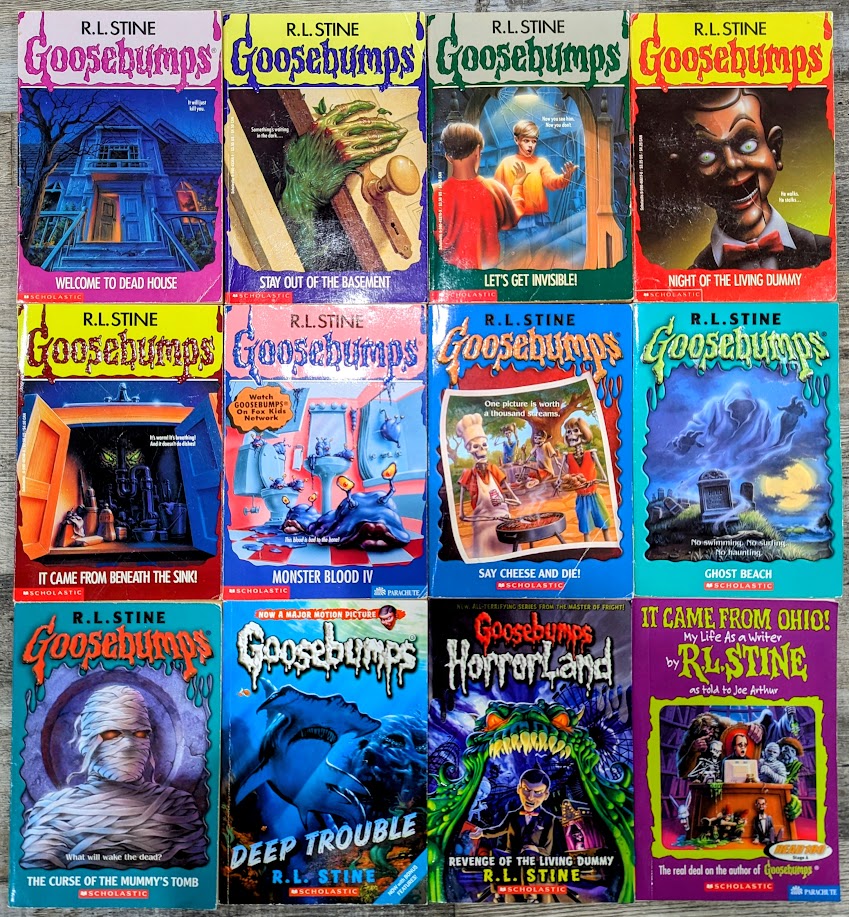
One of my favorite hobbies is going to used book sales and finding rare gems for low prices. It’s not just about paying less; it is more fun and fulfilling to find books in the wild rather than simply ordering a copy on Amazon. It’s akin to treasure-hunting—you never know what you might find. At one such sale, I acquired a collection of Goosebumps books for $0.25 each.
Written by R.L. Stine in the 1990s, Goosebumps was a series of horror books aimed at kids in the “middle grade” level. Goosebumps books were massively popular bestsellers in the 90s and were adapted into a television show, and the franchise remains popular today, with Stine still writing more books, Hollywood movie adaptations, and a rebooted TV series.
Despite being in the target age range at the time, I never read Goosebumps as a kid—though I was always curious about the books because of their evocative covers. Last year, while working on my re-write of Trick or Zombie Treat (a horror book about kids in the 1990s, very much in the vein of Goosebumps), I was feeling nostalgic for the 90s, the formative decade of my childhood, so I decided to see if the Goosebumps books were worth the hype (or at least worth a quarter).
The first Goosebumps book I read was Say Cheese and Die!, the fourth book in the series, originally published in 1992. I wish I had read this book when I was younger because I’m sure I would have loved it and fallen in love with reading sooner. If only my school allowed us to read Goosebumps for our summer reading list…
Say Cheese and Die! has a fantastic premise: a group of children find a polaroid camera that takes photos of horrific events that will happen in the future. It’s like a Twilight Zone episode with kids. R.L. Stine writes in such an entertaining fast-paced style that keeps you hooked. He is a master of the cliff-hanger1, and his plots are full of twists. The chapters are short, and the books themselves are novella-length (between 20,000 and 25,000 words), my favorite length for a story. You could easily read an entire Goosebumps book in a day.
A part of the reason I avoided reading the Goosebumps books as a kid (aside from the fact that I didn’t read for leisure at all back then) was that I didn’t like horror—or at least I didn’t think I liked horror. Certainly not visceral horror, gore, and movies that deliberately tried to scare you through shock and awe. I was easily frightened as a child, and horror movies gave me nightmares. Even a horror comedy like Scream haunted me for years when I saw it as a ten-year-old.
With Say Cheese and Die! in particular, the cover featuring a family of skeletons would have been a turn-off to me as a child. But when you read the book, it does not contain overt visceral horror like you might assume from its cover and title. The horror in the story is more cerebral, about the dread of possessing this camera that could seemingly cause terrible events to happen in the future. Like the Twilight Zone, it blends science fiction with horror, a favorite combination of mine. I didn’t like being scared as a kid, but I liked being spooked—and the vibe of Goosebumps is spooky, not scary. Which is exactly the same type of horror vibe I was going for with Trick or Zombie Treat.
The image on the cover of Say Cheese and Die! comes from a dream the protagonist boy had, a nightmare imagining that the camera would take pictures of his family as skeletons, meaning they would all die. However, no skeletons actually appear in the story (it was just a dream). In this respect, the cover is misleading.2 Perhaps it was a marketing gimmick to make the book seem scarier than it was, which might have drawn some readers looking for scares—but it backfired for other readers, like younger me. The cover would have turned me off when I was ten years old, yet I would have loved the book if I had read it then.3 I might have gotten hooked onto the rest of the Goosebumps books, which would have led me to reading other horror and science fiction novels. It might have led me to writing stories of my own sooner as well.
I don’t know that writing fiction earlier would have changed my life all that much, considering I still got there eventually. But if I had read more books as a child, it would have accelerated my reading and writing journey, so that I would be a better writer today. Becoming a great writer requires reading and writing. The more you do of each, the better you become at each. So had I gotten a head start earlier, it would only make me a better writer today. I would have reached my Gladwellian 10,000 hours sooner.
Due to my late start, I feel like I’m playing catch-up in terms of reading. I’m not as well-read as I would like to be, because I didn’t start reading (outside of school assignments)4 until after college. Better late than never, I suppose. Then again, it’s also a unique experience to read Goosebumps books for the first time now. They serve as a time capsule of the 1990s, a time period I am especially nostalgic for. Reading Goosebumps today adds nostalgia for my own childhood in the 90s. I can view the books as a period piece set in the 90s, rather than just being contemporary fiction released in the 90s. This is also opposed to contemporary books being released today that are purposely nostalgic period pieces set in the 1990s, like my book, Trick or Zombie Treat.
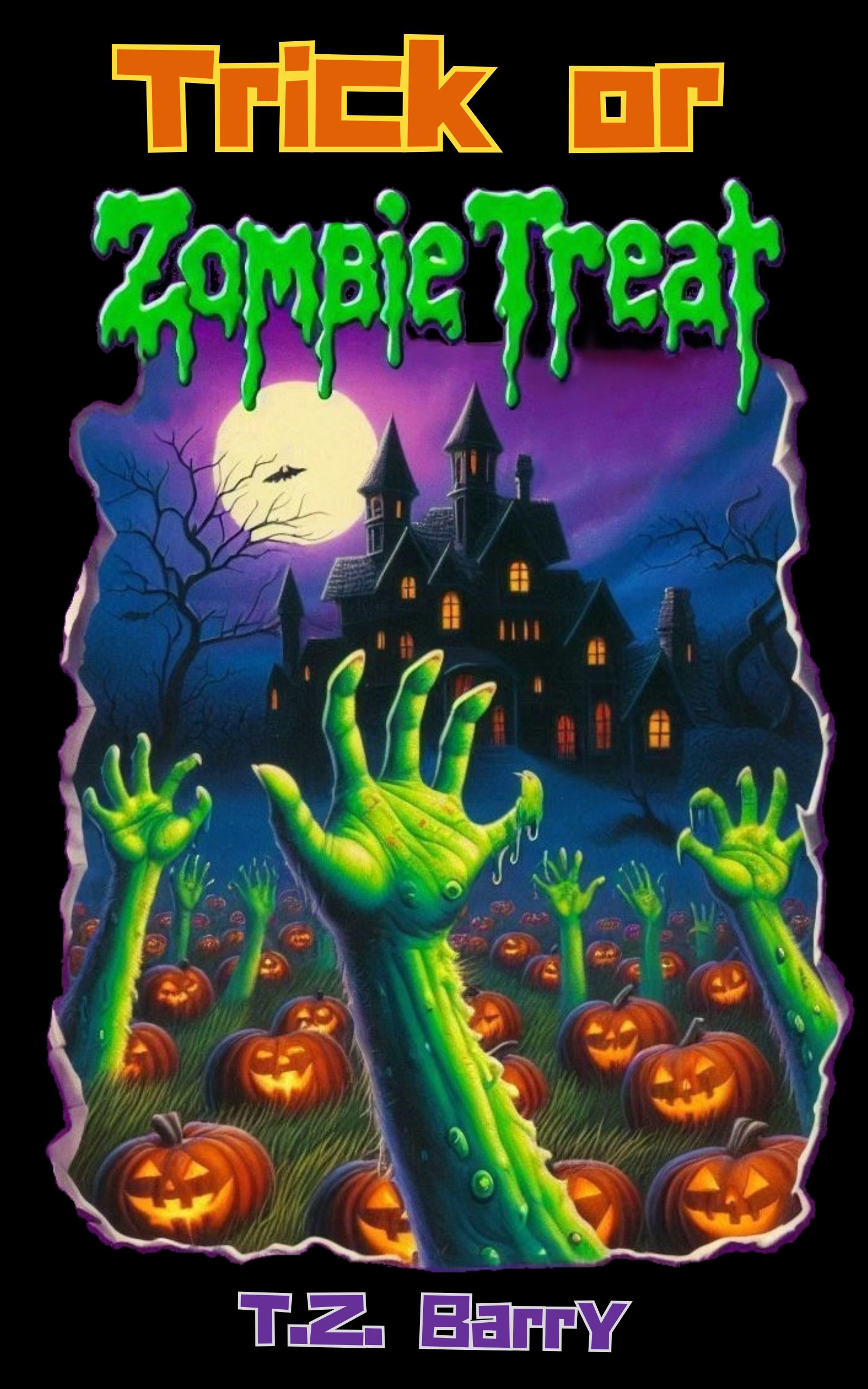
The second edition of Trick or Zombie Treat re-published last year featured a new cover inspired by the classic Goosebumps cover art created by Tim Jacobus.5 It is remarkable how similar in style and tone my book is to Goosebumps despite me never having read any of R.L. Stine’s books before writing it. (I don’t think I even saw the TV show as a kid.) Both feature short chapters with cliffhangers intended to promote a fast-paced reading experience. Though Stine’s books are shorter, in the novella length, whereas TZT is a full novel, triple the length of most Goosebumps books, at 63,000 words (though I hope it is still a quick read).
The second Goosebumps book I read was Ghost Beach, published in 1994. It is more of a classic ghost story—but with several great twists, which I wouldn’t be surprised to have been an inspiration for M. Night Shyamalan when writing The Sixth Sense five years later in 1999. I plan to read and collect more of the classic Goosebumps books, and write more of my own nostalgic horror stories set in the 1990s. I have great love for that decade and wish society would return to embracing the culture of that era. For now, the best I can do is go back in time through stories—and hope, perhaps, that someday my fiction influences reality.
- And twist ending. ↩︎
- I later learned that the art for the cover was created independently of the book, so R.L. Stine had to add the dream sequence later for it to fit the story. ↩︎
- Then again, there were likely countless more young readers who were drawn to that book precisely because of its cover. ↩︎
- Which I often didn’t read in full either. ↩︎
- By the way, the new Goosebumps cover designs (as seen on Deep Trouble in the image above) are so much worse than the originals. ↩︎
 T.Z. Barry