
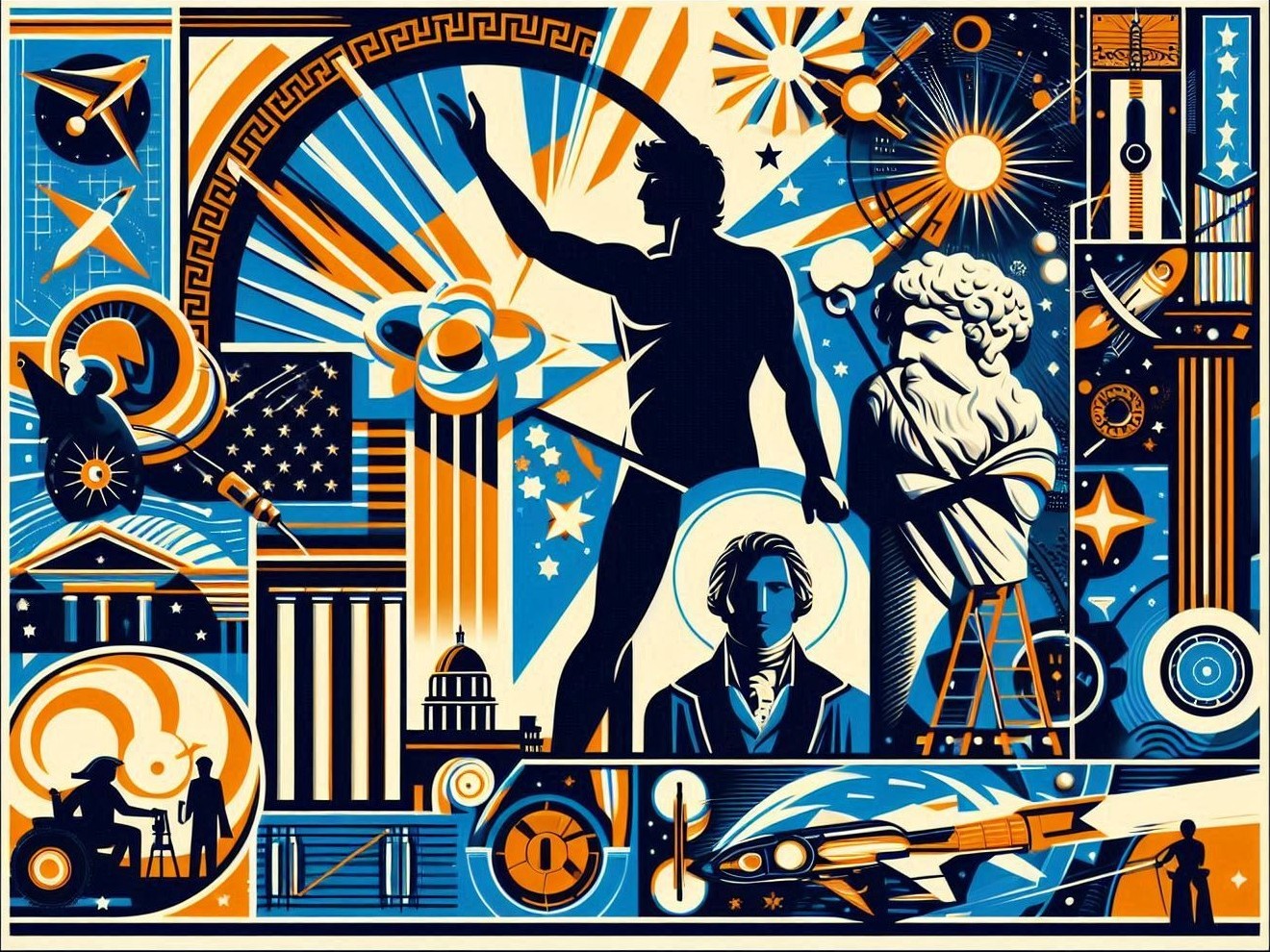
Every society is built on myths. Myths are stories and legends about the history of that society. Those myths shape the culture in the present. Societal elites and nobles with money and power propagate myths that they want the culture to adopt. The elites create (or fund the creation of) stories to mythologize themselves to maintain and increase their wealth and power in the future.
Millennia ago, these myths were told orally by bards, poets, and musicians who were commissioned by the elites. Scrolls and paper were rare and expensive, so they commissioned writers and painters to create and propagate their myths. When the printing press was invented, it disrupted the elites’ ability to control the culture with myths exclusively of their own making. Hence someone like Martin Luther could create new myths and was able to spread them widely. This resulted in a fracturing of culture through the Protestant Reformation and the religious wars that followed.
Eventually new myths were created to unite various denominations of Christians in the United States. These were the myths of the Founding Fathers: myths of freedom, liberty, and democracy. The Founding Fathers were mythologized through the storytelling methods of their day, which were pamphlets, newspapers, public speeches, and plays.
A century later, the radio was invented, presenting a new way to create and transmit myths. Leaders like Hitler, Stalin, and FDR used radio broadcasts to rise to power, transmitting their voices (and their myths of fascism, communism, and democracy) to millions of people at the same time. Mass communication of human speech on that scale was not possible before.
After radio came motion pictures. Television and movies were a monumental tool for elites to spread their preferred mythology. Film is the ultimate method of propaganda because of its audio-visual capacity—movies combine all other artistic mediums. But because of the capital needed to create movies, only those elites who already had wealth and power could afford to use TV and movies to create the myths that shaped the culture.
As a result, entrenched elites were able to keep a hold of their wealth and power and prevent counter-cultures from spreading new myths that could change the culture at large. They could not allow new myths to spread that might allow counter-elites to rise to power. The high cost of film production was a natural gatekeeping mechanism that allowed only those elites who already had wealth and power to finance new movies. That combined with the visceral power of the audiovisual medium made TV/movies the ultimate propaganda technique for the elites to maintain and expand their power through myth.
Myths shape culture, but technology shapes myths. Technology can either centralize mythmaking to a few elites, or decentralize mythmaking to the masses. When mythmaking is centralized, it allows those with power to infuse their myths with propaganda that reinforces their hold on power. But when mythmaking is decentralized, myths built on a foundation of truth can spread and topple those in power.
The invention of the internet facilitated vast decentralization of culture, causing a societal disruption akin to the printing press—yet more significant. We are currently in a fracturing of culture even greater than the Protestant Reformation, the results of which remain to be seen. On the internet, thousands of different subcultures are currently creating their own myths, which is causing chaos and disharmony throughout society. It is too soon to predict the ultimate consequences of this and where it will lead. But eventually a new myth must arise to create a new culture that brings everyone together again.
A new collection of elites will need to create new myths to form a new culture that reunites society. They could use generative AI to bypass the currently entrenched gatekeepers to make new movies and video games (or an as-yet invented future artistic medium)—create art that will change the culture. Or else the continued fracturing will accelerate civilization into oblivion.
 T.Z. Barry