

On April 8, 2024 in Burlington, Vermont I witnessed my first total solar eclipse. The moment of totality in which the moon covered the sun was the most awe-inspiring act of nature I have ever seen. No photograph or video can do it justice. Words fail to convey the experience. There is no comparison to seeing a total eclipse in person with your own eyes. It is an unforgettable sight every human being should see at least once in their lives.
The last total solar eclipse visible in the United States was in 2017. I was not in the path of totality, and I couldn’t get a pair of glasses, so I only saw the second-hand effects of the partial eclipse. I watched videos of totality, which looked impressive, and I heard accounts of people saying how transcendent it was, but there was a disconnect. It was like hearing somebody else talk about their dreams. The events in a dream may be astounding, but it doesn’t matter to anyone but the dreamer. Likewise, you can see videos of a total eclipse and hear people describe what they saw, but it will never matter as much to those who witnessed it firsthand. Regardless, I will attempt to describe my experience that day.
The partial eclipse began around 2:17 PM. I put on my special cardboard glasses to look at the sun: a small yellow/orange orb in the sky.1 A small black knob appeared in the bottom-right corner of the sun as the moon began to pass before it. My reaction was “That’s kind of interesting,” but the sun appeared so small and distant through the glasses. It felt no different than seeing pictures or video of the same thing.
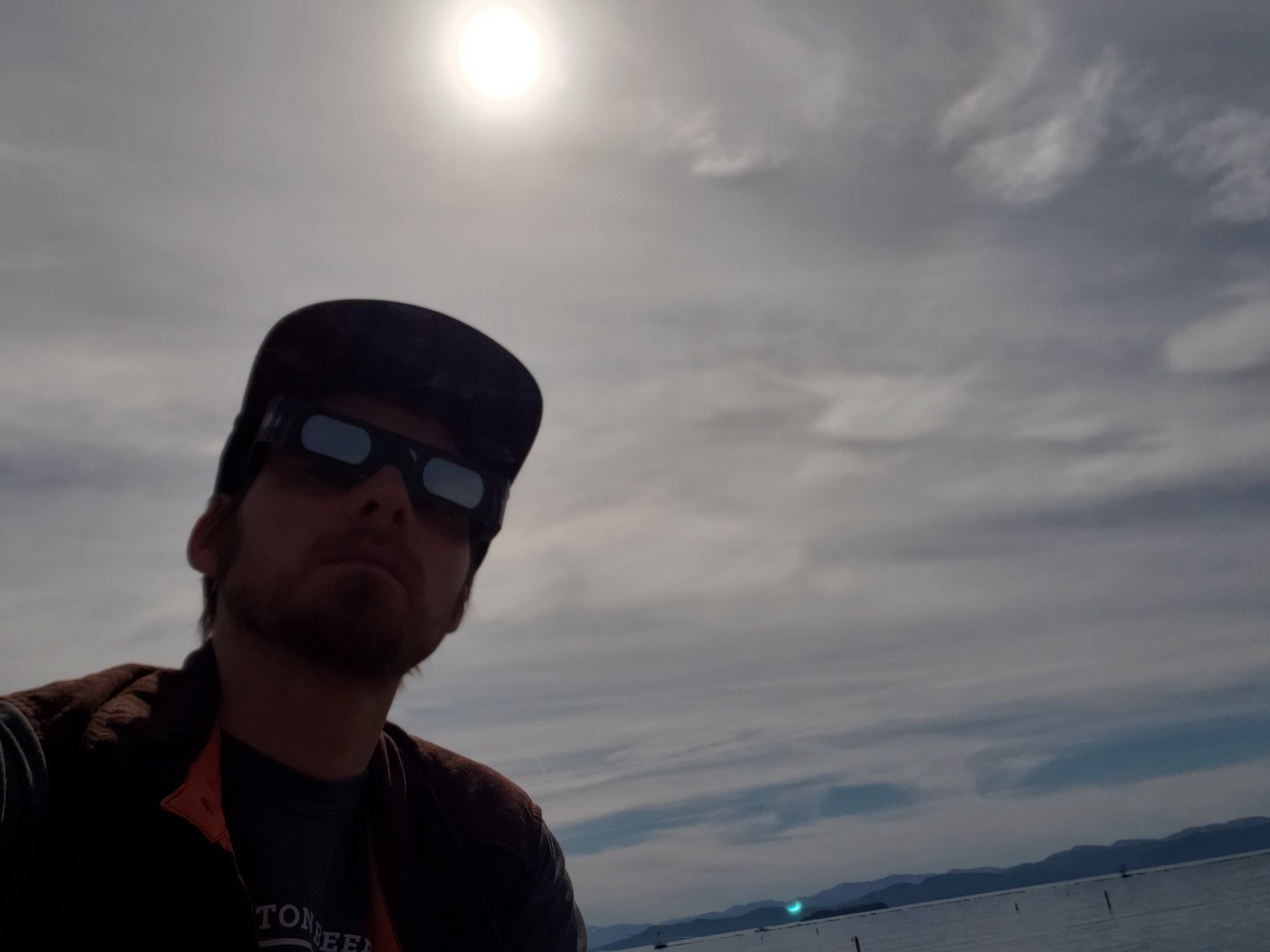
It would be about an hour until the total eclipse, so I didn’t spend that entire time staring at the sun. I’d periodically put my glasses on and look up to watch as the moon gradually moved further up and to the left, blocking more and more of the sun. It began to look like a crescent, then later a half-moon. Again, this looked interesting, but not particularly remarkable, since, as I said, it looked like a crescent moon, something I’d seen thousands of times before.
At the start of the partial eclipse, I was up by our apartment and my sister’s house, but as it got closer to the time of totality, I wanted to go down by the lake (Lake Champlain) to get a more picturesque view. So I ran down five blocks, pausing occasionally to look up at the sun as less and less of it was visible, to the waterfront where a large crowd of thousands had gathered to watch. I found a spot to sit on the rocks, right along the shore of the lake, and waited. It was about ten minutes until totality.
I used the time to snap some pictures on my phone, while constantly flipping on and off my glasses to check the sun—or what little was left of it. A couple minutes before totality, just a sliver of the sun was visible, yet it still provided plenty of blinding light. Though I did start to notice it becoming cooler and darker in the atmosphere around me. What had been a warm sunny day around 60 degrees, soon became overcast and 50.
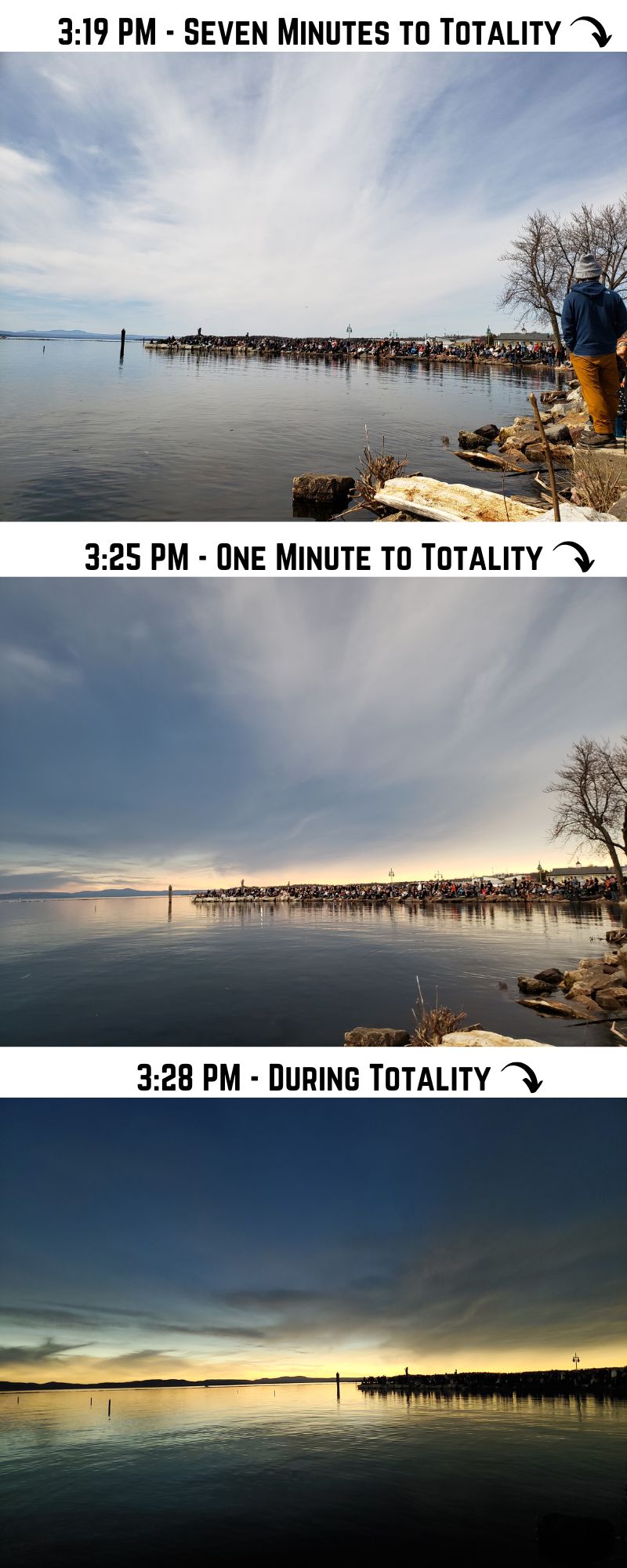
With a flash of the “diamond ring” atop the moon, totality was finally upon us. I took off my glasses to look at the sun—or the moon blocking the sun—with my bare eyes.2 My initial thought was “Whoa.” I was in stunned shock at what I was seeing, as I had never seen anything remotely like it before. The eclipse looked much larger and closer than it appeared through the glasses—and than it does in any of the photos I took, which is why you must see a total eclipse in person to get a true sense of what it is like.
The sky, which was bright and sunny just moments before, turned to a late-dusk hue with a beautiful orange/purple sunset 360-degrees in every direction. Stars and planets became visible in the sky. Birds started flying sporadically over the lake. The crowd of thousands around me gasped in silence as we all tried to make sense of the seemingly impossible spectacle before us. Whereas viewing a partial eclipse through your glasses is an intellectual exercise, seeing a total eclipse with your bare eyes is a spiritual experience.3 The collective silence eventually broke with some cheers and “oohs and awes” as people (including myself) took out their phones to take pictures.
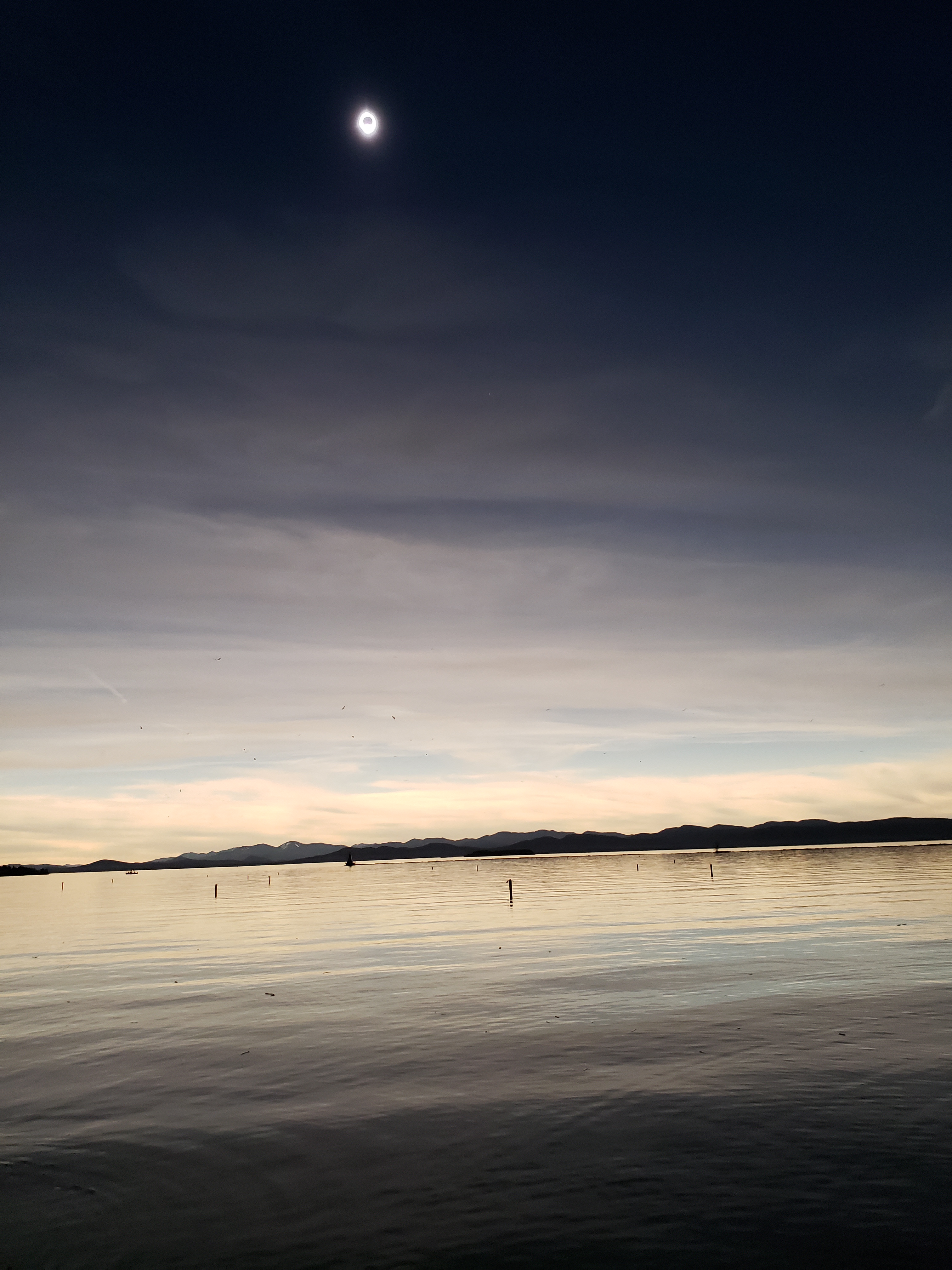
Knowing that totality would only last three minutes, I felt immense pressure, wanting to make the most of the short time. I wanted to see the effects of the eclipse all around me and take some photos and videos to capture the moment, but I spent most of the time of totality looking at the eclipse itself. It was simply jaw-dropping. The moon appears like a dark orb in the sky with a thin white corona of light around it.4 Words fail to convey what seeing a total solar eclipse truly feels like, but the best word to describe the sight is “surreal.” It looks literally incredible, as in beyond credibility. Something like this can’t really happen—not in real life—only in dreams and movies.
The fact that photographic technology is unable to reproduce the view of a total solar eclipse precisely as it appears to the human eye only adds to the magic of the moment. I took plenty of photos, and some came out quite pretty, but they look nothing like what I actually saw in the sky that day. The white halo appears much bigger and brighter in pictures, but IRL the moon itself looked larger and the corona around it was just a thin sliver of light. I’ve been revisiting my photos and tons of other people’s, and while many look fantastic, none look quite like what I actually saw—which makes what I actually saw all the more valuable.
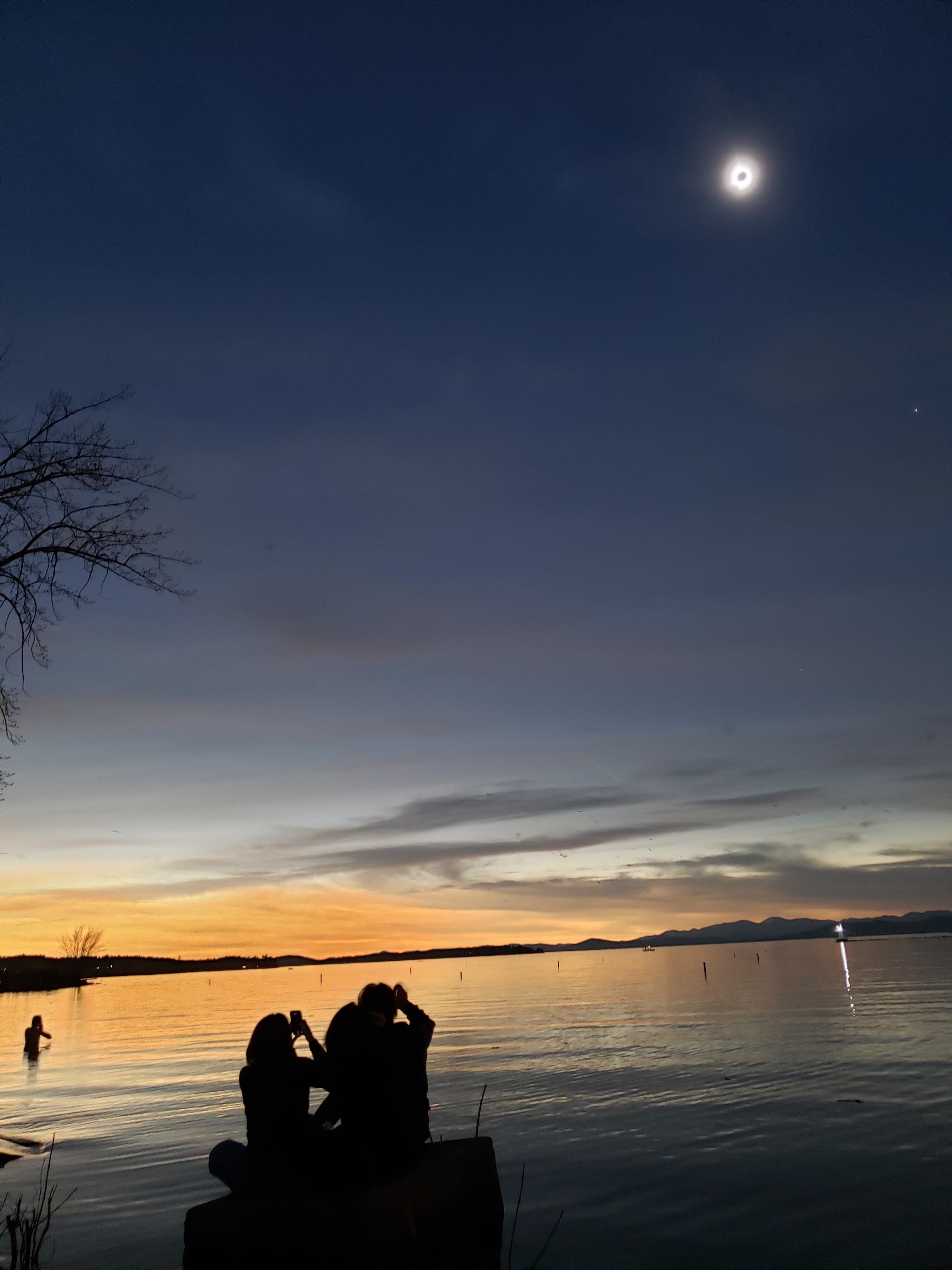
We are in the age of the internet, smartphones, mass surveillance, and on-demand entertainment. Everything in the world is recorded and instantly available to view on your screen—including the total solar eclipse of 2024—except it’s not the same thing. You can see thousands of pictures and videos of the eclipse from every angle, but you had to physically be there to truly see it and understand how it felt. The internet is not real life; the simulation is not the original.
I’ve written before about the oddities of our moon in my review of the book Who Built the Moon. What is most curious about the moon is that it just so happens to be 400-times smaller than the sun and 400-times closer than the sun, so the moon appears the same size as the sun in the sky when viewed from Earth. This is the only reason total eclipses are possible. If the moon or sun were any bigger or smaller, or closer or farther, total eclipses would not happen on Earth. This seems like such an extraordinarily rare coincidence that it can’t possibly be a coincidence. Witnessing the wonder of a total solar eclipse in person reiterated this intuition in me. It can’t all be mere chance; the odds are too astronomical.
Of the hundreds of billions of stars visible in the Milky Way galaxy, no other solar system is arranged in such a way to make total eclipses visible. Other planets have eclipses, of course, but not the same kind of “total eclipse” where the moon (or other planet) is the same size as the sun from the perspective of the third planetary body. The other planet/moon is either too big or too small to create the same effect of totality. Yet the one planet with lifeforms intelligent and conscious enough to understand and appreciate total eclipses just so happens to be the only planet where such eclipses occur. It almost seems like our solar system was designed in such a way to create total eclipses, perhaps to remind humans how special Earth truly is.
A total eclipse could happen on an alien planet, devoid of life or any conscious beings to observe it. In fact, by sheer mathematical probability, it would be more likely for a total eclipse to happen on one of the trillions of other planets in the galaxy that, so far as we know, are completely lifeless. But no. Instead the only total solar eclipse in the galaxy (that we know of) happens on the one planet with intelligent life and conscious beings able to observe the event and recognize its significance and beauty. The odds of that seem just as rare as the odds of intelligent life itself. One can’t help but wonder if the two phenomena—human beings and total eclipses—are somehow linked.
It would be remiss if I didn’t mention how and why I was in Vermont to see the eclipse, since I currently live in New York, five hours south of the path of totality.5 One of my sisters lives in Burlington and she had a baby last October, so my parents have been renting an apartment nearby to visit and babysit, so I was able to stay there that day. I bring this up to tie these two events together because the birth of my first nephew and witnessing my first total solar eclipse, both occurring in Burlington VT, produced similar feelings in me: a profound sense of awe. Both events felt like miracles of nature.
My sister and her husband created something out of nothing, and now a child is here, growing into a conscious intelligent being. Just as the universe was seemingly created out of nothing, and now Earth is here—and the sun and the moon—and life that evolved into humans. The total eclipses that our solar system periodically produces serve as a visible reminder to all who see them that life is not random and meaningless. If it was, how could something as improbable as this just “coincidentally” happen?
After the eclipse, I imagined what primitive humans who knew nothing of astronomy would have thought upon seeing the sun suddenly turn to black. It is an event that has spawned myths and inspired religions throughout human history. Humans back then must have believed the world was about to end. Those brief minutes of totality would have been the most terrifying of their lives. But then the sun came back, and everything seemingly returned to normal. A total solar eclipse mimics a near-death experience. When you die but then come back to life, it permanently shifts your perspective. You realize life is precious, so make the most of it while you can.
The three minutes of totality seemed to last so long but at the same time pass too quick. I took some photos but also wanted to soak up as much time as I could simply staring at the eclipse with my own eyes, not through the filter of a screen. I wish I could have had more time to study and dissect the scene, imprint every aspect of it to memory, but the eclipse revealed another truth about life: as special as it may be, it does not last forever. Life is short, even if you live a long life. The next total eclipse I might be able to see in person won’t be until 2045. I plan to be in Florida to see it.
They say there’s no such thing as an atheist in a foxhole because when you’re that close to death you can’t help but appeal to a higher power and pray to stay alive. I can’t say exactly the same thing for total solar eclipses because many of the scientists and astronomers who follow them most closely are atheist materialists. They may find eclipses to be beautiful and emotionally moving, but they maintain that it is a mere coincidence of nature with no supernatural meaning. However, believing in the pure coincidence of something so exceptionally rare does not seem to me fully rational. Such scientists may still come away from totality as atheists, but I would contend there are no nihilists under a total solar eclipse. Viewing totality is an antidote to nihilism—it is impossible to experience a total solar eclipse and still think nothing matters.
Seeing an eclipse does not reveal the answers to life. I don’t know why we are here, how total eclipses are possible, or what they might mean. Are they an easter egg in the simulation? A relic from ancient aliens (or future time travelers) who geo-engineered the moon? Or is it a divine message from God, that He created us and everything in the universe? I do not know. All I know after witnessing a total solar eclipse is this: planet Earth and human life are profoundly special. A total solar eclipse does not provide the meaning of life, but it does assure there is meaning to life. It defies all odds to believe otherwise.
- Depending on which brand of glasses I wore, it appeared either more yellow or more orange. ↩︎
- I wish I had brought my regular glasses for distance to get a clearer view of the eclipse. Then again, my vision is good enough that I could still see it clearly. Plus I like the idea of having seen the eclipse with no glass barrier between my eyes. ↩︎
- When people described the 2017 eclipse this way I thought they were being overly hyperbolic, but I now realize their zest was duly justified. ↩︎
- For some reason the corona always looks much thicker in photographs. ↩︎
- The normal 5-hour drive home after the eclipse took closer to ten due to traffic, but it was still worth it. ↩︎
 T.Z. Barry