

In honor of spooky season I will be exploring the Exorcist franchise. The 1973 original is a classic horror movie I had never seen until this year. Actually, I’d seen bits and pieces, specifically the infamous scene of the possession in Regan’s bedroom. That is part of the reason I avoided seeing the film for so long. As I’ve detailed before, I was not a fan of horror movies when I was younger, but even when I got into horror I avoided the demonic possession subgenre, perhaps because I found it particularly horrific. Demons seemed more realistic than zombies or vampires, and—if real—being possessed by an evil entity is probably the most terrifying horror scenario of all. Demonic possession movies could even be a case of “hyperstition”—or a piece of fiction that becomes a self-fulfilling prophecy and manifests itself in reality. Demons like those depicted in The Exorcist may not have existed before, but after the popularity of the movie, they surely exist now—at least in the imaginations of the viewers. I also avoided The Exorcist because there have been so many copycats over the years, vastly inferior retreads that further pushed me away from the possession subgenre as a whole. Plus with all the parodies and references that have permeated pop culture, I felt like I had already seen the movie. But because The Exorcist is so highly rated, and I am a horror fan, I finally saw the film in full for the first time this year, and I can confirm it is more than worthy of its high praise.
The Exorcist (1973) directed by William Friedkin

The Exorcist is often hailed as “the scariest movie ever made.” It has a grounded realistic feel, thanks to Friedkin’s documentary background and “unconventional” directing tactics. Some of the scariest parts of the film are actually the purely scientific scenes of Regan receiving ordinary medical treatments. In 1973 people literally passed out and vomited in the theater because of how shocking and horrific the movie was. Protesters wanted the film banned. Fifty years ago The Exorcist might have been truly frightening, but modern horror audiences now laugh at the film and think it is “boring.” Post-internet, people have been desensitized to vulgar language and visceral violence. The Exorcist is no longer the “scariest” movie ever made, but it remains one of the best movies ever made.
Part of what makes The Exorcist so great is that for the first half of the movie (an hour or so) there is no horror at all—at least not the overt supernatural kind you’d expect from such a film. The infamous scene of the demonic possession is in the third and final act. The story starts benignly with scenes devoted to developing the main characters: the MacNeil family (12-year-old Regan and her single mother Chris who is a famous actress) and the priest (Fr. Karras experiencing a crisis of faith). There is a subtle escalation of dread throughout the movie—which is how good horror should be. You want to build to that scene of ultimate terror at the end rather than starting at ten and leaving nowhere else to go. Too many modern horror filmmakers mistakenly try to make their movies scary from the start and maintain the fright throughout. “Visceral” horror movie fans have come to expect this—they are looking to be scared primarily rather than see a good story.
I had seen parts of The Exorcist on an episode of a TV show about the scariest horror movie moments.1 They showed the famous scene of Regan’s possession with the bed shaking and her vomiting green goo and cursing (and doing much more heinous things). It was an intense scene of frightening chaos. But watching it then was a turnoff because it was devoid of context. I did not know Regan or her mother or the priests, so the scene was simply disgusting and revolting. Of course that was by design—it was supposed to be disgusting and revolting—but if you see that scene in isolation, you’ll think, “I don’t want to see two hours of that.” So it turned me off from ever wanting to see The Exorcist. What I did not realize (or should not have assumed) is that the full movie is not two hours of that extreme depravity. Most of the movie is quite subtle and understated, building up to that shockingly horrific scene at the end.
When you see the movie in full, you spend time with Regan before she is possessed and you come to care for her and her mother, building an emotional attachment to them. Thanks to this early character development, when you see what Regan later turns into, you feel the same emotional turmoil that her mother feels, making the ultimate payoff of the possession scene all the more powerful. Too many modern horror movies forgo that essential time for character development and jump straight to the jump scares and gore. They try to extend the horrifying climax for a full movie, but that doesn’t work. When you have a jump scare every minute it’s not scary—it becomes rote and boring. Good horror does not merely try to scare you; it tells a good story that is also scary. This usually works best with a slow burn of fear that builds toward the most frightening moment at the end—which is precisely what The Exorcist does.
My one gripe with the movie is that it could have used some more ambiguity. In the film it is clear that Regan is possessed by a demon, but supposedly the novel leaves it more ambiguous by providing possible natural explanations for everything that happens, insinuating that Regan might have been faking it all along—though that is never revealed or proven either way.2 However there are some interpretations of film that maintain ambiguity, claiming that the supposedly supernatural things we see and hear are merely being imagined by the characters.
Finally, I want to return to the beginning: the opening scene with Fr. Merrin (the exorcist) at an archaeological site in Iraq where he discovers the buried statue of Pazuzu. This scene would be cut from most modern horror movies as it is not scary and seemingly doesn’t have anything to do with the rest of the film. But I think it is essential. The scene shows just how deep the horror goes, and how ancient the demon is, adding to its power and fear. Even when there’s a partially happy ending—for Regan at least—you know that Pazuzu will go on. The demon existed long before our civilization and will exist long after. Pazuzu represents the very force of evil itself, which will always exist. Fr. Merrin discovering those ancient demonic ruins from 1000 BC reminds us that the battle of good versus evil never ends.
Exorcist II: The Heretic (1977) directed by John Boorman

It was a poor choice to do a direct sequel following Regan and forcing her to revisit her memories of the possession (which also seemed like poor psychiatry). It would have been better to go back in time and follow Fr. Merrin (as they did in the subsequent prequel), or follow new characters dealing with the same demon (like Part III: Legion). Making Pazuzu obsessed with Regan renders the demon petty, weaker, and less significant. In the first movie, Regan was merely a pawn to lure Fr. Merrin, Pazuzu’s true obsession, in an attempt to destroy the faith of a prominent Catholic priest and powerful exorcist. In the sequel they should have had other Holy people, perhaps even higher in the Church, to raise the stakes. Instead they tried to raise the stakes by merely returning to Regan’s Georgetown bedroom but with a bigger crazier possession scene—which completely misunderstands what was great about the first movie. It disregards the powerful message of that prologue in Iraq.
Based on the reviews (3.8 out of 10 on IMDb) I feared the movie would be far worse. Gene Siskel gave it zero stars out of four, calling it “the worst major motion picture I’ve seen in almost eight years on the job.” It wasn’t that bad—just a typical money-grab sequel to a hit horror movie. Actually, it was vastly more interesting than the majority of modern mediocre horror movies. There was an inventive piece of sci-fi tech like something from Inception that allowed people to go inside other’s minds and memories. There were chilling scenes and impressive visuals—but there were also some cringe-worthy laughable moments. I would ultimately categorize it as a flawed movie and wasted opportunity, but an interesting failure that is still worth watching for fans of the franchise.
The Exorcist III: Legion (1990) Directed by William Peter Blatty
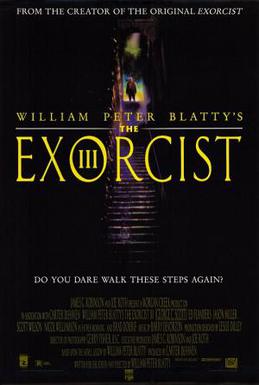
This film was written and directed by William Peter Blatty, the author of the book the first Exorcist movie was based on, as well as the novel his film was based on. It was a return to the setting of the original movie, Georgetown, Washington DC, featuring the detective from the first movie (played by a different actor) and Fr. Karras (possessed by a demon). The general story was interesting: a police detective investigates a series of murders that follow the same M.O. of the Gemini serial killer3, who was already arrested and executed fifteen years ago. It appears the Gemini killer and the “copycat(s)” was/are possessed by the same demon.
I liked aspects of the film, but the tone was off. The script was too comedic at times, with the priest and detective constantly cracking jokes and exchanging witty banter. Some comedic relief is necessary in horror, and some of the lines were legitimately funny, but it just didn’t fit tonally. Nor did the random cameos from Fabio and Patrick Ewing as angels in a heaven dream sequence (even though, as a Knicks fan, I love Patrick Ewing). And I know George C. Scott is considered a great actor, but his performance as the lead detective felt off to me, and I would have liked to have seen another actor in the role.
This was the rare case of a good script that could have used a better director (movies are usually the opposite). There are some brilliant moments throughout the film, including an iconic jump scare, but other parts are slow-moving and could have used some editing to quicken the pace. For a horror movie there was surprisingly little gore—they never show the actual murders, instead leaving the violence implied. Some fans consider Legion a great film as is, but for me it was uneven. Horror noir is one of my favorite genres, so I thought I would have liked this movie more, but the editing, pacing, casting, and tone were too disjointed. It likely would have been better if they discarded all connections to The Exorcist and made this an original self-contained movie (which is apparently what Blatty wanted to do).
Dominion: Prequel to the Exorcist (2005) directed by Paul Schrader

This is a flawed but interesting prequel to The Exorcist. I liked how they went deeper into the mythology of the demon Pazuzu, plus developed the backstory of “the exorcist” Fr. Merrin. Though the film works best if you have no expectations of it being anything like The Exorcist—because it is not. It is actually more like an Indiana Jones movie crossed with H.P. Lovecraft’s At the Mountains of Madness (a mash-up I would personally love to see). Archeologists discover ruins of a Christian church buried in the African desert, then they find an even more ancient pagan temple buried beneath that. They later learn the church was built to trap something, the ancient demon Pazuzu, which they unwittingly unleash. There is a tense dynamic between the local African tribe, the British military, and the Christian missionaries clashing together. Violence arises but you’re not sure if the motivations are purely human or the work of Pazuzu.
Being directed by Paul Schrader, Dominion is much more sophisticated than a typical horror movie, exploring the nature of evil, and the core question of theology: how could a purely good God allow the existence of evil, such as the kind Fr. Merrin encounters at the beginning of the film (where he was forced by Nazi soldiers to choose ten people in his village to be killed or else they would all be killed). Because Schrader was more concerned with those deeper philosophical questions than jump scares and gore, the studio took the movie away from him and hired a new director (Renny Harlin) to make a scarier version, Exorcist: The Beginning, which is apparently terrible. (Out of respect for Schrader I have not seen it.)
Parts of Dominion are great. It is the possession itself and the audio/visual depictions of the demon that are flawed and cheesy. Perhaps if the studio stood by Schrader and gave him more of a budget for special effects it could have been a fully great movie on the same level as the original. Even still, it is worth watching, at least for viewers more interested in cerebral horror than visceral scares.
I have not seen the newest Exorcist: Believer yet, but based on the reviews I will not be rushing out to the theater to see it anytime soon. The Exorcist television series has decent reviews, but I haven’t found the time to watch twenty episodes yet. One other exorcism movie I watched this year is The Rite (2011) directed by Mikael Håfström. While it is not at all related to The Exorcist franchise, it is more similar to the original Exorcist than any of the actual Exorcist sequels—but that is not a good thing. I applaud the Exorcist sequels for at least trying something original, though they failed.4 Ultimately I would categorize each of the 3.5 Exorcist sequels as flawed films with moments of brilliance. The 1973 original stands alone as a true cinematic masterpiece and likely will for as long as evil exists, for all time.5
- I would not normally watch something that spoils movies I haven’t seen, but this was for my old job that I mentioned before. ↩︎
- Paul Tremblay’s novel A Head Full of Ghosts also handles the ambiguity of a possession well. ↩︎
- Legion is actually similar to Se7en in some respects, and I would not be surprised if it served as partial inspiration for David Fincher and Andrew Kevin Walker. ↩︎
- Unfortunately the 2023 sequel sounds like it took The Rite route—which is the wrong route. ↩︎
- For my vision of what an Exorcist sequel (or prequel to the prequel) could have been, check out my “hyperstitional” movie review from Time Zone Weird, The Exorcist: Primeval Pazuzu. ↩︎
 T.Z. Barry